

On this page
If you stand at the mouth of the Amazon River, you are looking at the largest volumetric flow of water on Earth. Every second, roughly 200,000 cubic metres of water spill into the Atlantic Ocean. But when scientists study the currents circulating within the ocean itself, the scale of movement dwarfs even the Amazon.
To make sense of such immense volumes, oceanographers rely on a specific measure: the sverdrup.
Who was Harald Sverdrup?
Harald Sverdrup (1888–1957) was a Norwegian oceanographer and meteorologist whose work laid the foundation for modern physical oceanography. Among his many achievements, Sverdrup successfully formulated the theoretical relationship between wind stress on the ocean surface and the resulting mass transport of water underneath, known today as the Sverdrup balance).
He served as the director of the Scripps Institution of Oceanography from 1936 to 1948 and co-authored *The Oceans* (1942), a seminal textbook that defined the field for over four decades. Because his research was central to understanding how water moves across the globe, the unit for measuring ocean transport was named in his honour.
What is the sverdrup unit of ocean current flow?
The sverdrup (symbol: Sv) is a non-SI metric unit used to measure the volumetric rate of transport of ocean currents. One sverdrup is equivalent to a flow rate of one million cubic metres per second (10⁶ m³/s).
Instead of quoting current flows in unwieldy billions of litres, the sverdrup allows researchers to use manageable numbers. The total global input of freshwater from all rivers into the ocean is approximately 1.2 Sv.
By comparison, the major ocean currents transport vastly more water:
The Gulf Stream transports roughly 30 Sv near Florida and up to 150 Sv as it moves further north.
The Antarctic Circumpolar Current transports approximately 125 Sv, making it the largest ocean current on Earth.
When studying fluid mechanics and pressure, visualising a vast block of water moving across the globe is not easy. The Fermi Simulation Lab provides interactive simulations for the ideas that are easier to see than to read, allowing you to model dynamic flows visually.
How do we visualise a million cubic metres a second?
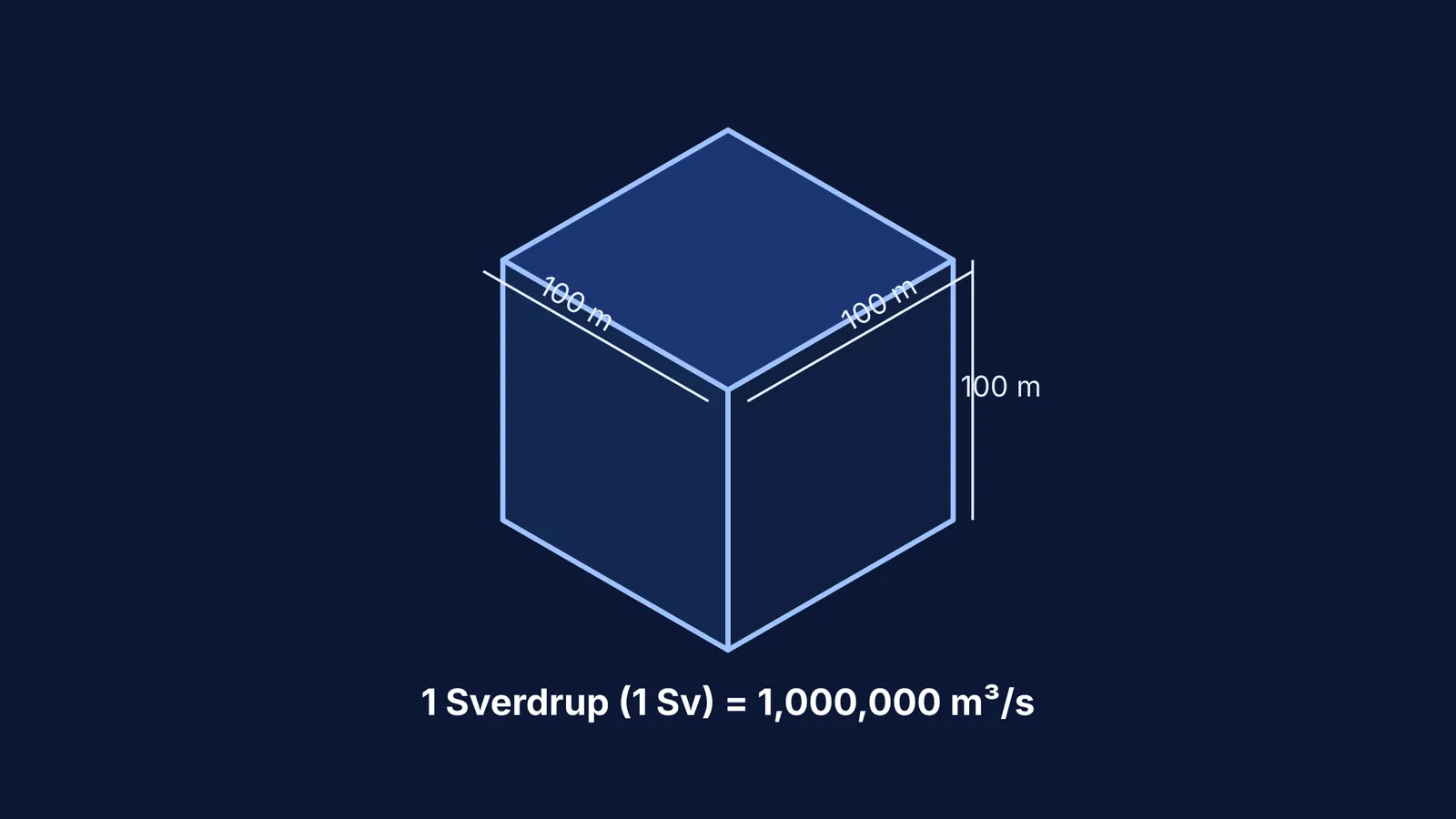
If you struggle to picture a million cubic metres of water, imagine a giant cube. A cube measuring 100 metres wide, 100 metres deep, and 100 metres long holds exactly one million cubic metres (100 × 100 × 100 = 1,000,000).
Now imagine that entire cube of water rushing past a fixed point every single second. That is the flow of 1 Sv.
Because ocean currents are extremely wide and relatively deep, they can reach these massive volumes even if the water is not moving at breakneck speeds.
Worked Example: Calculating a current's transport Imagine a hypothetical ocean current that is 50 kilometres wide and 500 metres deep. If the water moves at a steady speed of 2 metres per second, what is its flow rate in sverdrups?
Convert all measurements to metres: the width is 50,000 m.
Find the cross-sectional area: Area = 50,000 m × 500 m = 25,000,000 m².
Calculate the volume flow rate: Flow = Area × Speed = 25,000,000 m² × 2 m/s = 50,000,000 m³/s.
Divide by 1,000,000 to convert to sverdrups.
The current transports 50 Sv.
Understanding these flows is crucial for modern science. As researchers map the convection currents inside the Earth and the currents on its surface, they rely on the sverdrup to track how heat is distributed. Much like how Wallace Broecker modelled the great ocean conveyor belt to explain global climates, scientists today track sverdrups to understand how our oceans keep the planet's temperature in check.