

On this page
Hans Lippershey (often spelled Lipperhey), a Dutch-German spectacle maker, is traditionally credited with inventing the telescope. In 1608, he submitted a 30-year patent application to the States General of the Netherlands for a device that could magnify distant objects (Britannica).
While his patent was ultimately denied, the written record of his invention spread rapidly. By 1609, the news reached Galileo Galilei, sparking a scientific revolution.
What was Hans Lippershey's 1608 telescope like?
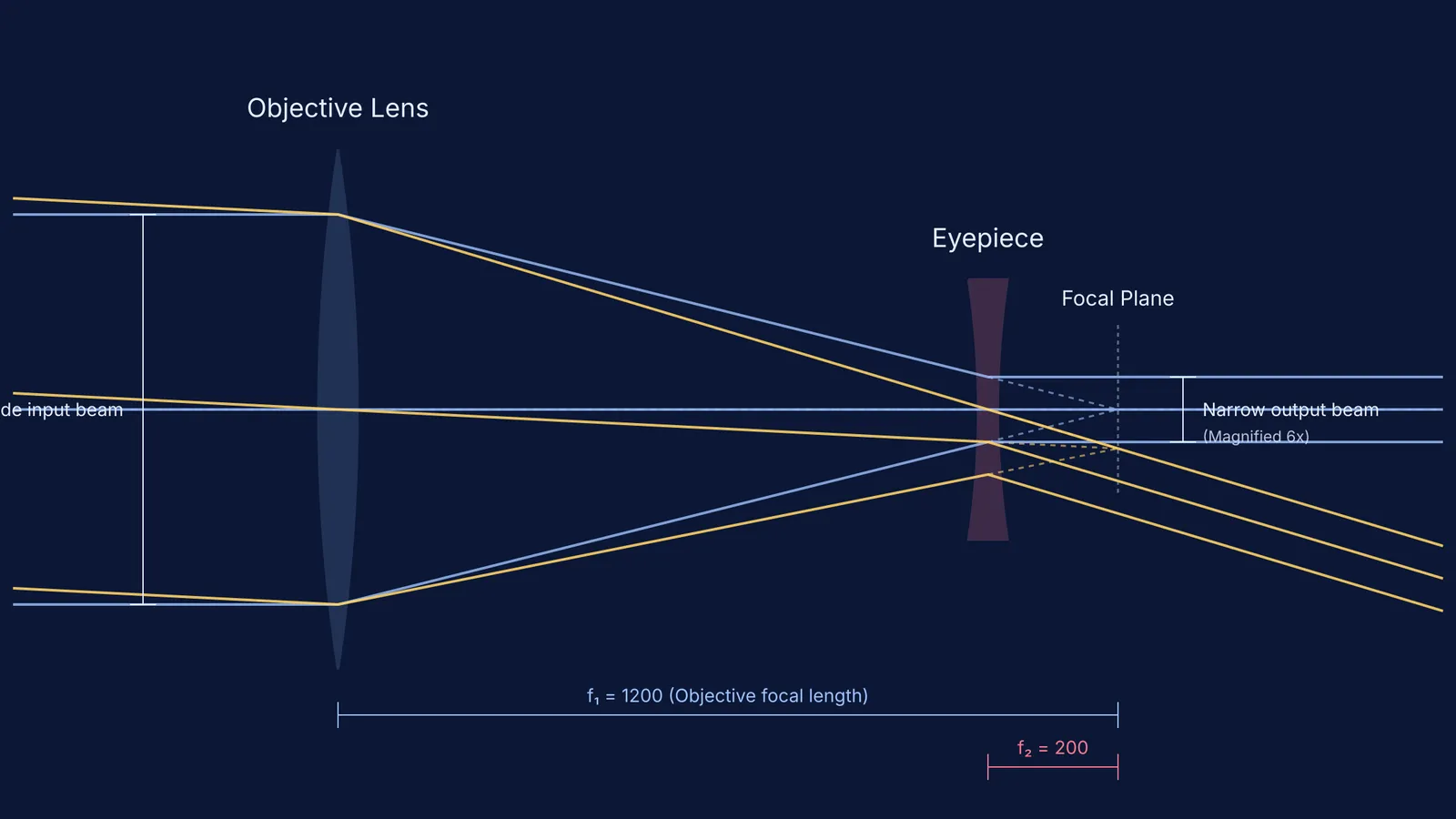
Lippershey's original instrument used a convex objective lens at the front and a concave eyepiece at the back. This configuration produced an upright image but had a low magnification of only about 3x (Space.com).
When you are trying to picture how a convex objective and a concave eyepiece form an image, Fermi's Simulation Lab lets you adjust the lenses and see the rays trace themselves. The concave eyepiece intercepts the converging rays from the objective lens before they reach the focal point, rendering them parallel again for the observer's eye.
Why was the 1608 patent denied?
The Dutch government denied Lippershey's patent application for two main reasons. First, the device was deemed too easy to copy, making the patent impossible to enforce (Britannica). Second, two other spectacle makers—Jacob Metius and Sacharias Jansen—had emerged with similar claims within weeks of Lippershey's filing.
Although he did not receive the patent, the government recognised the invention's military value. They paid Lippershey a handsome reward of 900 florins to build several binocular versions for the state (Britannica).
How did Galileo Galilei improve the telescope in 1609?
News of the "Dutch perspective glass" travelled fast. In 1609, Galileo Galilei heard about the invention and, without ever seeing Lippershey's original device, deduced how it worked.
Galileo significantly improved the design by grinding better lenses, quickly achieving 20x magnification (Space.com).
More importantly, Galileo changed the instrument's purpose. While the Dutch makers viewed the telescope as a military and terrestrial tool, Galileo pointed his improved device at the night sky. He discovered craters on the Moon, the phases of Venus, and the four largest moons of Jupiter, providing the first observational evidence for a heliocentric universe.
The optical advantage of the Galilean design
The specific optical arrangement chosen by Hans Lippershey, and later perfected by Galileo Galilei, offered several immediate advantages over other early designs.
Because the concave eyepiece intercepts the light rays before they cross at the focal point, the final image reaches the observer's eye standing upright. In contrast, telescopes built with two convex lenses produce an inverted, upside-down image. While an upside-down image is perfectly acceptable for looking at stars and planets, it is highly disorienting if you are a naval captain trying to identify a ship on the horizon.
Furthermore, a Galilean telescope is physically shorter than its two-convex-lens counterpart. The length of the tube is the difference between the two focal lengths (f₁ − f₂), rather than their sum (f₁ + f₂). This made Lippershey's original *kijker* compact and portable, ideal for military scouting and maritime navigation.
However, the design does have a critical flaw: its field of view is extremely narrow. When looking through a Galilean telescope with high magnification, it is as if you are looking down a long, dark tunnel. This narrow field of view is why Galileo struggled to piece together his observations of the Moon, having to painstakingly map it one tiny patch at a time.
How to build your own Galilean telescope
You can recreate Lippershey and Galileo's original design using two simple lenses.
Find your lenses: You need a convex lens (like a magnifying glass) for the objective, and a concave lens (like a nearsighted eyeglass lens) for the eyepiece.
Measure the focal lengths: Go outside and focus the sun's light onto a piece of paper with the convex lens. The distance from the lens to the sharpest point of light is its focal length (f₁). Do not look at the sun.
Calculate the separation: A Galilean telescope works when the lenses are separated by the difference of their focal lengths (f₁ − f₂), using the positive magnitude for the concave lens (f₂). If your convex lens has a focal length of thirty centimetres and your concave lens has a focal length of five centimetres, you must hold them twenty-five centimetres apart.
Calculate the magnification: The magnification is simply f₁ / f₂. In this example, your telescope will magnify objects by a factor of six (30 / 5).
This is exactly how Lippershey's 1608 *kijker* was assembled, giving you an upright image without needing a third inverting lens.
The legacy of the first telescope
Lippershey's 1608 patent was the spark that ignited modern astronomy. Similar observational leaps followed, from Jeremiah Horrocks and the first transit of Venus ever observed in 1639 to George Ellery Hale and the magnetic fields inside sunspots in 1908. To understand how multiple optical elements work together today, you can explore how a Lens and mirror set apart: tracing the image through both behaves.
Every major astronomical discovery began with a spectacle maker in the Netherlands who realised that two simple lenses could bring the universe closer.


