

On this page
In 1942, a Swedish physicist proposed something that sounded impossible to many of his peers. Magnetic fields, he argued, could behave like plucked strings and carry waves through a fluid.
That physicist was Hannes Alfvén, and his brief paper on the subject changed how we understand the universe. His discovery of what are now called Alfvén waves founded the field of magnetohydrodynamics (MHD) and eventually won him the 1970 Nobel Prize in Physics. Today, these waves are the key to understanding everything from the behaviour of the Sun to the containment of plasma in nuclear fusion reactors.
What are Alfvén waves?
To understand an Alfvén wave, you first have to understand plasma. A plasma is a gas that is so hot that its electrons have been stripped away from their atoms, leaving a fluid of free-moving charges. Because these charges are moving, they interact strongly with magnetic fields, much like a single particle following a helical path in a magnetic field.
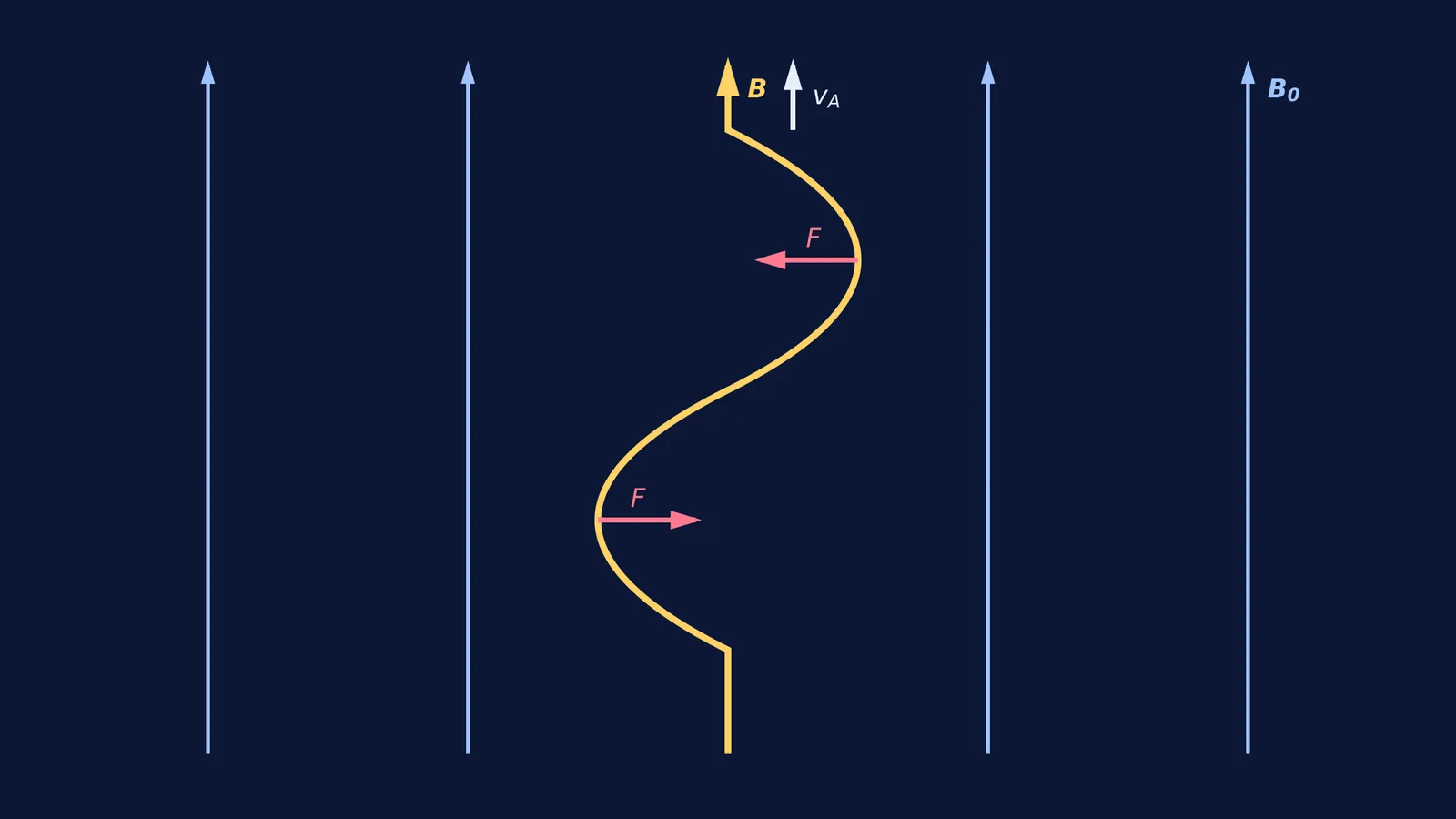
In a perfectly conducting plasma, the magnetic field lines are "frozen in" to the fluid. If the fluid moves, the magnetic field lines move with it. If the magnetic field lines bend, they drag the fluid along.
Alfvén predicted mathematically that if you pluck a magnetic field line in a plasma, it will snap back because of a restoring force known as magnetic tension. The mass of the plasma provides the inertia, creating a transverse wave that travels along the magnetic field line.
The speed of an Alfvén wave depends on just two things: the strength of the magnetic field and the mass density of the plasma. A stronger magnetic field increases the tension, making the wave travel faster, while a denser plasma adds inertia, slowing it down.
How do Alfvén waves heat the solar corona?
One of the great mysteries of astronomy is why the Sun's outer atmosphere, the corona, is incredibly hot while its visible surface is relatively cool. If you hold your hand near a fire, the air gets cooler the further you pull away. On the Sun, the opposite happens.
Scientists now believe that Alfvén waves are a primary mechanism for this heating. Because the Sun is a giant ball of turbulent plasma laced with strong magnetic fields, its surface is constantly churning. This motion plucks the Sun's magnetic field lines, sending Alfvén waves shooting upwards into the corona. When these waves crash into each other or become unstable, they dissipate their energy, heating the surrounding plasma.
This superheated plasma eventually flows outwards as the solar wind, carrying the Sun's magnetic influence across the solar system.
What is magnetohydrodynamics?
Alfvén waves are the most famous result of magnetohydrodynamics (MHD), the study of how magnetic fields interact with moving, electrically conducting fluids. Before Alfvén, physicists largely treated electromagnetism (such as the energy density of an EM wave) and fluid dynamics as separate subjects. Alfvén showed that in plasmas, the two are inseparable.
For students studying for the JEE, this is a great example of how different branches of physics connect. MHD combines the fluid mechanics of the Navier-Stokes equations with the electromagnetism of Maxwell's equations. While you won't be asked to solve full MHD equations in an entrance exam, the underlying principles—such as the Lorentz force and magnetic flux—are central to the syllabus.
If you are struggling to picture how magnetic fields interact with moving charges, interactive simulations for the ideas that are easier to see than to read are available in the Fermi Simulation Lab. For practising the mathematics, the Fermi Problem Library has worked problems with a step-by-step solver that explains the reasoning rather than printing an answer.
Understanding Alfvén waves reminds us that the fundamental laws of physics we learn in school are the same laws that govern the stars.


