

On this page
Soap, paper and chlorinated water depend on a Class 10 reaction: splitting salt water with electricity. In the 1890s Hamilton Castner, an American, and Karl Kellner, an Austrian, found a way to make very pure caustic soda this way at industrial scale, using liquid mercury. Here is how it worked, why it was abandoned, and how it helps with your board exam.
What is the Castner–Kellner process?
The Castner–Kellner process is the electrolysis of brine (concentrated sodium chloride solution) in a cell that uses mercury as an electrode, giving sodium hydroxide, chlorine and hydrogen (Wikipedia: Castner–Kellner process).
Castner was born in Brooklyn, New York, on 11 September 1858 and died of tuberculosis on 11 October 1899, aged 41 (Wikipedia: Hamilton Castner). In 1890 he developed a way to make pure caustic soda by electrolysing brine in a rocking cell containing mercury.
His US patent 528,322 was filed on 26 September 1892 and issued on 30 October 1894 (Google Patents: US528322A). Its key idea was a moving body of liquid mercury that separates the products, doing away with a porous diaphragm. Kellner had filed a similar patent, assigned to the Solvay company. To avoid a legal fight, Castner's company and Solvay formed the Castner–Kellner Alkali Company, which built a large works at Runcorn in Cheshire, England (Wikipedia: Hamilton Castner).
How does the mercury cell make sodium hydroxide?
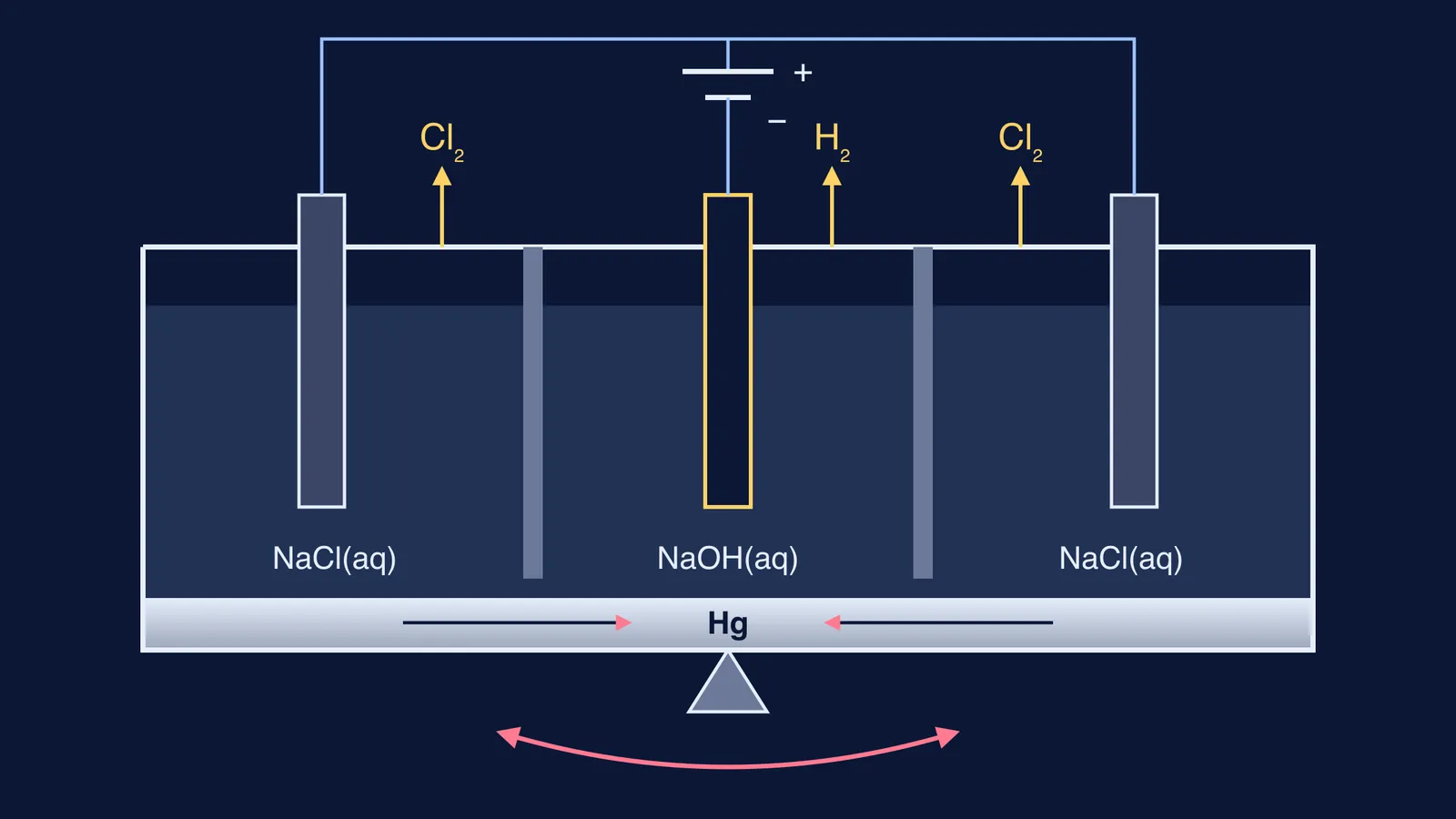
The hard part is keeping the products apart, because chlorine reacts with sodium hydroxide. The cell has three compartments separated by slate walls that dip into the liquid but let a layer of mercury on the floor flow beneath them (Wikipedia: Castner–Kellner process).
In the two outer compartments, brine sits above the mercury. Graphite anodes release chlorine: 2Cl⁻ → Cl2 + 2e⁻.
The mercury underneath acts as the cathode. Sodium ions gain electrons and dissolve in it as sodium amalgam: Na⁺ + e⁻ → Na (amalgam).
A rocking mechanism moves the mercury, carrying the amalgam under the walls into the middle compartment, which holds sodium hydroxide solution.
There, the amalgam gives up its sodium as Na⁺ ions, and an iron cathode releases hydrogen: 2H2O + 2e⁻ → H2 + 2OH⁻. Sodium and hydroxide ions together make the caustic soda.
The chlorine never meets the sodium hydroxide, so the caustic soda comes out pure.
How does this connect to the Class 10 chlor-alkali process?
Your NCERT Class 10 Science textbook (Chapter 2, section 2.4.3) describes the same chemistry: when electricity is passed through brine, it decomposes to form sodium hydroxide, and the process is called chlor-alkali after its products, chlor for chlorine and alkali for sodium hydroxide (NCERT Class 10 Science, Chapter 2). The equation it gives is:
2NaCl(aq) + 2H2O(l) → 2NaOH(aq) + Cl2(g) + H2(g)
Chlorine is given off at the anode, hydrogen at the cathode, and sodium hydroxide forms near the cathode. NCERT's Figure 2.8 lists uses: chlorine for water treatment, PVC and disinfectants; hydrogen for fuels and ammonia for fertilisers; sodium hydroxide for soaps, detergents and paper making.
The NCERT diagram shows a membrane, not mercury: same reaction, different way of keeping the products apart.
Why did the world stop using mercury cells?
Mercury is toxic, and mercury-cell plants released some of it into the environment; their chlorine and sodium hydroxide also carried trace amounts of mercury (Wikipedia: Chloralkali process). Today the most common design is the membrane cell, whose membrane lets sodium ions through but stops chloride and hydroxide ions.
The Minamata Convention on Mercury, in force since 16 August 2017, lists mercury-cell chlor-alkali production among the processes to be completely phased out by 2025 (Minamata Convention text; Minamata Convention: manufacturing processes). Castner's cell solved a purity problem; its replacement solved a pollution problem.
How much salt makes one tonne of caustic soda?
Use the NCERT equation with molar masses Na = 23, Cl = 35.5, O = 16, H = 1.
2 mol NaCl = 2 × 58.5 = 117 g
2 mol H2O = 2 × 18 = 36 g
2 mol NaOH = 2 × 40 = 80 g
1 mol Cl2 = 71 g, and 1 mol H2 = 2 g
Both sides total 153 g, so mass is conserved. Scale up by 1,000,000 ÷ 80 = 12,500 to make 1,000 kg of NaOH: you need 1,462.5 kg of salt and 450 kg of water, and you also get 887.5 kg of chlorine and 25 kg of hydrogen.
If the cell is hard to picture, the Fermi Simulation Lab has interactive simulations for ideas that are easier to see than to read.
What goes in a 3-mark board answer?
Name it: the chlor-alkali process.
Write the balanced equation with state symbols.
Say where each product forms: Cl2 at the anode, H2 at the cathode, NaOH near the cathode.
Give one use for each product.
Explain the name.
If electrolysis still feels shaky, the Fermi Concept Library gives each chemistry concept its own lesson and its place in the map, so you can fill the gap before your next test.


