

On this page
Gustav Gassner (1881–1955) was a German botanist who taught botany and plant pathology at the agricultural university in Montevideo, Uruguay, from 1907 to 1910, according to his Wikipedia biography. His 1918 paper on summer and winter cereals turned a farmer's rule of thumb into the science of vernalisation.
What did Gustav Gassner discover in 1918?
Farmers already knew the pattern. Winter cereals must be sown before the end of winter if they are to bear grain within 12 months, while spring cereals flower soon after a spring sowing, as the Sorbonne plant physiologist P. Chouard explained in his 1960 review in the Annual Review of Plant Physiology. The same review records that John Klippart reported in 1857 that a few weeks of cold on young plants lets winter cereals flower.
Gassner tested the idea on cereals. He showed that germinating wheat or rye seeds at normal growing temperatures strongly delayed flowering, while germinating them at low temperatures sped it up, as Ben Trevaskis summarises in a 2010 review in Functional Plant Biology. Gassner concluded that many cereals have a *Kaltbedürfnis*, a cold requirement that must be met before the plant can flower. Chouard adds that species vary widely in the cold they need, and that even a germinating seed can sense it.
In Uruguay's subtropical climate, Gassner had also linked lower cereal yields to cold requirements left unmet early in growth, as H. L. Walster described in 1920.
Why does winter rye need cold before it flowers?
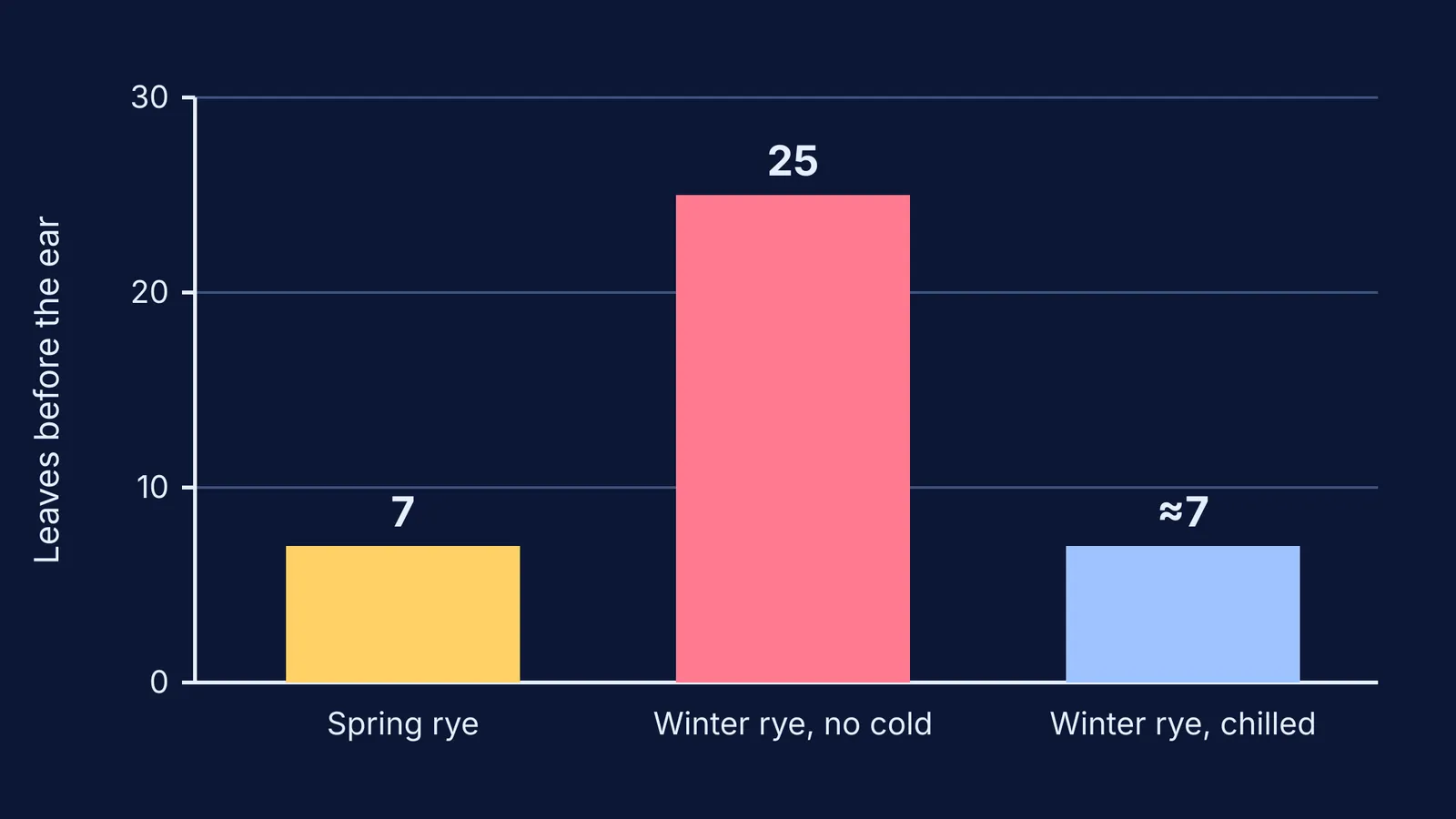
The clearest numbers come from Petkus rye, a variety with a spring race and a winter race. Gregory and Purvis studied it in London; Chouard (1960) summarises both races sown in spring under long days:
Spring race: 7 leaf primordia form on the main shoot, then the young ear.
Winter race, no cold: 25 leaf primordia form before the ear, so flowering comes late.
Winter race grown from chilled seed: it grows exactly like the spring race.
So the cold does not make the plant flower there and then. Chouard calls vernalisation a "preparatory process": chilling gives the plant the capacity to flower later, when long days arrive. In his review, the effective temperature lies between +1 °C and 6–7 °C, and complete vernalisation of winter Petkus rye takes about 40 to 45 days. The seed must have taken up water, and it needs air.
What is vernalisation, in one line?
Vernalisation is "the acquisition or acceleration of the ability to flower by a chilling treatment", in the definition given by Chouard (1960). The name came from Trofim Lysenko, who called the process "jarovization" and translated it as "vernalization" (Latin *vernum*, spring).
Today the response is traced to genes: in wheat and barley, cold gradually switches on the VRN1 gene, which controls this flowering response (Trevaskis 2010).
Cold is half of the flowering story; day length is the other half. Read how Garner and Allard found photoperiodism in a dark shed, and use our guide to matching each plant growth regulator to its effects for the hormones.
Is vernalisation still in Class 11 NCERT?
Only in passing. The current NCERT Class 11 chapter, Plant Growth and Development (Reprint 2026-27), has four sections (growth; differentiation, dedifferentiation and redifferentiation; development; plant growth regulators) and names vernalisation once, among events that extrinsic factors such as temperature and light control. Revise against this year's official textbook.
How do you answer a vernalisation question?
Try this worked example, built on the Petkus figures in Chouard (1960). Seeds of a winter rye are split into two lots. Lot A is sown straight away in spring. Lot B is soaked and kept at 4 °C for six weeks, then sown alongside. Both get long days. Predict and explain.
Spot the plant type: a winter cereal with a cold requirement.
Check the treatment: 4 °C sits inside the +1 to 6–7 °C window, and six weeks (42 days) matches the 40 to 45 days winter Petkus rye needs.
Predict: Lot B forms its ear after about 7 leaf primordia and flowers early, like a spring variety; Lot A forms about 25 and flowers late.
Name it: vernalisation, a preparatory effect of cold.
Add the trap: the seed had to be moist, and Chouard notes that warm temperatures above about 15 to 17 °C begin to undo the effect (devernalisation).
If photoperiodism, dormancy and vernalisation blur together, the Fermi Concept Library gives each concept its own lesson and its place in the map. If a prediction question stalls you, Fermi's AI tutor works out what you already know and builds a plan for the session.


