

On this page
Our world is full of complex systems characterised by randomness and disorder. From the shifting weather patterns of the Earth to the thousands of whirling starlings in a flock, predicting how these systems behave seems impossible. Yet, the Italian theoretical physicist Giorgio Parisi, born on 4 August 1948 in Rome, found a way to map this chaos NobelPrize.org.
His research earned him a 1/2 share of the 2021 Nobel Prize in Physics NobelPrize.org "for the discovery of the interplay of disorder and fluctuations in physical systems from atomic to planetary scales." A major contribution, however, came from studying a peculiar magnetic material that behaves unlike any standard magnet.
What is a spin glass?
In a standard ferromagnet, like the iron on your fridge, the magnetic spins of the atoms all align in the same direction, much like the orderly atomic bonds in a crystal. But in a spin glass, the magnetic state is characterised by randomness. The individual atomic bonds in a spin glass are a mixture of roughly equal numbers of ferromagnetic bonds (where neighbours align) and anti-ferromagnetic bonds (where neighbours point in opposite directions) Wikipedia.
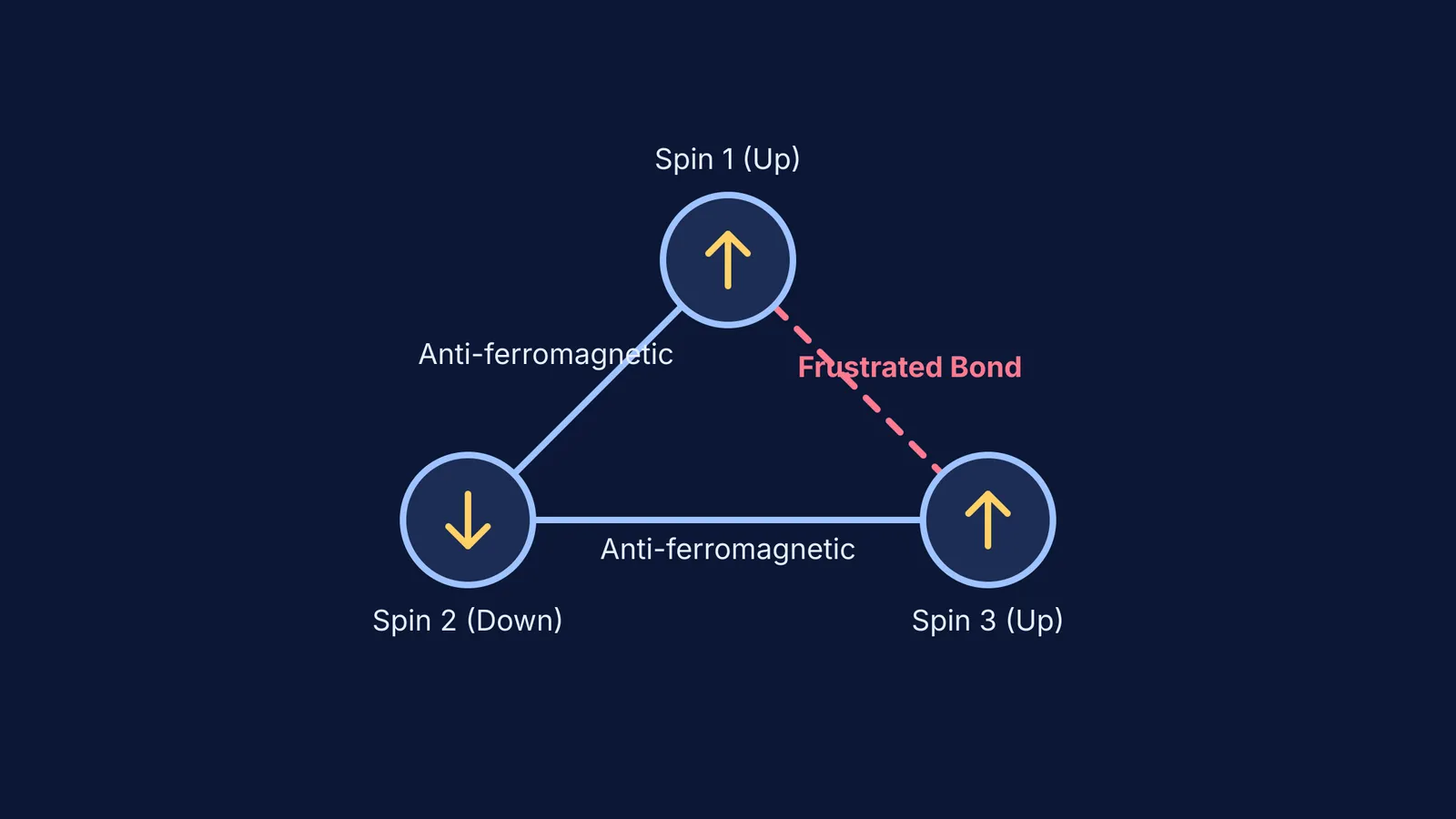
This creates what physicists call "frustrated interactions". Imagine three atoms in a triangle: if atom A and atom B want to point in opposite directions, and atom B and atom C want to point in opposite directions, atom A and atom C are forced to point in the same direction—even if their own bond is anti-ferromagnetic and demands they be opposite. The system cannot satisfy all its constraints at once. The atoms become "stuck" in a disordered, metastable configuration, much like the irregular positional disorder of the atoms in conventional window glass.
Just as Dan Shechtman and quasicrystals: the symmetry that was banned changed our view of solids, and S. Chandrasekhar and disc-shaped liquid crystals mapped new complex phases, Parisi looked at these seemingly chaotic magnetic alloys and realised they contained a hidden mathematical structure.
How did Giorgio Parisi solve the spin glass problem?
To model spin glasses, physicists use the "replica trick"—a mathematical technique that involves making many imaginary copies of the system to average out the disorder. For years, the standard calculations failed at low temperatures.
In a 1979 study published in Physical Review Letters, Parisi introduced the concept of "replica symmetry breaking" Crossref. He showed that the different replicas of the spin glass do not remain identical at low temperatures. Instead, the energy landscape fractures into an infinite number of possible stable states, arranged in a fractal-like hierarchy. His exact solution provided the key to calculating the macroscopic properties of these deeply frustrated materials.
Why do spin glasses matter for neural networks?
The mathematics of spin glasses turn out to be remarkably universal. An artificial neural network, which forms the basis of modern machine learning, is also a highly connected network with complex, sometimes conflicting weights and biases.
When a neural network learns a pattern, it navigates a rugged "energy landscape" filled with many local minima—exactly the kind of frustrated, complex system Parisi described. His methods have heavily informed computer science, enabling researchers to better understand how memory and learning function in algorithms that trace their roots back to John McCarthy, the Dartmouth proposal and the birth of AI.
Understanding the intricate mathematics of statistical mechanics can be daunting. Fermi's AI tutor can work out what you already know and build a plan for the session, guiding you through university-level physics step-by-step. If you struggle to picture how energy landscapes and frustrated bonds work, the Fermi Simulation Lab provides interactive simulations for the ideas that are easier to see than to read.
A framework for studying complex systems
When you need to tackle a highly disordered or complex topic in physics or computer science, follow this structured approach:
Identify the microscopic rules: What are the basic individual components (e.g., atomic spins, or artificial neurons)?
Look for frustration: Are there conflicting rules or constraints that prevent a simple, uniform solution?
Map the energy landscape: Recognise that frustrated systems often have many different stable states rather than a single perfect answer.
Learn through connection: Do not just memorise formulas. Use the Fermi Concept Library to explore every concept in physics, chemistry, biology, mathematics and computing, each with its own lesson and its place in the map.


