

On this page
Photography in the late 19th century was a messy business. Before you could take a picture, you had to haul heavy glass plates, coat them in noxious chemicals in the dark, and develop them before they dried. That all changed when George Eastman patented and released the original Kodak camera in 1888. It was a simple box that came pre-loaded with a flexible film roll capable of taking 100 exposures, and it carried a slogan that would define a new era: "You press the button, we do the rest."
How did the 1888 Kodak camera work?
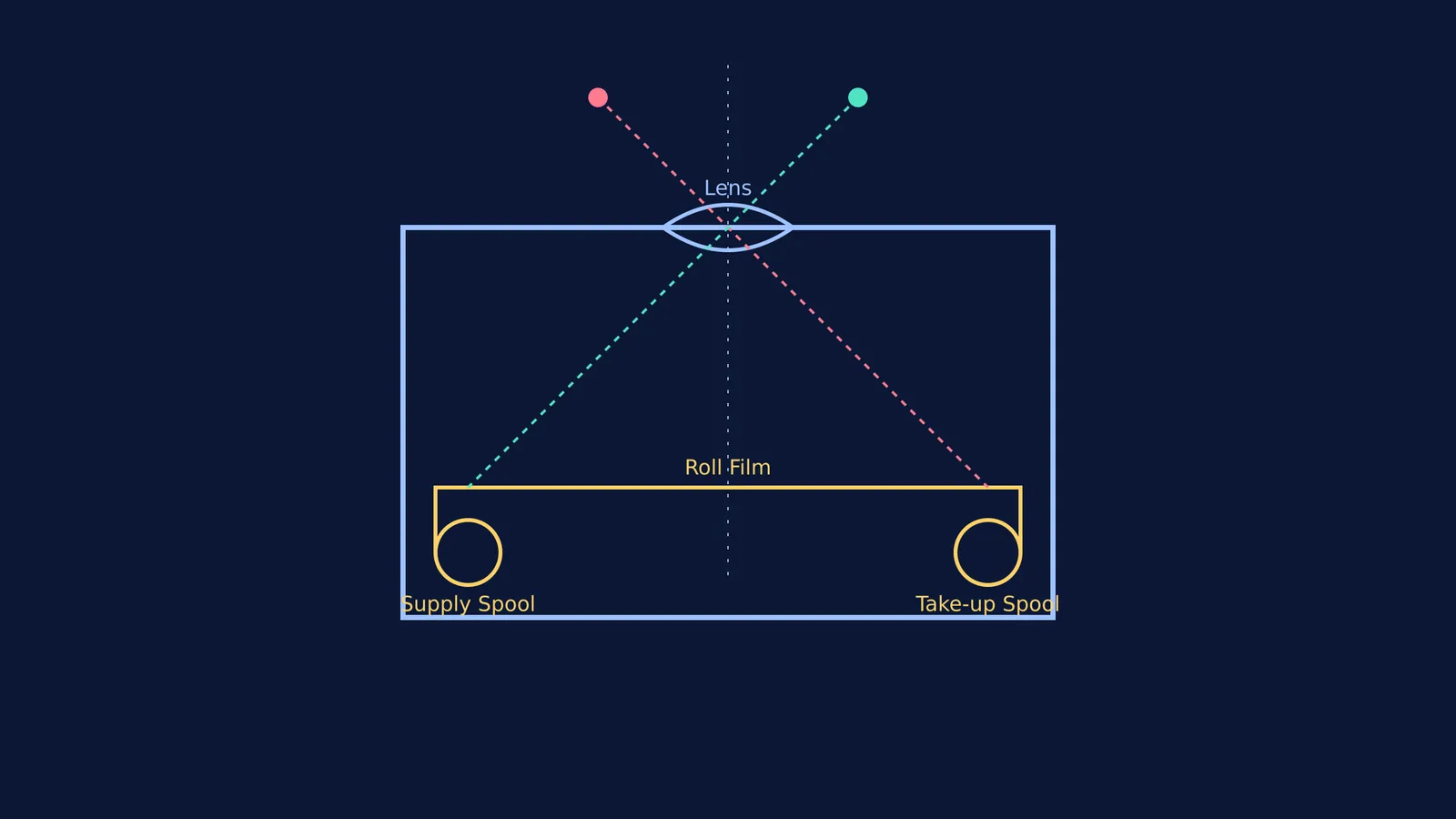
Priced at $25, the 1888 Kodak camera was remarkably simple compared to the complex professional equipment of its time. It was a portable wooden box, often referred to as the "No. 1 Kodak," equipped with a fixed-focus lens and no viewfinder. Instead of looking through a lens, users simply aimed the box using V-shaped lines etched on the top. The real innovation was what was hidden inside the wooden casing.
Instead of loading a single, heavy glass plate for each shot, photographers followed a straightforward process. First, they pulled a string to set the shutter. Second, they turned a rotating key to advance the film to the next frame. Finally, they pressed a button on the side to capture a circular image on the paper-based roll film.
Once all 100 exposures were taken, the photographer did not have to touch any darkroom chemicals. They simply mailed the entire camera back to the Kodak factory in Rochester, New York, along with $10. The company would develop the film, print the photos, reload the camera with a fresh roll, and mail everything back. This service-first approach brought amateur photography to the mainstream.
Why was George Eastman's roll film important?
By separating the act of taking a photograph from the chemistry required to develop it, Eastman launched the "snapshot" era. His 1885 patent for a practical film roll holder, U.S. Patent 317,049 (developed with co-inventor William H. Walker), was the technological bridge that made this possible. This holder allowed flexible film to replace fragile glass dry plates. He also licensed and purchased another roll film holder patent from David H. Houston to secure his position.
The name "Kodak" itself became a powerful brand. Eastman coined it in 1888 with the help of his mother and an Anagrams set. He wanted a word that was short, unique, and easy to pronounce in any language. He particularly favored the strong, incisive letter "K," ensuring the name both started and ended with it.
Eastman's insight was that the technical friction of the darkroom was keeping people from enjoying the actual craft of composing images. This "razor and blades" business model, where the company profited continually from film and processing services, was incredibly successful. It also funded massive philanthropic efforts. During his life, Eastman donated over $100 million to various educational causes, including the University of Rochester, MIT, Tuskegee University, and Hampton University, often giving anonymously as "Mr. Smith."
How can we remove the friction of getting started?
There is a powerful lesson for modern students in the Kodak business model. Often, the hardest part of studying is not the underlying concepts themselves, but the friction of getting started: finding the right notes, identifying which topic to tackle first, or setting up a difficult problem. When your cognitive energy is spent on setup and planning, significantly less is available for actual learning and retention.
This is where a well-designed system makes a crucial difference. A student brings a topic, a course, a problem set or a scanned assignment. Fermi's AI tutor works out what they already know, builds a plan for the session, and teaches through it — writing on a board, drawing the figure, running the simulation, and checking understanding as it goes. By completely removing the friction of planning and setup, students can focus purely on understanding the material, just as early photographers could finally focus purely on composing their picture.
Read more about the people who reshaped science:


