

On this page
Sir Ganga Ram is often called the "Father of Modern Lahore", and many of the city's best-known buildings are his. But his most interesting work is a small powerhouse on a canal near Renala Khurd. It solved a problem any physics student can state in one line: how do you make water flow uphill?
Who was Sir Ganga Ram?
Ganga Ram was born on 13 April 1851 in Mangtanwala, in what is now Sheikhupura District, Pakistan, and died in London on 10 July 1927, according to his Wikipedia biography. He studied at Government College, Lahore, won a scholarship to the Thomason Civil Engineering College at Roorkee in 1871, and passed its final lower subordinate examination with the gold medal in 1873 (Wikipedia).
He was knighted in 1922 and received the honour from King George V at Buckingham Palace. His name lives on most visibly in Sir Ganga Ram Hospital in Lahore, which he built in 1921.
What did Sir Ganga Ram build in Lahore?
Ganga Ram spent 12 years as Executive Engineer of Lahore and took early retirement in 1903, at the age of 52, Live History India reports. In 1887, for Queen Victoria's golden jubilee, he was commissioned to design and build the General Post Office and the Lahore Museum.
His other Lahore work includes:
Aitchison College
the Mayo School of Arts, now the National College of Arts
Sir Ganga Ram High School, now Lahore College for Women
Hailey College of Commerce
the planned neighbourhoods of Model Town and Gulberg
That list comes from his Wikipedia biography.
How did the Renala Khurd hydel scheme work?
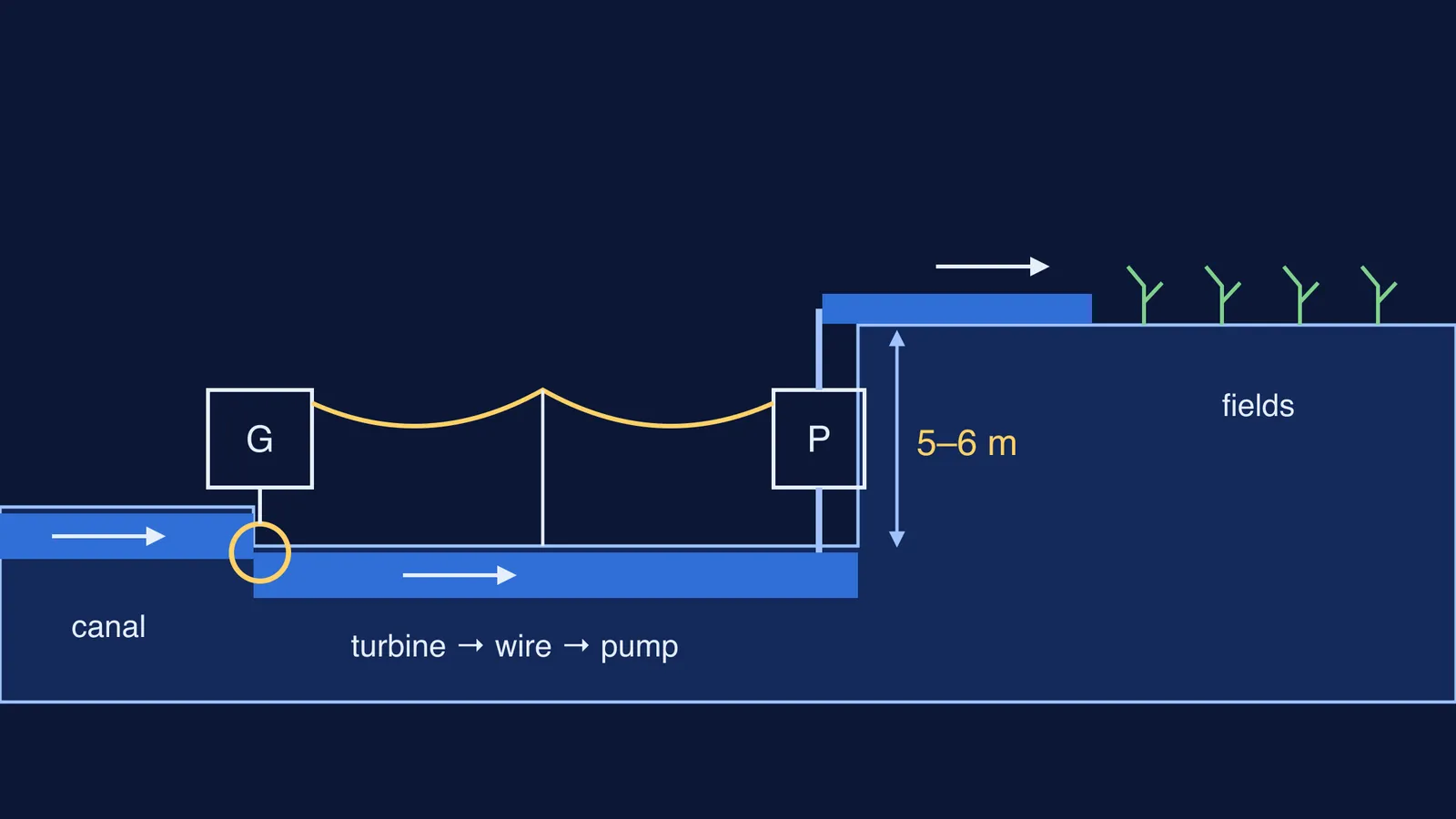
Ganga Ram held a lease of 50,000 acres of barren upland, writes travel historian Salman Rashid. The Lower Bari Doab Canal (LBDC), inaugurated in 1912, ran past it. The catch: the land lay 5 to 6 metres above the canal's water level, which made ordinary flow irrigation impossible (Salman Rashid).
His answer was to let the canal pay for its own lift. In 1924 he began building a power station on the LBDC just outside Renala Khurd. It was completed in 1925 with five generators delivering a total of 1.1 megawatts (Salman Rashid). That electricity worked five pumping stations that lifted canal water into channels above the LBDC, and Ganga Ram paid for that network of channels himself.
The plant opened on 22 March 1925 and is operated by WAPDA, according to the Renala Khurd Hydropower Plant entry. It is often described as the first hydropower station in what is now Pakistan. Writing in 2015, Rashid reported that the five pumping stations still worked, with new machinery and power from other sources, and that the network irrigated 64,000 acres of wheat and cotton land (Salman Rashid).
How much water could 1.1 MW lift? A worked example
This is a class 11 work-energy problem. We use the 1.1 MW output and the 5 to 6 metre lift from Salman Rashid's account. The efficiencies are our assumptions, not measured Renala figures.
Energy to lift 1 kg of water through height h is mgh. For h = 6 m: 1 × 9.81 × 6 ≈ 59 joules. One litre of water is about 1 kg.
Pump power is P = ρgQh, where ρ = 1000 kg/m³ and Q is the flow in cubic metres per second.
Rearrange: Q = P / (ρgh) = 1,100,000 / (1000 × 9.81 × 6) ≈ 18.7 m³/s. That is the ceiling with perfect pumps and no losses in the wires.
Real motors and pumps waste energy as heat and friction. If they turned 70% of the power into lift, Q ≈ 0.7 × 18.7 ≈ 13.1 m³/s.
In one hour that is about 13.1 × 3600 ≈ 47,000 m³, or roughly 47 million litres.
With a 5 m lift, the ceiling rises to about 22.4 m³/s; halve the efficiency and the flow halves.
To see energy change form, the Fermi Simulation Lab has interactive simulations for ideas that are easier to see than to read. If steps 2 to 4 felt shaky, the Fermi Problem Library has worked problems with a step-by-step solver that explains the reasoning rather than printing an answer.
What can a student learn from Ganga Ram's engineering?
Try this three-question habit on any problem, from a JEE Main numerical to a project at home:
What is the real obstacle? At Renala it was not a lack of water. It was 5 to 6 metres of height.
Where is the energy already? The canal was flowing anyway. He used that flow.
Does the arithmetic close? Before building, check that the power you have can do the work you need.
Next time you pass a canal, look for the drop in the water: that is stored energy waiting for an engineer.


