

On this page
Gopalswamy Doraiswamy Naidu, born in 1893 in a small agrarian village near Coimbatore, was fascinated by mechanics from a young age. Despite leaving school in the third grade to work on his father's farm, according to his biography, he transformed himself into an engineering pioneer who would later be known as the "Edison of India."
His lifelong habit of learning through observation began as a teenager when he saw a British official riding a Rudge-Whitworth motorcycle. Determined to understand how it worked, Naidu took on various jobs—working as a waiter, a mechanic, and a cotton mill worker—and saved ₹400 over three years to buy the exact same model (Wikipedia). Rather than just riding it, he famously dismantled the motorcycle completely and rebuilt it piece by piece, teaching himself the mechanical principles he had never learned in a classroom.
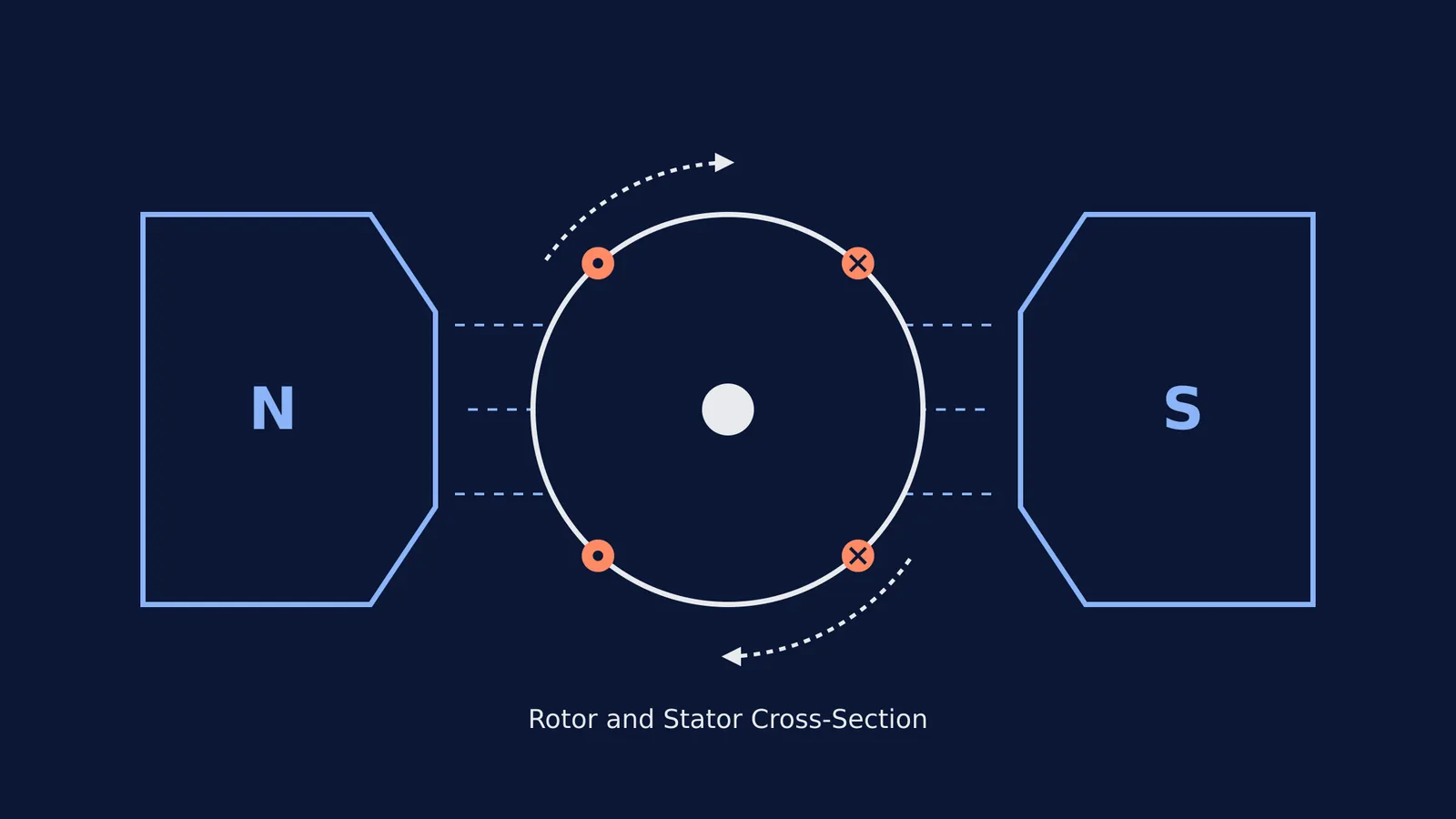
How did G. D. Naidu build the 1937 electric motor?
In the 1930s, almost all electrical equipment and heavy machinery in India was imported from Europe. Naidu, working closely with engineer D. Balasundaram at his factory, set out to change that dependence. In 1937, they successfully manufactured India's first indigenous electric motor (Wikipedia).
When World War II broke out a few years later, the global conflict disrupted the supply of crucial imported parts like enamelled wire and bearings. Instead of waiting for the supply chains to recover, Naidu built his own machines to manufacture these precise components locally. His success proved that high-quality electrical goods could be made domestically, laying the groundwork for Coimbatore to become a major industrial hub and leading to the rise of heavy engineering firms in the region.
If you are trying to understand how a motor uses magnetic fields to turn electrical energy into motion but don't have a vintage machine to dismantle, the Fermi Simulation Lab has interactive simulations for the ideas that are easier to see than to read.
What else did G. D. Naidu invent?
Naidu's inventions spanned from consumer goods to public utilities and agricultural machinery. One of his notable early inventions was the "Rasant" electric razor in the mid-1930s, which he built by creatively adapting a small toy motor. He patented the device in Europe, where it achieved commercial success.
He also built kerosene-run fans for rural Indian homes that lacked electricity, mechanical voting machines, distance adjusters for film cameras, and even low-cost dwellings that could be assembled in a single day. In 1952, he built a two-seater petrol engine car (Wikipedia), though the government ultimately denied him a license to mass-produce it. Like Al-Jazari and the book of ingenious mechanical devices or Konrad Zuse and the Z3, Naidu built his machines by deeply understanding the physical principles and working with the materials he had on hand.
How did his agricultural research change farming?
Beyond mechanics and electrical engineering, Naidu applied his systematic approach to biology and agriculture. He established a 40-acre research farm (Wikipedia) where he cultivated and identified new, higher-yielding varieties of cotton, maize, and papaya.
He also played a crucial role in local infrastructure. Collaborating with local leaders like R. K. Shanmukham Chetty, Naidu helped spearhead the project to bring Siruvani River water to Coimbatore. This initiative secured a reliable water supply for both the growing population and the surrounding agricultural lands, fundamentally changing the region's development trajectory.
How did he change transportation and education?
Naidu's first major business venture was in transportation. In 1920, he secured a loan to found a transport business that eventually grew into the Universal Motor Service (UMS). He personally drove the very first bus on the route between Palani and Pollachi. By the late 1930s, his company operated a fleet of 600 buses across South India, setting a strong example for regional public transit (Wikipedia).
Despite his own lack of formal schooling, he understood the critical need for technical education in a newly industrialising nation. In 1945, he established India's first polytechnic college in Coimbatore. Serving as its first principal, he created a space where practical, hands-on engineering could be taught to the next generation of Indian innovators.
If you are a student working through the physics of circuits or mechanics today, you do not have to struggle alone. The Fermi Problem Library has worked problems with a step-by-step solver that explains the reasoning rather than printing an answer, helping you build the same foundational understanding Naidu sought.


