

On this page
Müllerian mimicry is a form of biological resemblance where two or more harmful species evolve to look alike, sharing the same warning signals (Mallet 2001). Unlike Batesian mimicry—where a harmless mimic tricks predators by looking like a dangerous model—in Müllerian mimicry, all species involved are genuinely defended.
This evolutionary strategy solves a mathematical problem of survival. When toxic species share a pattern, they also share the cost of educating local predators.
How does the mathematics of predator education work?
In 1879, German biologist Fritz Müller solved a puzzle that had confused naturalists in Brazil: why would two already toxic butterflies evolve to copy each other? His answer became the first exact mathematical model of frequency-dependent selection in evolutionary ecology (Mallet 2001).
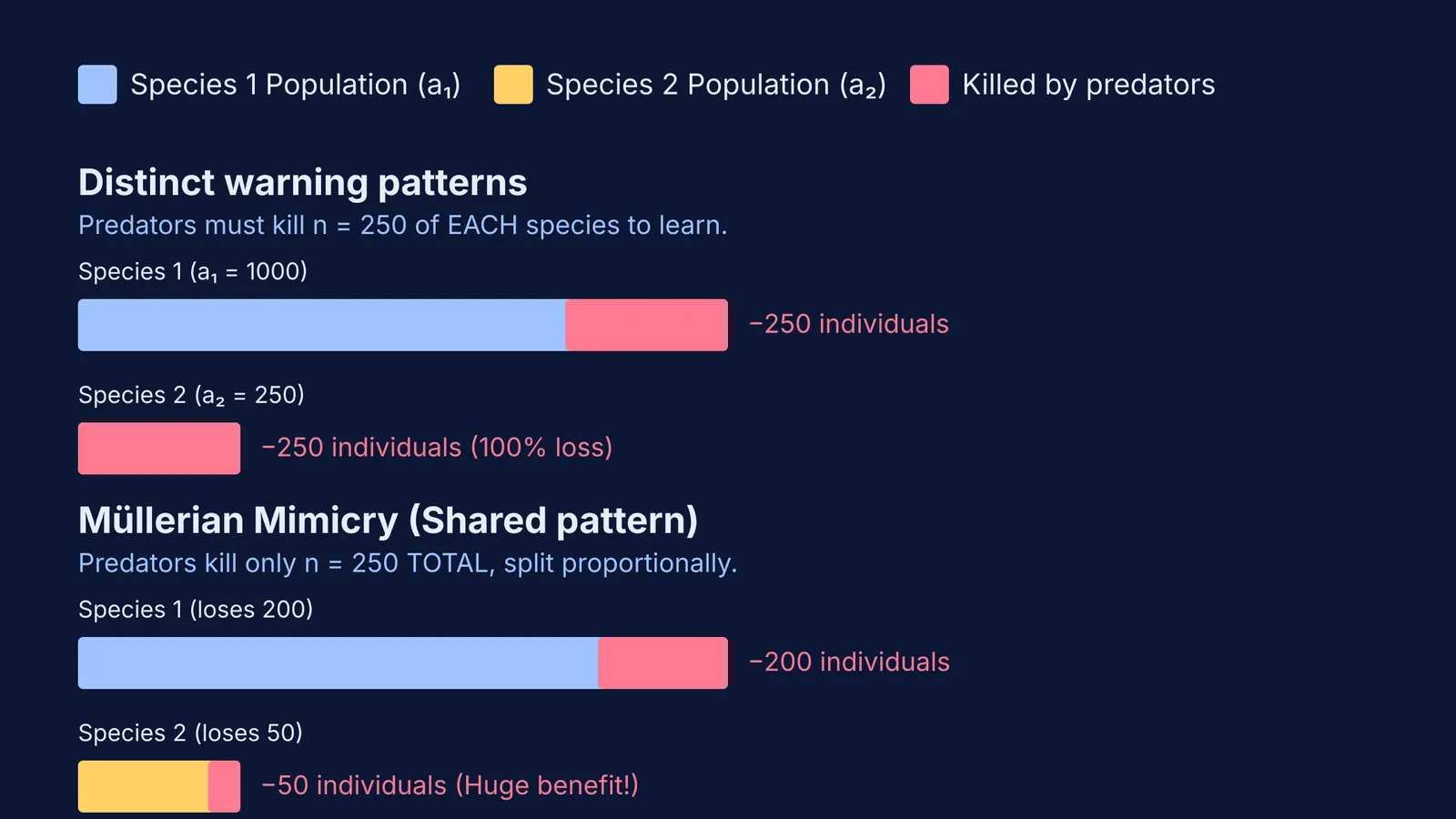
Müller realised that a predator must attack a certain number of prey, which we can call *n*, to learn to avoid a specific warning pattern. If two unpalatable species look completely different, predators have to learn two separate rules.
Here is how Müller laid out the algebra for two species with populations *a₁* and *a₂*:
If they have different warning patterns: The predator must kill *n* individuals of Species 1 to learn its pattern, and another *n* individuals of Species 2 to learn the second pattern.
If they share a warning pattern: The predator only needs to kill *n* individuals in total. These casualties are divided across both species in proportion to their abundance. Species 1 loses *n × a₁ / (a₁ + a₂)* individuals, while Species 2 loses *n × a₂ / (a₁ + a₂)* individuals.
Do both species benefit equally?
No. As Müller's mathematics showed, the rarer species gains far more from the mimicry ring than the abundant species. Because the frequency of the pattern determines how quickly predators learn, the rarer species effectively drafts off the high visibility of the common one. This elegant mathematical approach helped explain the selective pressures that shape ecosystems, building on the earlier work of Henry Walter Bates and the butterflies that copy others.
If you are studying these mathematical dynamics in genetics or ecology, the Fermi Problem Library has worked step-by-step solutions for frequency-dependent selection problems. It explains the reasoning behind each algebraic step instead of just printing the final ratio.
Are the Viceroy and Monarch butterflies Müllerian mimics?
For over a century, biology textbooks taught that the Viceroy butterfly was a Batesian mimic—a harmless species copying the toxic Monarch. However, a 1991 study published in *Nature* proved that Viceroys are as unpalatable as Monarchs (Ritland & Brower 1991).
Because both butterflies are defended by a foul taste and share the same bright orange warning colours, they are actually Müllerian mimics. This discovery changed how biologists classify North American butterflies and highlights how evolutionary models continue to be refined by new field data. Understanding how selection curves shift over time is a core part of ecology, similar to reading graphs for stabilising, directional and disruptive selection.
How can you spot Müllerian mimicry in exams?
Biology exams like NEET-UG often test the difference between Batesian and Müllerian mimicry. Use this quick checklist to tell them apart:
Are both species harmful or toxic? If yes, it is Müllerian. If only one is harmful, it is Batesian.
Does the mimicry ring rely on a shared, honest warning? Honest signals indicate Müllerian mimicry, because predators receive the punishment the bright colours advertise. Batesian mimicry relies on deception.
Which species benefits? In Müllerian mimicry, both species gain protection, though the rarer species gains a larger proportional advantage.


