On this page
Every parent who has watched a three-year-old stack blocks has wondered whether it is play or learning. Friedrich Froebel's answer, two centuries ago, was that for a young child the two are the same thing. He built the first kindergarten around that idea, and some of what he guessed now has research behind it.
Who was Friedrich Froebel?
Froebel was born on 21 April 1782 in Oberweißbach in Thuringia, Germany, the sixth child of a pastor. According to the timeline kept by the Friedrich Fröbel Museum in Bad Blankenburg, his mother died the next year. He trained as a land surveyor, studied natural sciences at Jena, and in 1805 began teaching at a model school in Frankfurt run on the ideas of the Swiss educator Johann Heinrich Pestalozzi. He then spent two years with Pestalozzi himself at Yverdon, from 1808 to 1810, before studying science again at Göttingen and Berlin.
In 1816 he opened his own school, which moved to Keilhau the next year. In 1826 he published his main book, The Education of Man (Die Menschenerziehung).
When and where was the first kindergarten?
In 1837 Froebel moved to Blankenburg and began making play materials. In 1839 he opened a play and activity institute for young children there. On 28 June 1840, at a meeting in the town hall of Blankenburg, he founded what he called the General German Kindergarten. The museum's timeline records that from 1842 he ran courses to train kindergarten teachers.
The University of Roehampton's Froebel Archive describes him as the inventor of both the concept and the word kindergarten, a "children's garden", and as responsible for the first training programmes for women kindergarten teachers. The museum notes that this new profession was an important step for women's independence in the 19th century.
The first kindergarten closed in 1844 because of funding problems. On 23 August 1851 kindergartens were banned in Prussia, and Froebel died on 21 June 1852 in Marienthal.
What were Froebel's gifts?
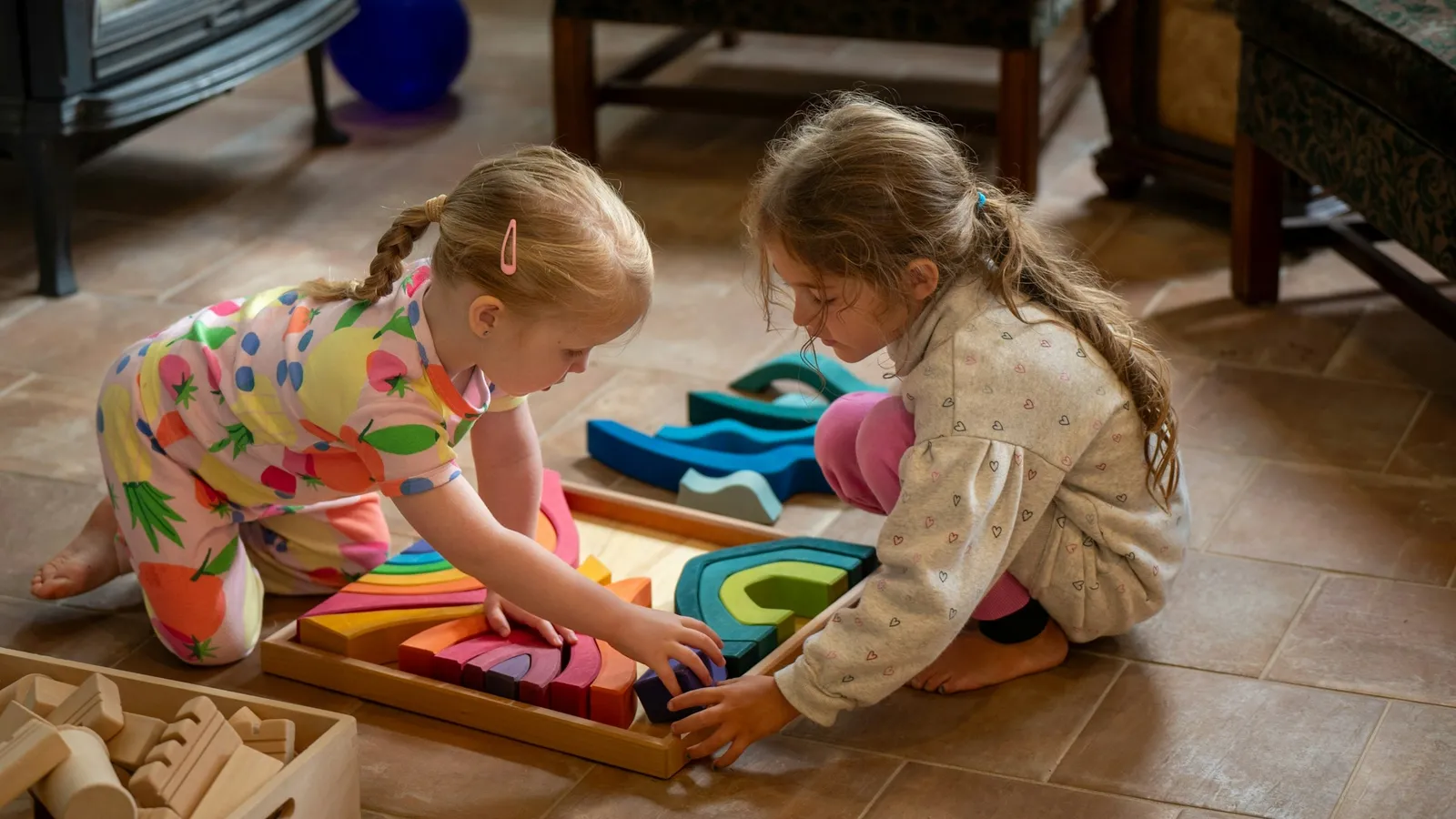
Froebel designed a sequence of play materials he called gifts. The museum's account of his teaching describes the most famous ones: a sphere, a cylinder and a cube, and building blocks made by dividing the cube. Playing with these simple forms, together with an adult, gives a child early insights into mathematical and physical relationships and logical structure.
The museum stresses a second point that is easy to miss. Froebel held that warmth and spoken language from the adult are needed for a child to learn through play. The blocks were not meant to be handed over and left.
Does block play really help with maths?
Froebel had no way to test his ideas. Modern researchers have. In a 2014 study in Child Development, Brian Verdine and colleagues asked 102 three-year-olds to copy models made of interlocking blocks. Children's spatial assembly skill predicted a significant part of the differences in their maths performance at the same age, separately from other factors.
The study also found that children from lower-income families were already behind in block assembly, and that their parents reported using fewer spatial words, such as "under", "corner" or "between". This is a correlation, not proof that blocks cause better maths. But it fits Froebel's pairing of hands-on building with adult talk.
What can parents take from Froebel's way of working?
Froebel watched children closely and designed materials to match what he saw. Parents can do something similar at home.
Offer simple shapes. Plain wooden blocks, balls and boxes leave more room for thinking than toys that do one thing.
Talk about space and number. "Can you put the small one on top?" "How many blocks make the tower as tall as the chair?" Our post on maths talk with young children has more prompts.
Divide and rebuild. Froebel's cube split into smaller blocks. Cut a sandwich or a sheet of paper into halves and quarters and put it back together.
Let the child lead, then join in. Follow what your child is building before suggesting a change.
Stay warm and present. In Froebel's view the adult's warmth and words were part of the learning, not an extra.
Froebel's ideas fed later early-years approaches. Our posts on the evidence behind Montessori education and on Gijubhai Badheka, who brought play-based schooling to Gujarat, follow the thread. For older children, the same principle of learning by seeing and handling applies: the Fermi Simulation Lab has interactive simulations for ideas that are easier to see than to read.
This weekend, build something with your child from plain blocks and describe each move out loud as you go.