On this page
Maria Montessori opened her first school in Rome in 1907. A 2023 systematic review calls her method "the oldest and most widely implemented alternative education in the world." For parents choosing a pre-school or primary school, the useful questions are what the method actually involves and what careful studies have found. The short answer: the best evidence is positive, with small-to-moderate effects, and it depends on schools actually doing what the method describes.
Where did the Montessori method come from?
The American Montessori Society (AMS) describes Maria Montessori as an Italian educator, physician and scientist. In 1906 she was invited to create a childcare centre in San Lorenzo, a poor inner-city district of Rome. She opened it on 6 January 1907 and called it the Casa dei Bambini, "Children's House."
Her own writing shows what she was aiming for. In Dr. Montessori's Own Handbook (1914), she describes a wooden block with holes into which a child fits ten cylinders of different sizes. If a cylinder goes into the wrong hole, one will be left over with nowhere to go, and the child has to find the mistake. She writes that "the control of the error lies in the material itself," and that "It is not a teacher who makes him notice his mistake." She reports children of three to three and a half repeating the exercise up to forty times.
What does a Montessori classroom involve?
The AMS lists five components it considers essential to a high-quality programme:
Properly trained Montessori teachers, credentialed for the level they teach.
Multi-age classrooms, typically spanning three years.
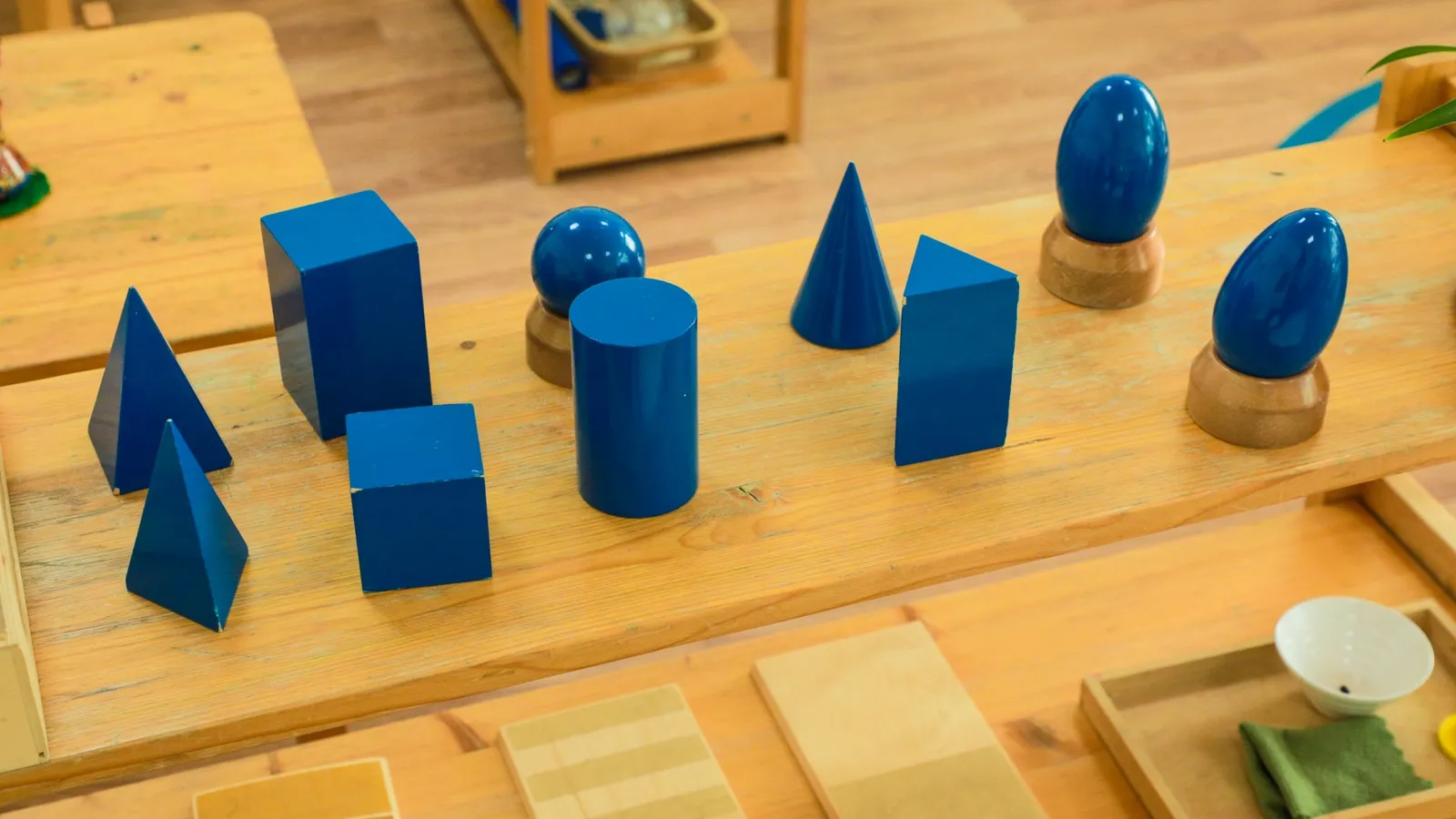
Specially designed, hands-on Montessori materials.
Student-directed work.
Uninterrupted work periods.
The same page adds an important warning: "any school can call itself Montessori, regardless of its fidelity to the philosophy and practice."
What does the research show?
A lottery study. Angeline Lillard and colleagues followed children who had applied to two public Montessori schools in a high-poverty American city, where places were given by lottery (Frontiers in Psychology, 2017). Lotteries matter because they make the two groups comparable. The final sample was 141 children: 70 in Montessori and 71 in other schools, tested up to four times from age 3 to 6. The groups did not differ at the start. Over time, the Montessori children did better on academic achievement, social understanding and mastery orientation, and liked school tasks more. The achievement gap between lower-income Montessori children and higher-income children in other schools was smaller at each test point and was not statistically significant by the end. The sample was small, and the authors called for a larger study.
A systematic review. A 2023 Campbell systematic review by Randolph and colleagues screened 2,012 articles and included 32 studies that compared Montessori with traditional education and showed the groups were comparable at the start. Its main findings:
An overall academic effect size of 0.24 and a non-academic effect size of 0.33 (Hedges' g), both favouring Montessori.
Mathematics (0.22) and language (0.17) were rated high-quality evidence. Science was the only academic outcome rated low-quality.
Executive function (0.36) was rated moderate-quality evidence.
Effects were larger in randomised studies, in pre-school and elementary than in middle or high school, and in private than in public Montessori.
Two cautions. Effect sizes of 0.2 to 0.4 are meaningful but not dramatic. And Lillard is a co-author of the review as well as the lottery study, so it is worth reading the full papers rather than headlines.
A parent's checklist for visiting a "Montessori" school
Use the AMS components as questions:
Teachers: What Montessori training do the lead teachers have, and for which age level?
Ages: Are classes mixed across about three years?
Materials: Can you see the materials in use? Do children choose them, and do the materials let children spot their own mistakes?
Time: How long is the uninterrupted work period each day? Ask to see a timetable.
Observation: How do teachers record what each child is doing and decide the next step?
Watch for a classroom that has the furniture but runs as whole-class instruction all day.
What can older students take from Montessori?
The "control of error" idea works at any age. Build self-checking into practice: attempt the problem fully, then check against a worked solution, and find your own mistake before reading the explanation. Our guide on why mistakes help you learn explains why this matters, and when to help with homework and when to step back covers the parent's side.
For physics and maths, the Fermi Problem Library has worked problems with a step-by-step solver that explains the reasoning, so a student can compare their own attempt line by line after trying it first. If you are visiting schools this term, take the five questions above with you.