

On this page
If you watch Sirius, the brightest star in the night sky, move over many decades, you might expect it to travel in a straight line. Instead, it wobbles. This slight, rhythmic deviation puzzled 19th-century astronomers.
In a letter dated August 10, 1844, the German astronomer Friedrich Wilhelm Bessel analysed this irregular path and made a bold claim. He argued that the wobble was the gravitational tug of an unseen companion star. It took 18 years for telescope makers to catch a glimpse of Sirius B, a strange, faint object that eventually forced physicists to rewrite their understanding of stars.
How did Bessel predict the Sirius companion wobble?
Bessel did not have a photograph of the companion. He found it using astrometry, which is the precise measurement of stellar positions over time. As Sirius A moves across the sky over the years, a movement known as proper motion, Bessel recorded deviations from a straight-line trajectory.
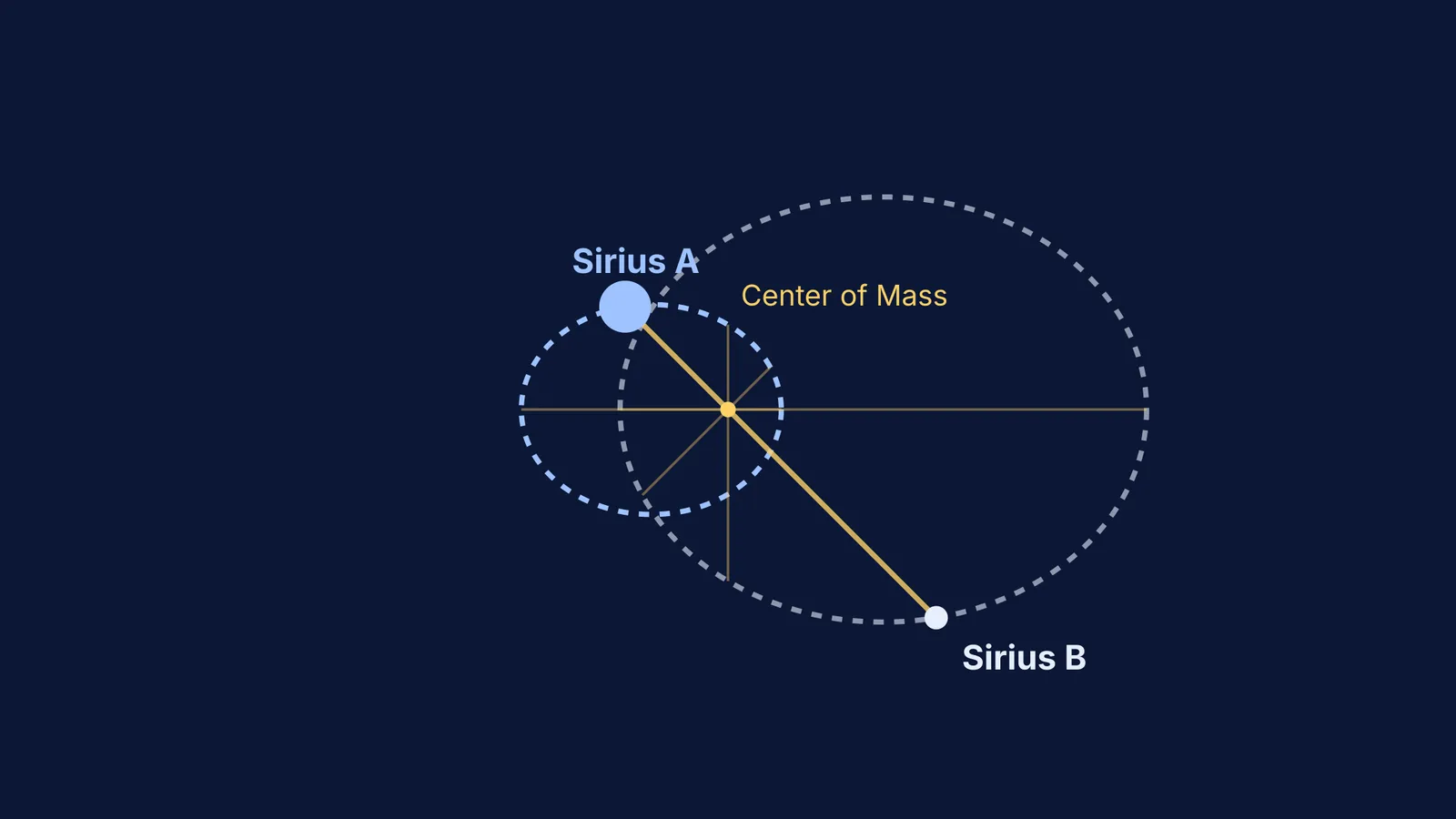
He calculated that Sirius A was not travelling alone. Instead, it was orbiting a shared centre of mass with an invisible object, completing a full orbit every 50.1 years. By tracking how Sirius A's speed changed—much like how planets behave under Kepler's second law of planetary motion—Bessel proved the unseen companion had to be incredibly massive, yet it produced no visible light.
Bessel proved that Newton's laws worked for the stars, not just the planets, and that "dark" masses could be detected entirely by their gravitational pull. This is a clear example of how mathematics uncovers what the eye cannot see. When you face a physics problem where a force is acting but no object is visible, you must trust the equations. The Fermi Problem Library has worked problems with a step-by-step solver that explains the reasoning rather than printing an answer. This helps you trace the invisible connections in mechanics.
When was Sirius B discovered?
For nearly two decades, Sirius B was a mathematical ghost. Then, the companion was finally observed visually on January 31, 1862.
American telescope-maker Alvan Graham Clark found it while testing a new 18.5-inch refractor telescope. At the time, this was the largest refracting telescope in the United States, destined for the Dearborn Observatory. Pointing the massive instrument at Sirius, Clark spotted a faint point of light hidden in the overwhelming glare of the bright main star.
Sirius B had been found exactly where Bessel's gravitational equations said it should be. This triumph of theoretical prediction over observation paved the way for modern astronomy, much like how the Hulse-Taylor binary pulsar later put general relativity to the test.
What makes Sirius B a white dwarf?
When astronomers finally measured the properties of Sirius B, the numbers made no sense for a normal main-sequence star. In 1915, Walter Sydney Adams observed the spectrum of Sirius B and determined it was a hot, faint, whitish star.
This classification meant it was the second white dwarf ever discovered (the first was noted by Williamina Fleming). A white dwarf is the collapsed core of a dead star, held up not by the thermal pressure of nuclear fusion, but by the quantum mechanical repulsion of its electrons.
The physical dimensions of Sirius B are staggering:
Sirius B has a mass 1.018 times that of the Sun.
It is squashed into a sphere with a radius of just 5,634 km, making it roughly the size of the Earth.
Its surface temperature burns at an intense 25,200 K.
Because of its tiny size and massive weight, its surface gravity is hundreds of thousands of times stronger than Earth's. The star that was once much more massive than Sirius A had burned through its fuel, swelled into a red giant, and eventually collapsed into its current state approximately 120 million years ago.
How can you use mathematics to find the invisible?
Bessel's method—looking for the wobble—is still exactly how astronomers find exoplanets orbiting other stars today. By measuring the radial velocity or proper motion of a host star, we can weigh the planets that orbit it.
If you are studying mechanics or gravitation, you can apply the same logic to your problems:
Trust the centre of mass: In an isolated system, the centre of mass must move in a straight line at a constant velocity. If a visible object curves, there must be another mass balancing the system.
Calculate the force: Use Newton's law of universal gravitation, F = G m₁ m₂ / r², to find the pull required to draw the visible object off its straight path.
Balance the momentum: The heavier the visible star, the more massive the invisible companion must be to produce the observed wobble.
If you struggle to picture how two unequal objects orbit a shared, empty point in space, the Fermi Simulation Lab provides interactive simulations for the ideas that are easier to see than to read. You can change the mass of a star and watch how the orbit of its companion shifts in real time.
Next time you look up at Sirius, remember you are looking at a binary system where the brightest light in the sky hid the heaviest secret, and where mathematics pointed the way.


