

On this page
Before 1938, if you wanted to move meat, dairy or fresh fruit across the country, your truck had to carry massive blocks of ice and salt. This system was heavy, inefficient and unreliable. By the time the journey ended, the ice had often melted, and the cargo was ruined. Frederick McKinley Jones changed that when he designed the first shock-resistant, portable refrigeration unit. His invention, which became the Thermo King, built the modern cold chain that allows supermarkets to stock fresh produce year-round.
How did Frederick McKinley Jones design the refrigerated truck?
The main challenge of cooling a moving truck is vibration. Early attempts at mobile cooling broke down because the delicate copper pipes, seals and compressors could not handle the constant shaking of a highway journey. In 1938, Jones began working on the Model A unit for entrepreneur Joseph A. Numero 1. This early model was mounted underneath the truck, where it was exposed to mud, rocks and debris.
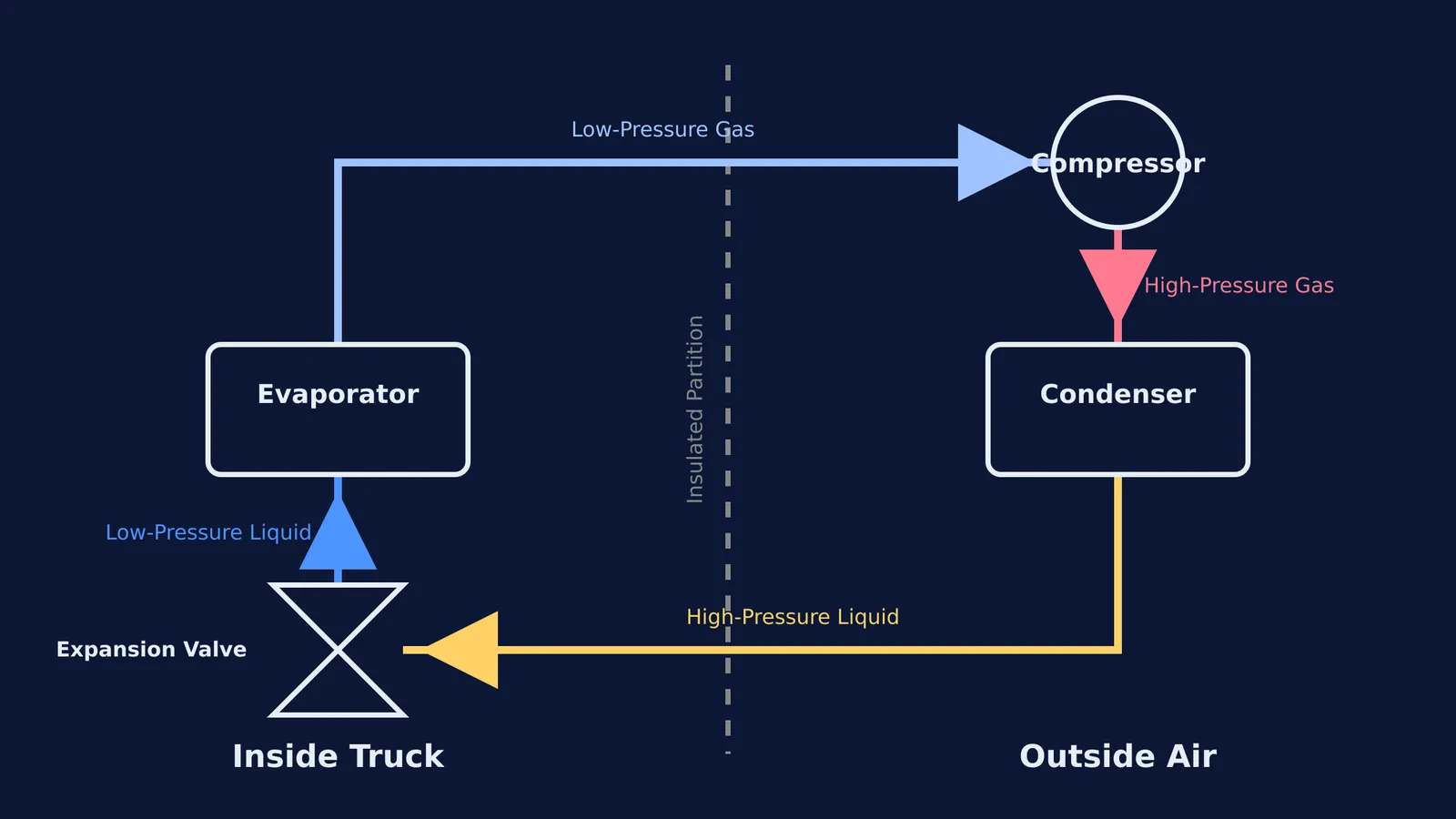
By 1941, he had perfected the Model C, a compact and rugged unit that sat high on the front of the truck trailer, safely away from the road surface. In his U.S. Patent 2,475,841 (filed in 1944 and issued in 1949), Jones outlined an ingenious dual-chamber design 2. A single heavy-duty shaft, driven by a gas engine, ran through a thick insulating partition. On the outside chamber, one blower forced external air across the condenser coils to release heat. On the inside chamber, a second blower moved air across the evaporator coils to cool the insulated compartment. This simple, direct-drive design was incredibly tough and worked efficiently regardless of the vehicle's speed or the outside wind direction.
Why was the Thermo King crucial for World War II?
When the United States entered World War II, the military urgently needed a reliable way to preserve perishable supplies on the battlefield. Jones's portable refrigeration units were rapidly adapted for military use to transport and store food, medicine, and blood plasma in tropical and desert climates.
While dried plasma was developed to survive without cooling, whole blood and liquid plasma still required strict temperature control. Just as Charles Drew and the science of storing blood plasma revolutionized the mass collection of these life-saving fluids, Jones provided the technology to keep them cold in army hospitals, airplanes and field tents. By the end of WWII, the American Red Cross had collected and provided enough blood for over six million plasma packages 3. The portable cooling units ensured these medical supplies remained viable.
After the war, the Model C and its successors were released for commercial use, permanently transforming the global food and shipping industries. In 1944, Jones became the first African American elected to the American Society of Refrigeration Engineers, and in 1991, he posthumously received the National Medal of Technology 1.
Mastering the refrigeration cycle
For physics students studying thermodynamics, refrigeration often feels counterintuitive because it forces heat to move from a colder space to a warmer one. While Sadi Carnot: the 1824 book that founded thermodynamics laid the theoretical groundwork for heat engines, it was engineers like Jones who figured out how to make these cycles work reliably on a bumpy road.
If you are learning about heat pumps and reversed Carnot engines, it can be hard to picture how the gases compress and expand at each stage. The Fermi Simulation Lab lets you run interactive thermodynamic cycles to see how pressure, volume and temperature change in real time. When you are ready to test your knowledge, the Fermi Problem Library offers a step-by-step solver that explains the mathematical reasoning behind Refrigerators and heat pumps: coefficient of performance problems.
Checklist: Solving refrigerator problems
If you are tackling coefficient of performance (COP) questions in your physics exams, follow this framework to avoid common mistakes:
Identify the temperatures: Locate the cold reservoir (Tc, the truck interior or freezer) and the hot reservoir (Th, the outside air or room).
Convert to Kelvin: Always add 273.15 to your Celsius temperatures before doing any thermodynamic calculations. Using Celsius in a ratio will give you the wrong answer.
Find the heat and work: Note the heat extracted from the cold space (Qc) and the mechanical work input (W) from the compressor. By the first law of thermodynamics, the heat rejected to the outside (Qh) equals Qc + W.
Calculate COP: Use the core formula COP = Qc / W. This tells you how much cooling you get per joule of electricity or fuel. For an ideal (Carnot) refrigerator, you can also calculate the theoretical maximum efficiency using temperatures: COP = Tc / (Th − Tc).


