

On this page
Cotton plants can drop their young bolls before they ripen. In the early 1960s, Frederick T. Addicott led a group at the University of California, Davis, that studied substances speeding up abscission, the shedding of leaves and fruit (Botany online, University of Hamburg). What his team pulled out of young cotton fruit belongs to one of the five major groups of plant growth regulators in your Class 11 textbook (NCERT Biology, Chapter 13), and it was named after a job it does not appear to do directly.
What did Frederick Addicott's team find in cotton bolls?
In 1961, Wen-Chih Liu and Harry Carns reported a crystalline substance from cotton burs, called abscisin, that sped up abscission in cut leaf stalks at 0.01 µg per abscission zone; they got about 1 milligram from 10 kilograms of dried plant material (Liu and Carns, Science, 1961).
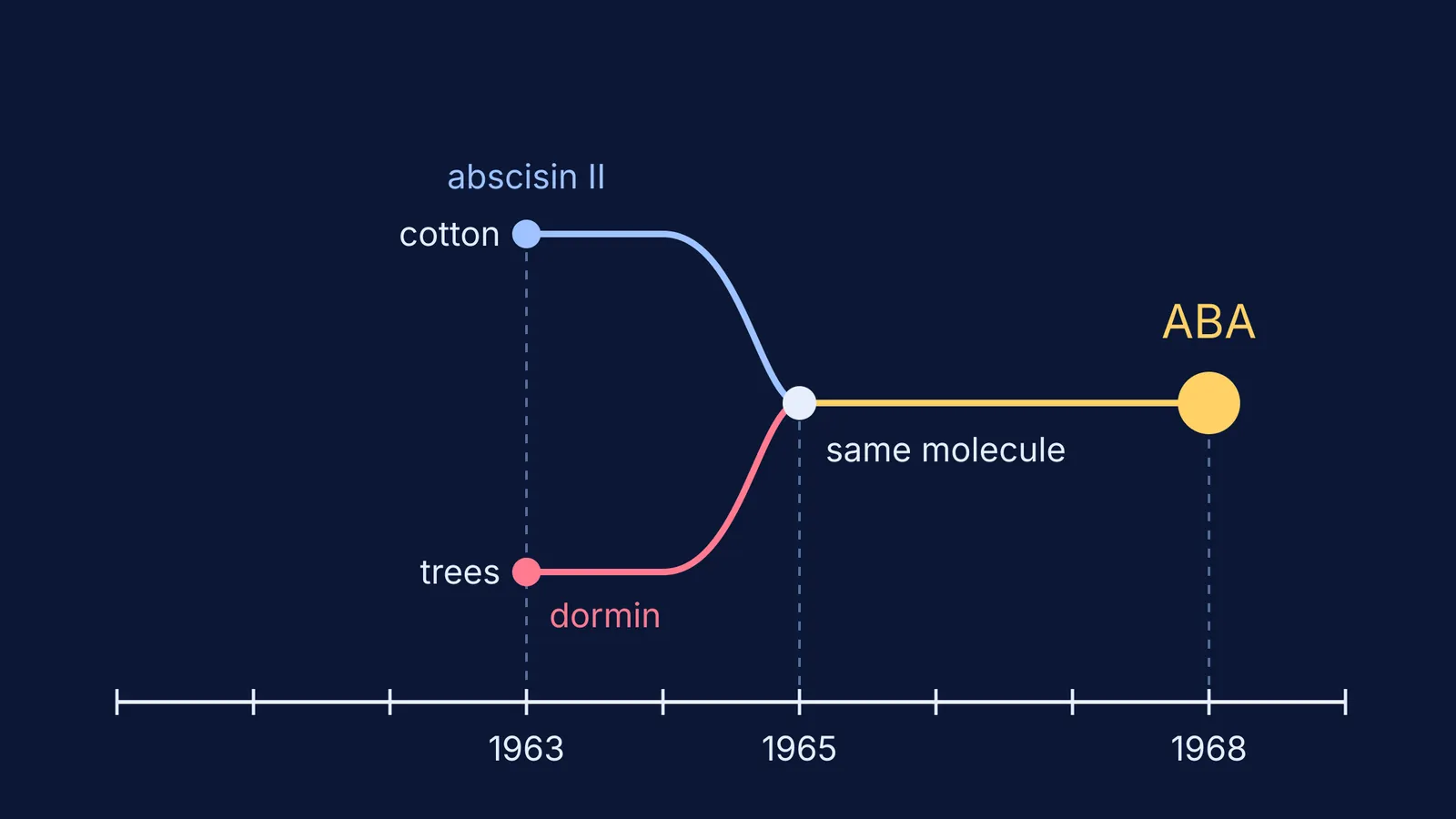
In December 1963, Kazuhiko Ohkuma, J. L. Lyon, Addicott and O. E. Smith reported a second crystalline substance from young cotton fruit and named it abscisin II (Ohkuma et al., Science, 1963). Its tentative molecular formula was C15H20O4, and it sped up abscission when applied in amounts as low as 0.01 µg per abscission zone, according to the same paper.
In 1965, Ohkuma, Addicott, Smith and W. E. Thiessen published the structure of abscisin II (Tetrahedron Letters, 1965).
How strong is 0.01 µg of an abscission substance?
Use the Liu and Carns figures: about 1 mg of pure substance from 10 kg of dried material, active at about 0.01 µg per abscission zone (Liu and Carns, Science, 1961).
10 kg is 10,000,000 mg, so the yield was about 1 part in 10 million.
1 mg is 1,000 µg, and 1,000 ÷ 0.01 = 100,000.
So that single milligram, squeezed out of 10 kg of plants, was enough to test about 100,000 abscission zones.
Substances like this are present in traces and work in traces.
How did abscisin II become abscisic acid?
Meanwhile, Philip Wareing's group was studying a growth inhibitor that built up in sycamore leaves as the trees were made to go dormant; they called it dormin (Finkelstein, The Arabidopsis Book, 2013). In 1965, J. W. Cornforth, B. V. Milborrow, G. Ryback and Wareing showed that sycamore dormin was identical with abscisin II (Cornforth et al., Nature, 1965). Cornforth, Milborrow and Ryback also made it in the lab that year (Synthesis of abscisin II, Nature, 1965).
Two teams now had two names for one molecule. Botany online records that the groups met in 1967 and settled on abscisic acid as the acceptable compromise, abbreviated ABA (University of Hamburg). In March 1968, ten scientists from both camps, Addicott and Wareing among them, co-authored a short paper titled ‘Abscisic acid: a new name for abscisin II (dormin)’ (Addicott et al., Science, 1968).
NCERT compresses this into two lines: three mid-1960s groups reported inhibitor-B, abscisin II and dormin, later proved chemically identical and named abscisic acid (NCERT Class 11 Biology, Chapter 13). For similar detective stories, read Frits Went and the discovery of auxin and Eiichi Kurosawa and the gibberellin fungus.
What does abscisic acid actually do in a plant?
NCERT describes ABA as a general plant growth inhibitor that stimulates the closure of stomata and increases tolerance to stresses, which is why it is called the stress hormone (NCERT Class 11 Biology, Chapter 13). The same chapter says ABA inhibits seed germination, plays a role in seed development, maturation and dormancy, and usually acts as an antagonist to gibberellins.
A 2013 review by Ruth Finkelstein lists drought, salinity, cold, pathogen attack and UV radiation among the stresses ABA helps plants respond to (Finkelstein, The Arabidopsis Book, 2013). The review notes that ABA helps plants reduce transpiration when water is short.
The hormone NCERT links to shedding is ethylene, which promotes senescence and abscission of leaves and flowers (NCERT Class 11 Biology, Chapter 13). Addicott's team found a real hormone; its main job was simply different.
How do you remember the ABA story for exams?
Say this chain aloud once, then write it from memory the next day.
Source: young cotton fruit (Addicott's group, UC Davis) and sycamore leaves (Wareing's group).
Old names: abscisin II and dormin, plus inhibitor-B in NCERT.
Proof: 1965, shown to be the same molecule.
New name: abscisic acid, agreed in 1967, published in 1968.
Real job: stomatal closure, stress tolerance, seed dormancy; acts against gibberellins.
Three common traps:
Calling ABA the main abscission hormone. NCERT ties ethylene to abscission.
Calling ABA a growth promoter. NCERT groups it with inhibitors.
Saying ABA breaks dormancy. It induces seed dormancy; gibberellins oppose it.
For a full match-the-hormone drill, see our guide to plant growth regulators and their effects. If the five hormone groups still blur together, the Fermi Concept Library gives every biology concept its own lesson and its place in the map, so you can study ABA alongside auxin, gibberellin, cytokinin and ethylene.
Next time a plant droops on a hot afternoon, picture ABA closing its stomata.


