

On this page
In 1961, an astronomer named Frank Drake faced a practical problem. He was hosting the first-ever scientific meeting on the search for extraterrestrial intelligence (SETI) at the Green Bank Observatory, and he needed an agenda. To organise the discussion, he wrote down an equation that broke the massive question of alien life into smaller, solvable pieces.
Today, the Drake Equation is often called the second most famous equation in science, after E = mc². It does not give a single, definitive answer to how many alien civilisations exist. Instead, it acts as a roadmap for astrobiology, telling scientists exactly what they need to find out.
What is the Drake equation?
The Drake Equation is a probabilistic formula that estimates N, the number of transmitting societies in the Milky Way galaxy.
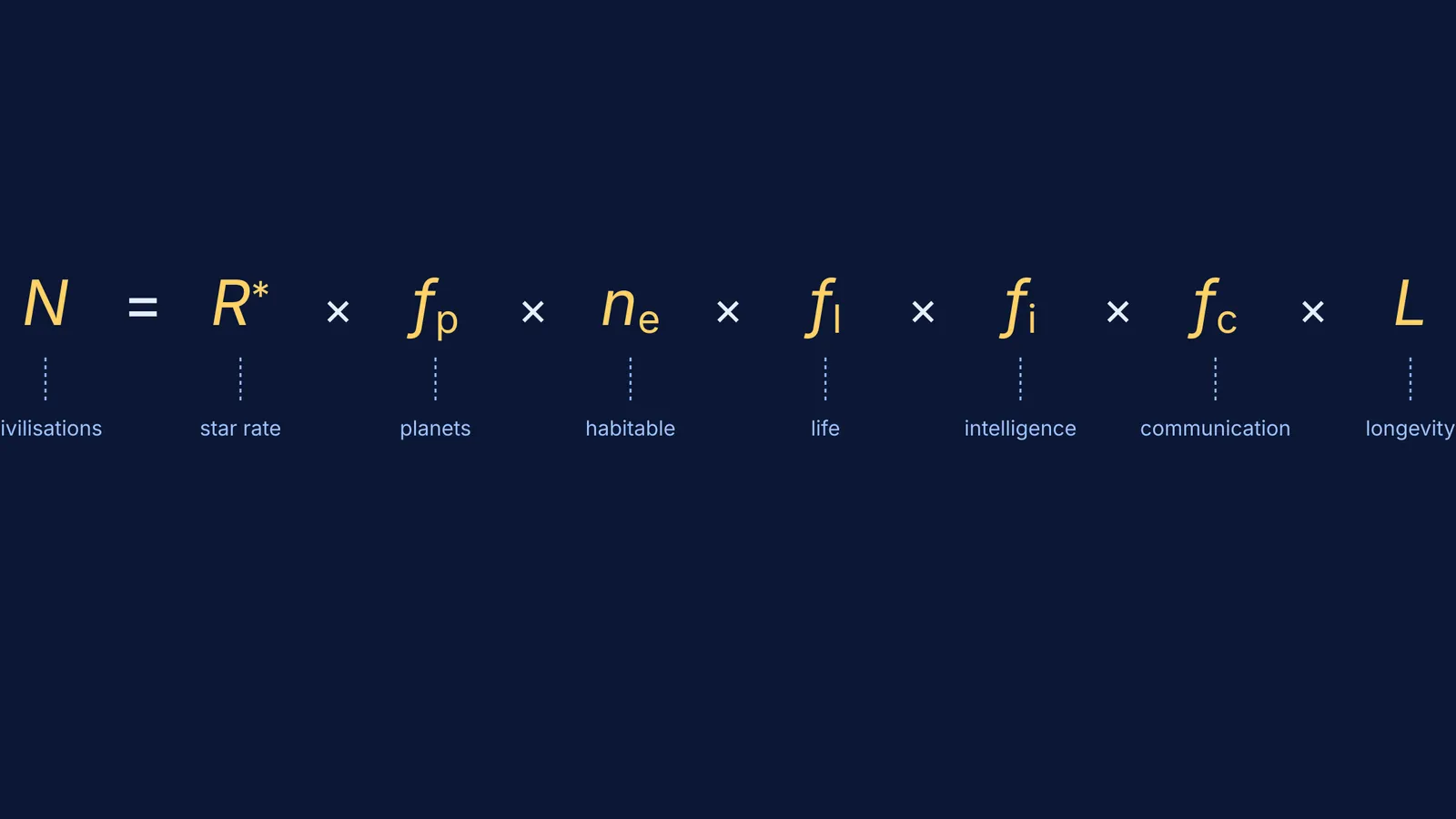
The equation is written as a chain of seven factors multiplied together:
N = R* × f_p × n_e × f_l × f_i × f_c × L
To find the final number, you start with the rate at which stars form and filter it down step by step until you are left only with civilisations that are currently broadcasting signals into space.
What are the seven factors of the equation?
Each term in the formula represents a specific variable required for a civilisation to exist and be detected:
**R* (Star formation rate):** The rate of formation of stars suitable for the development of intelligent life.
f_p (Fraction with planets): The fraction of those stars with planetary systems.
n_e (Habitable planets): The number of planets, per solar system, with an environment suitable for life.
f_l (Life emerges): The fraction of suitable planets on which life actually appears.
f_i (Intelligence emerges): The fraction of life-bearing planets on which intelligent life emerges.
f_c (Communication): The fraction of civilizations that develop technology that produces detectable signs of their existence.
L (Longevity): The average length of time, in years, such civilizations produce such signs.
The first six terms multiplied together (R* × f_p × n_e × f_l × f_i × f_c) yield what is sometimes called the "freshman rate" — the number of new, transmitting societies that appear in the Milky Way each year. Multiplying this by L, their average lifespan, gives the total number of detectable civilisations existing right now.
A worked example: calculating N
To see how the formula works in practice, we can run a calculation that produces the "freshman rate" of 1 new society per year, which was the guess at the original 1961 Green Bank meeting.
**Star formation (R*):** Assume 10 suitable stars form per year.
Planets (f_p): Assume 50% of these stars have planets (0.5).
Habitability (n_e): Assume an average of 2 habitable planets per system with planets (2.0).
Life (f_l): Assume 100% of habitable planets develop life (1.0).
Intelligence (f_i): Assume 100% of those planets develop intelligent life (1.0).
Communication (f_c): Assume 10% of intelligent species develop detectable radio technology (0.1).
Multiplying these gives the freshman rate: 10 × 0.5 × 2.0 × 1.0 × 1.0 × 0.1 = 1 new civilisation per year.
Longevity (L): If a civilisation broadcasts for an average of 10,000 years, the final calculation is:
N = 1 × 10000 = 10000 detectable civilisations.
Under these estimates, which Frank Drake himself suggested, there are 10,000 civilisations in the Milky Way whose signals we could theoretically detect today.
When you are exploring astronomical models in the Fermi Simulation Lab, you can see how changing one variable completely alters a system's outcome, just as tweaking the longevity factor L changes the Drake Equation's result from a lonely galaxy to a crowded one.
How many civilisations are out there?
Because several factors in the equation are still unknown, there is no single agreed-upon value for N. If civilisations tend to destroy themselves shortly after discovering radio technology, the number is extremely low. Current estimates for N range from 1 (Earth is completely alone) to several million.
When Frank Drake wrote the equation, scientists only had a good estimate for the first term: the rate of star formation (R*). Today, astronomical discoveries have filled in the next two blanks. Thanks to modern telescopes (which led astronomers like Mayor and Queloz, who found the first planet around a Sun-like star, to open the field of exoplanetary science), we now know that the fraction of stars with planets (f_p) is close to 100%, and the number of potentially habitable planets per system (n_e) is approximately 1. If you need a refresher on how planets orbit and form, the Fermi Concept Library maps out the underlying astrophysics step by step.
The remaining four biological and sociological factors are still blank. We do not yet know how often life emerges from non-living matter, how often that life becomes intelligent, or how long a technological society can survive. Until we find a signal from the stars—perhaps a repeating radio pattern, much like the one that led to the discovery of pulsars—the Drake Equation remains a guide to the greatest mystery in science.


