

On this page
Shine light on a small round disc and look at its shadow. Common sense says the middle should be the darkest place of all. It isn't. At the exact centre sits a small bright spot, and the story behind it is one of the cleanest tests in physics.
The spot is named after François Arago (1786–1853), who later directed the Paris Observatory, according to his MacTutor biography at the University of St Andrews. It is also called Poisson's spot, after the man who hoped it would not exist.
What is the Arago spot?
The Arago spot is a bright point in the geometrical shadow of a circular obstacle, produced because waves passing the edge reinforce each other on the central axis (Reisinger and colleagues, Physical Review A, 2009). That team saw the same spot with a beam of deuterium molecules, so it belongs to waves in general, not just light.
How did Poisson's objection become proof of the wave theory?
The French Academy of Sciences set diffraction, the bending of light round edges, as the subject of its Grand Prix for 1819. Augustin Fresnel entered a wave theory that let him calculate the brightness at any point behind an obstacle, according to the St Andrews biography of Fresnel. The judging committee had Arago as chairman and included Poisson, Biot and Laplace; the same source says most members favoured the particle model of light.
Poisson worked through Fresnel's mathematics and found it put light in the centre of a disc's shadow, as bright as if the disc were not there at all. He meant this as a reason to reject the theory. Arago did something simpler: he looked. Robert P. Crease's Physics World account records that Arago used a flame, filters and a 2 mm metal disc fixed to a glass plate with wax, saw the spot, and Fresnel won. Crease adds that two others had noticed the spot a century earlier without knowing what it meant.
A 1984 paper in the American Journal of Physics says the result put Fresnel's theory on a firm technical foundation. Read more on Thomas Young's double-slit evidence for light waves, Augustin Fresnel's diffraction theory and lighthouse lens and Francesco Grimaldi, who first described diffraction.
Why is the centre of the shadow bright?
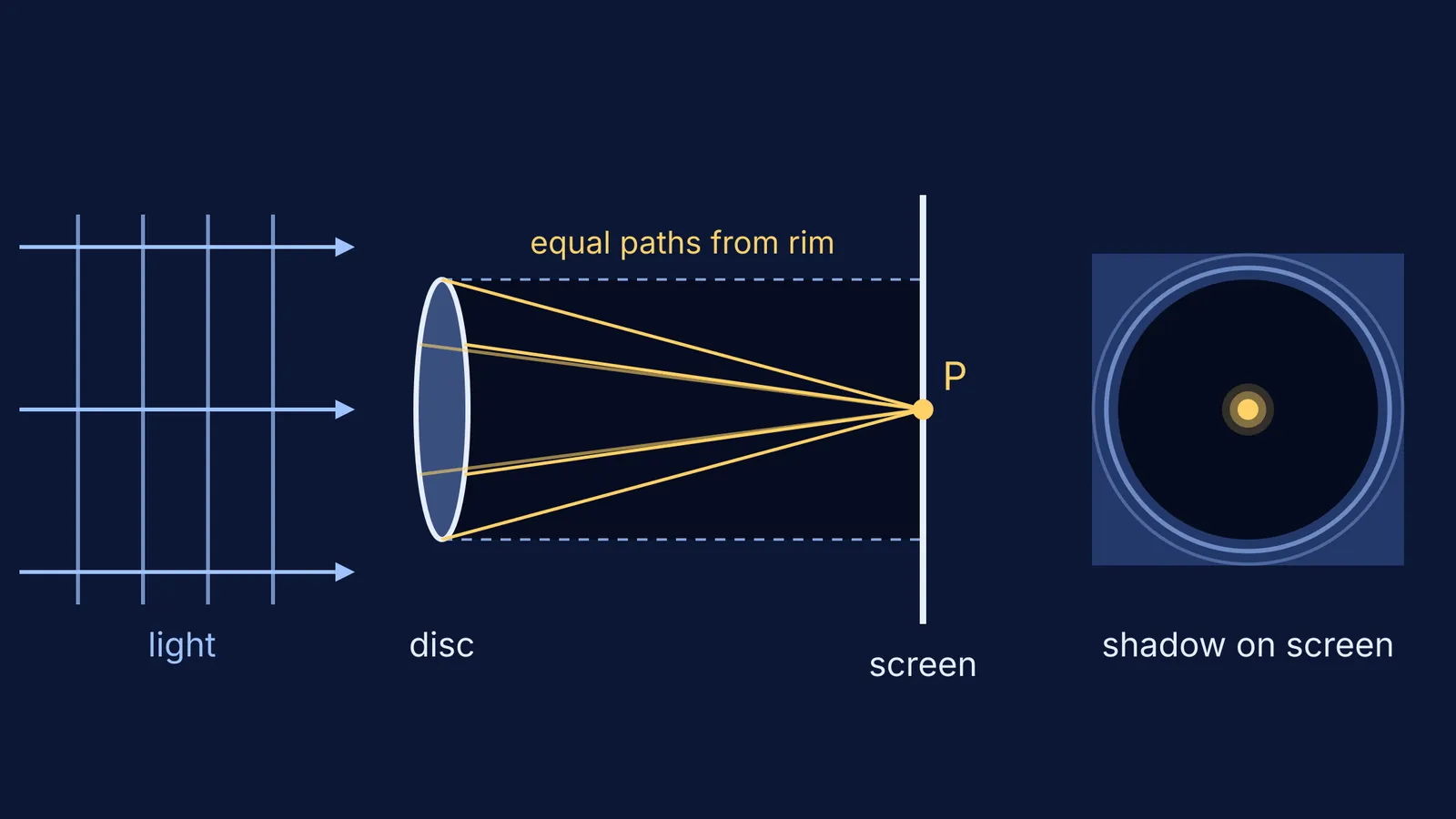
In Fresnel's picture, every point of the wavefront that gets past the disc sends out wavelets. For a point P on the screen directly behind the centre, the wavelets from the open wavefront largely cancel ring by ring, leaving the light just past the rim to set the result. Every point on the rim is the same distance from P, so those wavelets arrive in step. Crest meets crest, and P is bright.
Move a little off the axis and that symmetry breaks. Rim points on one side are now nearer, the wavelets arrive out of step, and they start to cancel. That is why the spot is small and sits only at the centre.
How big is the spot? A worked example
Take Arago's 2 mm disc, so the radius a is 1 mm. Put the screen L = 1 m behind it, and use red helium-neon laser light, whose wavelength NIST gives as about 633 nm.
On the axis, every rim point is √(L² + a²) from P, so all the wavelets agree.
At a distance y off the axis, rim distances spread by about ±a·y/L. The full wave calculation (a Bessel function, J₀) puts the first dark ring at y ≈ 0.38 λL/a.
Put the numbers in: 0.38 × 633 × 10⁻⁹ m × 1 m ÷ 10⁻³ m ≈ 0.24 mm. The spot is about half a millimetre across.
Double the disc's radius and the spot halves. A large obstacle gives a tiny spot, which is one reason you never notice one behind a cricket ball.
A bump of height δ on the edge changes a path by about a·δ/L. To keep the wavelets in step, δ must be well below λL/(2a), about 0.3 mm here. A dented edge scrambles the phases.
How can you see the Arago spot yourself?
The UC Santa Barbara lecture demonstration uses laser light and a small ball bearing. A careful home version:
Use a laser pointer as the source. Never look into the beam or point it at anyone.
Fix a small, smooth ball bearing to a clean glass slide with a dot of glue.
In a dark room, catch its shadow on a white wall a few metres away.
Before you look, write down your prediction for the centre.
Look at the exact middle, then move the slide nearer to or farther from the wall and watch the spot change size.
No laser? The Fermi Simulation Lab has interactive simulations for ideas that are easier to see than to read. If Huygens' principle feels shaky, the Fermi Concept Library gives each physics concept its own lesson.
Arago's lesson is short: when a theory predicts something that sounds absurd, look before you laugh.


