

On this page
In the early 1980s, physicians and medical researchers faced an escalating global health crisis with an unknown cause. Patients presented with collapsed immune systems, opportunistic infections, and fatal complications from what became known as Acquired Immunodeficiency Syndrome (AIDS). By 1984, researchers had identified a retrovirus associated with the disease, but isolating the pure virus to prove it caused AIDS remained a challenge (HIV.gov Timeline).
At the National Cancer Institute (NCI) in Bethesda, Maryland, molecular biologist Flossie Wong-Staal set out to provide the definitive molecular answer. Her objective was to isolate the virus's genetic code in its pure form, map its sequence, and prove beyond doubt how it functioned.
Why was cloning HIV such an urgent challenge?
Retroviruses present a distinct puzzle to geneticists. Unlike typical DNA viruses, an infectious retrovirus carries its genetic material as single-stranded RNA. When the virus infects a human CD4+ helper T cell, the enzyme reverse transcriptase copies this RNA into double-stranded proviral DNA, which integrates directly into the host genome. To understand how this infection cycle destroys immune defenses, see our guide to how HIV replicates in helper T cells.
In 1984, isolating viral genetic material directly from human tissue meant searching for minute quantities of viral DNA hidden among billions of host base pairs. Patient blood also contained antibodies and cellular fragments, making it difficult to obtain pure viral proteins. To study the pathogen systematically and build reliable diagnostic tools, scientists needed a way to produce identical, pure copies of its full genetic sequence.
How did Flossie Wong-Staal clone the HIV provirus?
Wong-Staal tackled this obstacle using recombinant DNA technology. Earlier breakthroughs had established how to insert foreign DNA into bacterial plasmids, as described in our review of Cohen and Boyer's recombinant DNA techniques. Wong-Staal applied this logic to the integrated provirus in human T cells.
Working with colleagues Beatrice Hahn and George Shaw in Robert Gallo's laboratory, Wong-Staal digested cellular DNA from infected cell cultures using restriction enzymes and inserted the fragments into bacteriophage lambda vectors (Nature, November 1984). They screened the resulting genomic libraries to isolate individual recombinant clones of the provirus.
In July 1985, Wong-Staal and her team reached a decisive milestone: they isolated a complete, biologically active molecular clone of the virus, known as HXB2 (Nature, July 1985). When they inserted this cloned DNA into uninfected human T lymphocytes, the host cells began producing fully infectious viral particles that specifically targeted and killed healthy T cells. By showing that a single cloned sequence caused the exact cellular destruction seen in patients, Wong-Staal provided the definitive proof that HIV was the sole causative agent of AIDS.
What did Flossie Wong-Staal discover in the HIV genetic map?
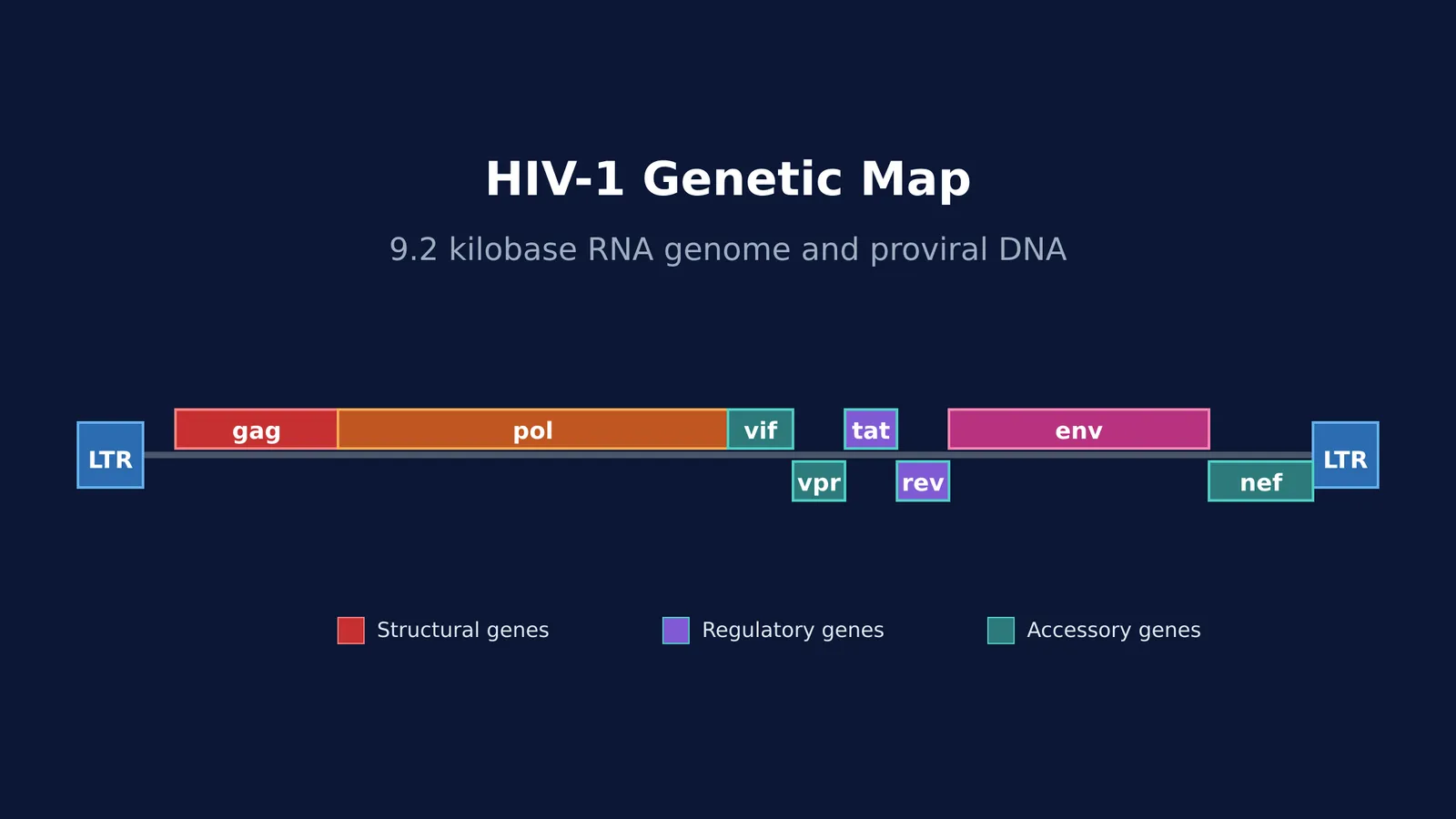
With cloned viral DNA in hand, Wong-Staal led the effort to sequence and map the complete genome. Before this work, retroviruses were thought to carry simple genomes consisting of only three structural genes: *gag* (core structural proteins), *pol* (enzymes including reverse transcriptase), and *env* (envelope proteins). If you are studying how vectors carry these sequences, review our guide to cloning vectors and restriction enzymes.
The genetic map published by Wong-Staal and her colleagues revealed that HIV was far more complex, spanning approximately 9.2 kilobases (Nature, January 1985). Alongside the classic structural genes, the genome contained reading frames encoding previously unknown regulatory proteins:
***tat* (trans-activator of transcription):** produces a protein that accelerates the speed of viral RNA transcription.
***rev* (regulator of expression of virion proteins):** controls how viral messenger RNA is exported from the host nucleus into the cytoplasm.
**Accessory genes (*vif*, *vpr*, *nef*):** help the virus evade cellular defenses and enhance viral transmission.
Wong-Staal also made an unexpected observation: different clones isolated from different patients displayed significant sequence variation, concentrated heavily in the *env* gene. She identified this rapid mutation pattern as genetic micro-variation (Science, September 2020). This discovery explained why the human immune system could not easily clear the infection and demonstrated why single-drug therapies failed quickly, establishing the rationale for the multi-drug cocktails used in modern antiretroviral therapy.
Connecting how viral genes regulate transcription with host cellular machinery requires seeing molecular events as an integrated system. The Fermi Concept Library has every concept in biology and genetics, each with its own lesson and its place in the map, so you can see how molecular events connect.
How did cloning HIV make blood tests possible?
Before Wong-Staal cloned the virus, developing a diagnostic test was hindered by the risk of growing live virus in massive quantities and the high rate of false readings caused by cellular impurities. Cloning the genome provided the pure genetic sequence required to express specific viral proteins, such as the p24 capsid protein and the gp120 envelope glycoprotein, inside harmless laboratory host cells.
This molecular precision enabled manufacturers to produce pure viral antigens without handling live virus. On March 2, 1985, the U.S. Food and Drug Administration approved the first commercial enzyme-linked immunosorbent assay (ELISA) blood test for HIV (HIV.gov Timeline). Blood banks immediately adopted the test, securing donated blood supplies.
What does Flossie Wong-Staal teach future scientists?
Born Wong Yee Ching in Guangzhou in 1946, Wong-Staal moved to Hong Kong as a child and later attended the University of California, Los Angeles, where she earned her doctorate in molecular biology in 1972 (Science, September 2020). During the 1980s, the Institute for Scientific Information named her the most-cited female scientist of the decade, with nearly 7,800 citations reflecting the enormous influence of her work.
Her scientific journey offers a practical framework for students approaching complex biology problems:
Find the pure unit: When an experimental mixture is noisy or contaminated, isolate single molecular clones to study one variable at a time.
Test for biological function: Knowing a sequence is only the first step; transfecting the clone proved that the genetic code actually functioned in living cells.
Map the regulation: The key to stopping a pathogen lies in its regulatory switches (*tat* and *rev*), not just its static parts.
Account for variation: Recognizing that pathogens evolve rapidly prevents assuming a static target and leads to better multi-target solutions.
When students encounter multi-step genetic problems or need to understand how experimental methods prove causality, the Fermi Problem Library has worked problems with a step-by-step solver that explains the reasoning rather than printing an answer.


