

On this page
In 1972, two psychologists at the University of Toronto, Fergus Craik and Robert Lockhart, published a paper that asked memory researchers a different question (Craik and Lockhart, 197280001-X)). Instead of sorting memories into boxes, they asked: what did you do with the information when it first arrived? An hour of rereading and an hour of explaining can feel alike. Their theory says they leave very different traces.
What is the levels of processing theory of memory?
The idea is that the brain can analyse anything you see or hear at different depths, from its look and sound up to its meaning. In the paper's own words, greater depth "implies a greater degree of semantic or cognitive analysis" (Craik and Lockhart, 1972, full text).
The central claim is one sentence: "trace persistence is a function of depth of analysis, with deeper levels of analysis associated with more elaborate, longer lasting, and stronger traces" (Craik and Lockhart, 1972). Noticing a word's font is shallow; noticing its rhyme is deeper; asking what it means is deep.
The paper also said that repeating something at the same level, like chanting a formula, "merely prolongs an item's high accessibility without leading to formation of a more permanent memory trace". Only deeper analysis, they argued, should improve memory later.
What did the experiments actually show?
In 1975, Craik and Endel Tulving ran ten experiments to test the idea (Craik and Tulving, 1975; full text). Students saw a word and answered one question: is it in capital letters, does it rhyme with another word, is it in a category, does it fit a sentence? Then came a surprise test.
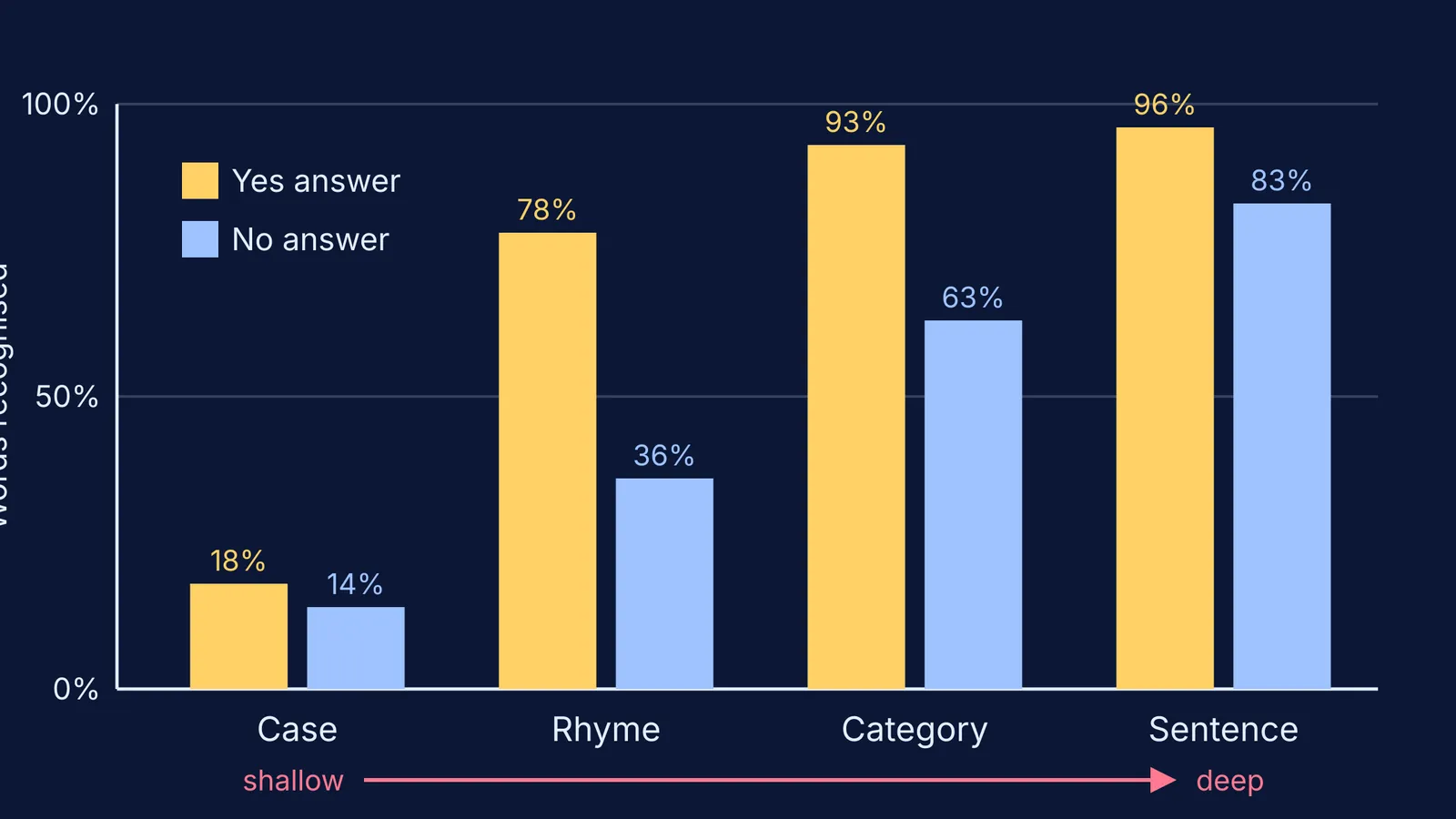
In their first experiment, 20 students recognised 18% of the words they had said yes to on a capital-letters question, 78% after a rhyme question, 93% after a category question and 96% after a sentence question (Craik and Tulving, 1975, Table 2). A second experiment with 24 students found the same pattern: from 15% for case questions to 81% for sentence questions.
Was it just more time? Probably not. In a later experiment in the same paper, a hard, slow shallow task still gave lower recognition than a quick question about meaning. Their summary: "a minimal semantic analysis is more beneficial than an extensive structural analysis". More on Tulving in Endel Tulving and the kinds of memory.
Does deeper processing always win?
Not on its own, and the researchers said so. Craik and Tulving warned that the theory risks going in a circle, since any well-remembered event can too easily be labelled deeply processed. They also noted that the best way to learn something depends on how you will be asked to recall it (Craik and Tulving, 1975).
Their tests used single words in a lab, not a chapter of physics. For real study, a large 2013 review of ten learning techniques rated rereading and highlighting as low utility, self-explanation and elaborative interrogation (asking "why?") as moderate, and practice testing and spaced practice as high (Dunlosky and colleagues, 2013). So depth is the start, not the whole plan: explain it, then test yourself on it later. Why rereading feels better than it is: the illusion of fluency.
How do you study at a deeper level?
Take one line from your physics notes: magnetic flux, Φ = BA cos θ. Here is the same line at three depths.
Shallow: highlight it, reread it, copy it out three times.
Middle: say it aloud until it sounds familiar.
Deep: answer questions about what it means.
The deep questions might be:
Why cos θ and not sin θ? (θ is the angle between the field and the normal to the surface.)
What is the flux when the loop's surface lies parallel to the field? (Zero, because θ is 90°.)
What is it like? (Rain falling on a tilted sheet: tilt it away and less rain lands on it.)
Where does it show up in a problem? (Any rotating coil, which is how a generator works.)
Can you explain it in three sentences without looking?
Questions like these work in any subject. Our guide to the self-explanation technique shows how to make this a habit.
If question 1 or 2 stumps you, you have found a gap in the concept, not in your memory. The Fermi Concept Library gives every concept in physics, chemistry, biology, mathematics and computing its own lesson, so you can fill the gap before going on.
What can parents ask instead of "Have you revised?"
"Have you revised?" gets a yes. Try these instead:
"Explain one thing you learnt today, as if I know nothing."
"Why does that work?"
"What would change if…?"
You don't need to know the answer. Asking "why" can nudge your child from rereading to thinking.
When no one is around to ask, Fermi's AI tutor decides whether to explain, ask or show, and checks understanding as it goes. Next time you revise, close the book first and explain.


