

On this page
Most car engines use pistons moving up and down inside cylinders. The Wankel rotary engine eliminates this vibrating, reciprocating motion entirely. Instead, it uses a spinning triangular rotor inside an oval chamber to perform the same thermodynamic cycle.
Felix Wankel, a self-taught German engineer, conceived the rotary engine concept in 1924 and won his first patent in 1929 (Wikipedia). However, it took nearly three decades before his first functional prototype, the DKM 54, successfully ran on 1 February 1957 (Wikipedia).
How does a Wankel rotary engine work?
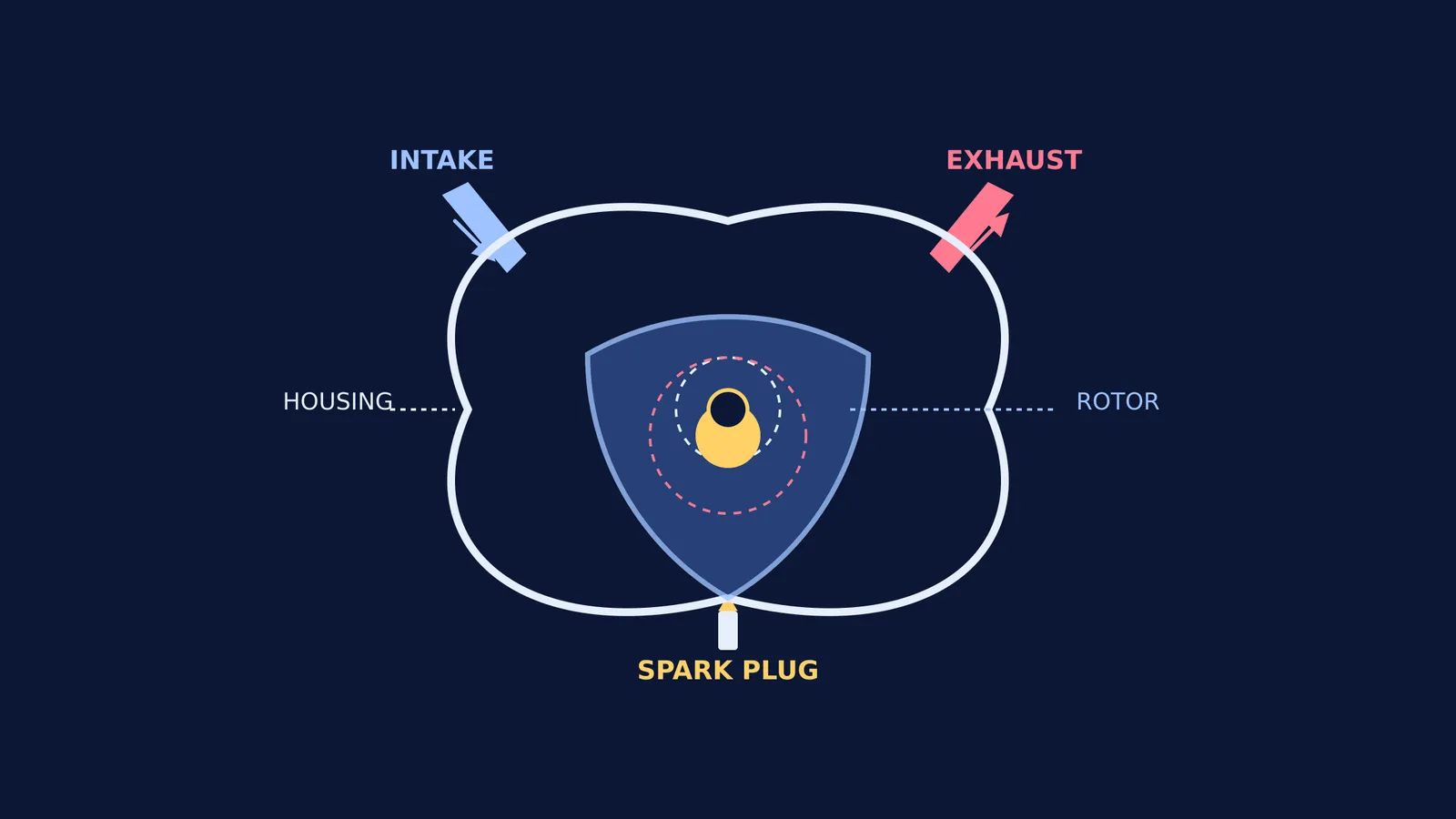
The engine consists of three main components: a three-sided rotor, a housing, and an eccentric shaft (which acts like a crankshaft). The rotor is a Reuleaux triangle—a shape with slightly curved sides. The housing is an epitrochoid, meaning it is shaped roughly like a peanut or a figure of eight.
As the rotor spins, its three tips (apices) stay in constant contact with the housing walls. This creates three separate, sealed pockets of space between the rotor faces and the housing. Because the rotor is mounted on an eccentric shaft (off-centre), it orbits as it spins.
This eccentric motion causes the three pockets to constantly expand and contract as they move around the chamber. This changing volume naturally replicates the four strokes of an internal combustion engine—a cycle governed by the same thermodynamic rules that explain why ΔU = nCvΔT holds for every ideal gas process:
Intake: As a rotor face passes the intake port, the pocket expands, creating a vacuum that sucks in the fresh air-fuel mixture.
Compression: The rotor carries the mixture around the housing. The pocket's volume shrinks as it approaches the pinched section of the housing, squeezing the gas into a tiny space.
Power: One or two spark plugs ignite the highly compressed mixture. The explosion expands the gases, pushing against the broad face of the rotor and forcing it to keep spinning.
Exhaust: The rotor tip passes the exhaust port, and the shrinking pocket pushes the spent gases out of the engine.
Understanding how the eccentric shaft translates this orbital motion into pure rotation can be difficult to picture from a static diagram. The Fermi Simulation Lab has interactive simulations for the ideas that are easier to see than to read.
How do you get 4 strokes in one turn?
The defining feature of the Wankel engine is how it delivers power smoothly. The phrase "four strokes in one turn" comes from the mathematical relationship between the rotor and the output shaft, determined by the engine's internal gears.
An internal gear fixed to the inside of the rotor meshes with a smaller stationary gear attached to the housing. This gearing forces the eccentric output shaft to spin exactly 3 times for every one full 360° rotation of the rotor (Wikipedia).
Because the rotor has three faces, each face is constantly working on a different stage of the process. In one full rotation of the rotor, each of its three faces completes a full four-stroke cycle. This means there are 3 distinct power strokes per single rotor revolution.
Because the output shaft is spinning 3 times faster than the rotor itself, the math works out perfectly: the engine delivers exactly 1 power stroke for every single revolution of the output shaft.
In contrast, a standard four-stroke piston engine requires 2 full revolutions of the crankshaft to produce just 1 power stroke per cylinder. This is why the Wankel engine feels so incredibly smooth and delivers power linearly.
Why did Mazda keep the rotary engine alive?
While Wankel designed the first prototype where both the heavy rotor and the outer housing spun, an NSU engineer named Hanns Dieter Paschke simplified it in 1958. Paschke created the KKM design, where the housing remains completely stationary and only the rotor orbits inside it (Wikipedia). This is the practical design used in all subsequent rotary cars.
Many major car manufacturers experimented with the Wankel engine in the 1960s, but most abandoned it due to the difficulty of sealing the rotor tips (known as apex seal wear) and lower fuel efficiency. Sealing the moving combustion chambers requires apex seals at the rotor tips, which are subjected to varying centrifugal forces and lack the consistent lubrication of standard piston rings.
Another significant challenge is thermal management and emissions. Because the engine's phases occur at fixed locations within the housing, one side is constantly cooled by the intake mixture while the opposite side is heated by continuous combustion. This extreme temperature gradient can distort the housing over time. Furthermore, the long, thin shape of the moving combustion chamber prevents the fuel from burning completely before it is expelled, leading to high unburnt hydrocarbon emissions (Wikipedia).
Despite these flaws, Mazda licensed the technology in 1961 and spent decades perfecting it, putting it into iconic sports cars like the Cosmo Sport in 1967 and later the RX-7 (Wikipedia). Engineers valued the Wankel because its purely rotational motion makes it exceptionally smooth, with fewer moving parts (no valves or timing belts) and the capability of reaching very high RPMs. It produces massive power for its small size and weight—a principle you can explore further when studying rotational motion and common JEE mistakes. Today, the engine survives in applications where size and weight are critical, such as small aircraft, drones, and as a compact range-extender in hybrid vehicles.


