On this page
In 2009, a team led by computer scientist Fei-Fei Li presented ImageNet, a database of millions of photos, each checked by people and labelled with what it shows. It sounds like a filing job. It turned out to be one of the foundations of modern AI, because it gave computers enough examples to learn to see, and a yearly contest that made progress impossible to ignore.
What is ImageNet and why did Fei-Fei Li build it?
ImageNet is an image database organised by the WordNet hierarchy of English nouns, so "husky" sits under "working dog" and "dog", and further up under "mammal" (ImageNet, CVPR 2009).
The 2009 paper by Jia Deng, Li Fei-Fei and colleagues at Princeton reported 3.2 million cleanly labelled images across 5,247 categories (Deng et al., 2009, DOI). The goal was far bigger: 500 to 1,000 images for most of WordNet's roughly 80,000 noun categories. No lab could label that many photos by hand, so the team used Amazon Mechanical Turk, an online platform that pays people to do small tasks such as checking labels, and a sample of 80 categories showed 99.7% labelling precision on average.
The paper argued that a large, organised collection of images is "a critical resource" for building programs that understand pictures. In other words, a machine needs to see a huge number of labelled examples before it can recognise things reliably. ImageNet's own site now lists 14,197,122 images (image-net.org).
How did the ImageNet challenge show deep learning worked?
From 2010, the team ran the ImageNet Large Scale Visual Recognition Challenge every year (Russakovsky et al., 2015). Teams trained on about 1.2 million images in 1,000 categories, then tried to label photos they had never seen.
The score was top-5 error: the program gives five guesses for each photo, and it counts as wrong only if the correct label is not among them.
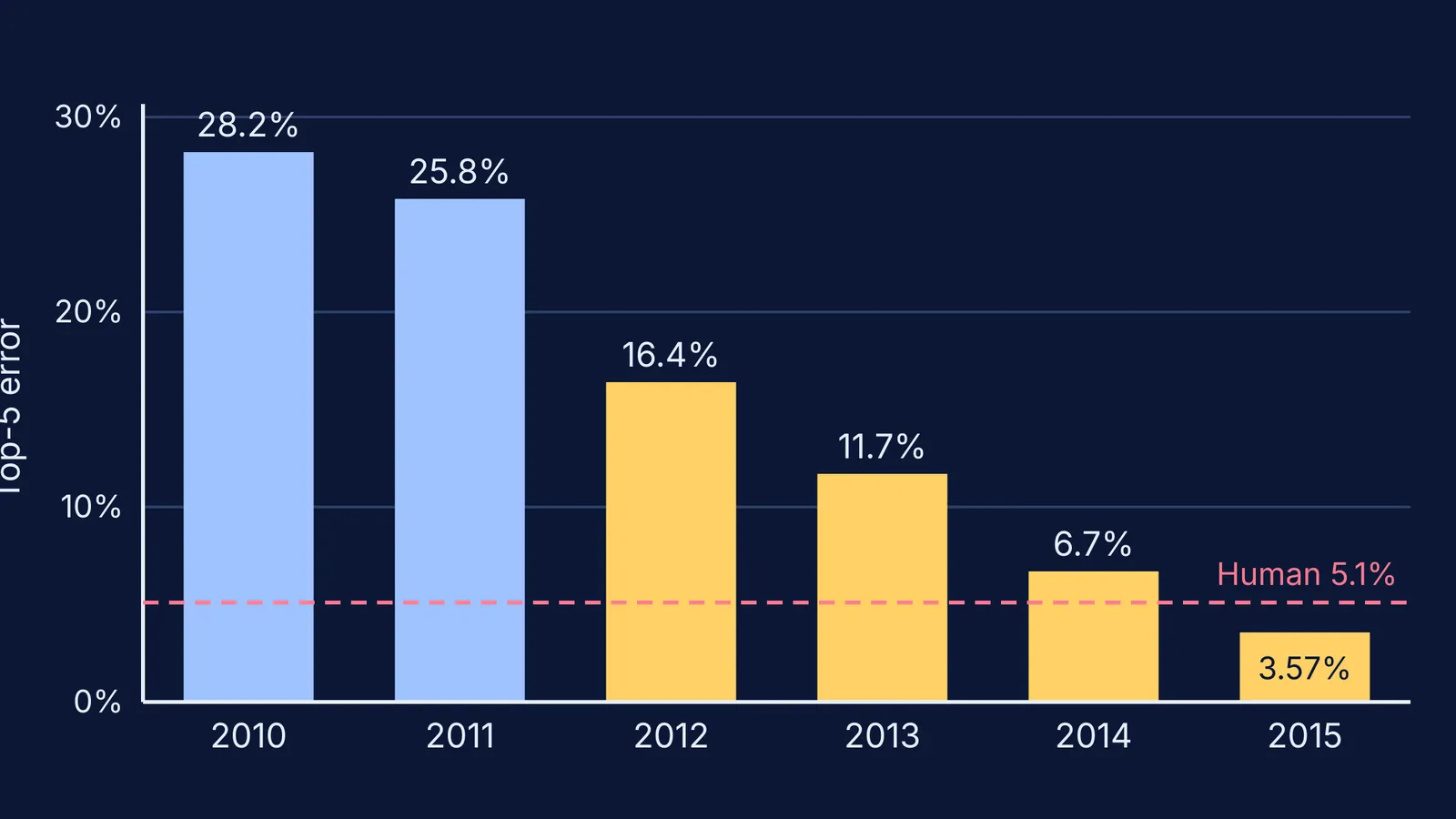
Here are the winning scores using the contest's own training data, from the challenge paper's results tables (Russakovsky et al., 2015, DOI):
2010: 28.2% error (NEC and partners)
2011: 25.8% (Xerox Research Centre Europe)
2012: 16.4% (SuperVision, University of Toronto)
2013: 11.7% (Clarifai)
2014: 6.7% (GoogLeNet, Google)
The 2012 jump is the one that changed the field. SuperVision, the team of Alex Krizhevsky, Ilya Sutskever and Geoffrey Hinton, used a deep convolutional neural network with 60 million parameters trained on graphics cards. A variant trained with extra data from a larger ImageNet release scored 15.3% against 26.2% for the second-best entry (Krizhevsky et al., DOI). The challenge paper notes that by 2014, all of the top contestants relied heavily on convolutional neural networks.
In 2015, residual networks built by Kaiming He and colleagues reached 3.57% error on the ImageNet test set and won the classification task (He et al., 2015). For comparison, a trained human annotator in the challenge paper scored 5.1% on a sample of 1,500 test images, though that was a smaller sample than the full test set.
How did ImageNet change artificial intelligence?
Before 2012, winning entries relied on hand-designed image features fed into separate classifiers. After it, the challenge paper says, networks could learn directly from the image data, with no need for hand-tuned pipelines. Li's Stanford profile describes ImageNet as "widely regarded as one of the three driving forces of the birth of modern AI and deep learning revolution" (Stanford profile). Li is now the Sequoia Capital Professor at Stanford and founding co-director of its Human-Centered AI Institute. She studied physics at Princeton and earned her PhD at Caltech in 2005.
The story continues a line of ideas you may already know: Alan Turing asking whether machines can think and John McCarthy naming artificial intelligence.
How can you see the ImageNet idea for yourself?
You do not need a GPU. Try this with a friend in 20 minutes.
Your friend picks 10 photos from their phone: food, animals, objects.
They write the correct label for each one on paper you cannot see.
They show you each photo once, and you write five guesses for it.
Count the photos where the correct label is missing from your five. That count out of 10 is your top-5 error.
Now swap in 10 photos of dog breeds or plant leaves and repeat.
Worked example: if you miss 1 of 10 everyday photos, your top-5 error is 10%. If you then miss 4 of 10 dog breeds, it jumps to 40%. The challenge paper found the same pattern: the human annotators struggled most with fine-grained classes like dog breeds, while the computer struggled with small or thin objects.
You have just learned what a benchmark is, why labels matter, and why one number can hide very different mistakes. If computing is your subject, read our guide to CBSE's Artificial Intelligence subject. To fill gaps in the maths behind neural networks, such as matrices and probability, the Fermi Concept Library covers every concept in mathematics and computing, each with its own lesson.