On this page
Today a gas chromatograph can sort petrol into its individual hydrocarbons or pick out a drug from a seized powder. The idea behind it was worked out in 1944 by Erika Cremer, a physical chemist in Innsbruck, Austria, at the end of the Second World War. Her paper was lost to bombing, her first apparatus was built in a school laboratory, and for years her work was little known outside Germany and Austria.
How did Erika Cremer invent gas chromatography?
Cremer joined the University of Innsbruck in 1940 as a lecturer in physical chemistry, according to the University of Innsbruck's profile of her. She was studying catalytic hydrogenation and needed a reliable way to measure how much acetylene and how much ethylene were in a mixture, as the chromatography historian Leslie Ettre describes in LCGC.
Chemists already separated dissolved substances by passing a liquid through a column of solid powder, a method that goes back to Mikhail Tsvet and his leaf pigments. Cremer's step was to ask what happens if a gas, not a liquid, does the carrying. She worked out an equation linking the difference in how strongly two substances are adsorbed to the distances they travel along the column in the same time, and in November 1944 she sent a paper called "The Migration Speed of Zones in the Chromatographic Analysis" to the journal Naturwissenschaften (LCGC).
She returned the corrected proofs on 6 February 1945, but an air raid then destroyed the journal's printing office, so the paper did not appear (LCGC). It was finally printed in 1976, in Chromatographia, volume 9, pages 363 to 366.
How did the first gas chromatograph work?
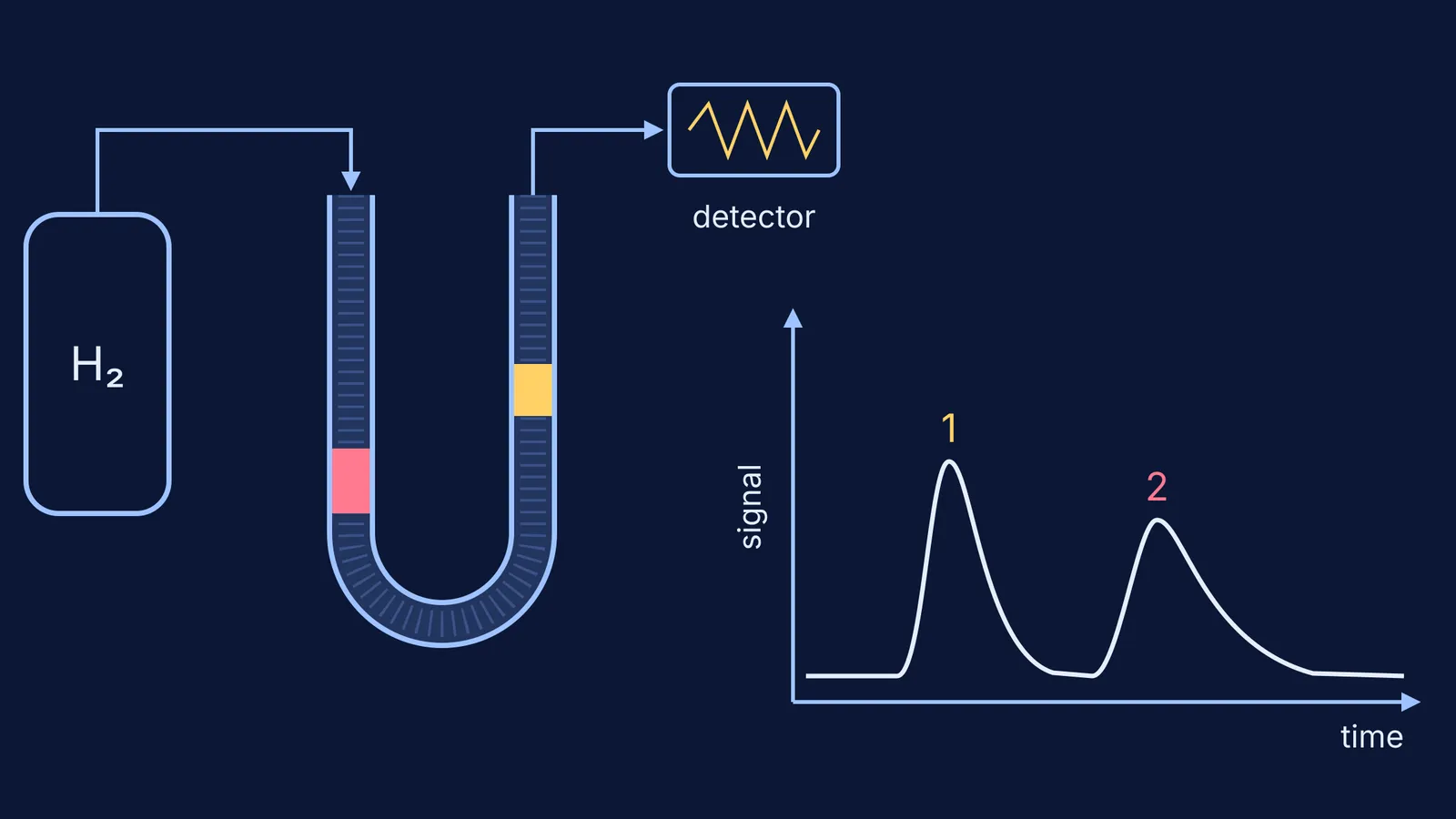
In November 1945 Fritz Prior came to Cremer as a doctoral student. He had just started teaching at a high school outside Innsbruck whose building was undamaged and had a physics laboratory, and he worked there (LCGC). His set-up, as Ettre describes it:
hydrogen from a Kipp generator as the carrier gas
a glass U-tube 1 cm wide, packed for about 20 cm with silica gel or activated carbon
a homemade thermal-conductivity cell, read with an old galvanometer
The peaks were broad and lopsided, but they showed the method worked, and Prior finished his thesis in May 1947 (LCGC). The 1951 paper by Cremer and Prior reports separating carbon dioxide from acetylene, acetylene from vinyl chloride, and ethylene from acetylene (Zeitschrift für Elektrochemie, 1951). From how long each gas was held back, they calculated the difference in adsorption energy between the two gases in each pair: 0.39, 0.65 and 0.67 kcal per mole, accurate to 0.02 kcal per mole (same paper).
Why was Cremer's work overlooked?
Her results came out in German and were little known outside Germany and Austria, especially among analytical and petroleum chemists (LCGC). During the war, and for a few years after, British journals were not available in Germany and Austria, so her group did not know that Martin and Synge had suggested a gas mobile phase in 1941. The field took off instead with A. T. James and A. J. P. Martin's gas-liquid work, published between 1950 and 1952 (LCGC).
Recognition came later. Cremer received the Wilhelm Exner Medal in 1957, and the medal foundation's biography of her notes that she suffered in the scientific community because she was a woman. She was elected to the Austrian Academy of Sciences in 1964 (University of Innsbruck).
Where is gas chromatography used today?
Compare Prior's 20 cm tube with today's petrol testing. The standard method ASTM D6730 uses a 100-metre capillary column to measure the individual hydrocarbons in spark-ignition engine fuels with boiling ranges up to 225 °C. In forensic labs, gas chromatography paired with mass spectrometry (GC-MS) is used to identify drugs in seized material (Royal Society of Chemistry, 2023).
How do you read a gas chromatogram?
Say you have a mixture of ethylene and acetylene, the pair Cremer wanted to measure. The numbers below are made up to show the method.
Run a pure ethylene sample. Its peak arrives at 2.0 minutes. That time to the detector is its retention time.
Run pure acetylene under exactly the same conditions. Its peak arrives at 3.5 minutes, so it sticks to the column more strongly.
Run your mixture. Peaks at 2.0 and 3.5 minutes tell you both gases are there.
Compare the areas under the peaks, after calibrating with known amounts, to find how much of each is present.
Notice the difference from paper chromatography. There you compare distances and work out an Rf value. In a gas chromatograph everything travels the whole column, so you compare times instead.
If the idea of adsorption is still fuzzy, the Fermi Concept Library has a lesson on every concept in chemistry, each placed in a map of related ideas. And if zones moving at different speeds are hard to picture, the Fermi Simulation Lab has interactive simulations for ideas that are easier to see than to read.
Every fuel test or forensic drug result in the news traces back, in part, to a lost paper and a small glass tube in a school lab near Innsbruck.