

On this page
In the late 19th century, diphtheria was a major cause of childhood mortality. While researchers had successfully identified the bacteria responsible for the disease, the mechanism of how it caused such severe and widespread illness remained a frustrating mystery until two researchers at the Pasteur Institute in Paris changed the course of microbiology.
What caused the systemic damage in diphtheria?
By 1884, the scientists Edwin Klebs and Friedrich Loeffler had isolated the bacterium *Corynebacterium diphtheriae* from the throats of infected patients. However, their important discovery presented a new and complex puzzle: the bacteria always remained localized in the patient's throat, yet the disease caused severe systemic damage to the heart, kidneys and nervous system.
Researchers could not explain how a strictly localized infection produced such widespread, fatal effects across the body. The prevailing medical idea was that the bacteria themselves might be spreading through the bloodstream undetected, but no one could find the microbes in the damaged organs during autopsies.
How did Roux and Yersin find the diphtheria toxin?
In December 1888, Émile Roux and Alexandre Yersin published a landmark paper that solved the mystery 1. Working at the newly established Pasteur Institute, they hypothesized that the bacteria were releasing a soluble chemical poison into the bloodstream.
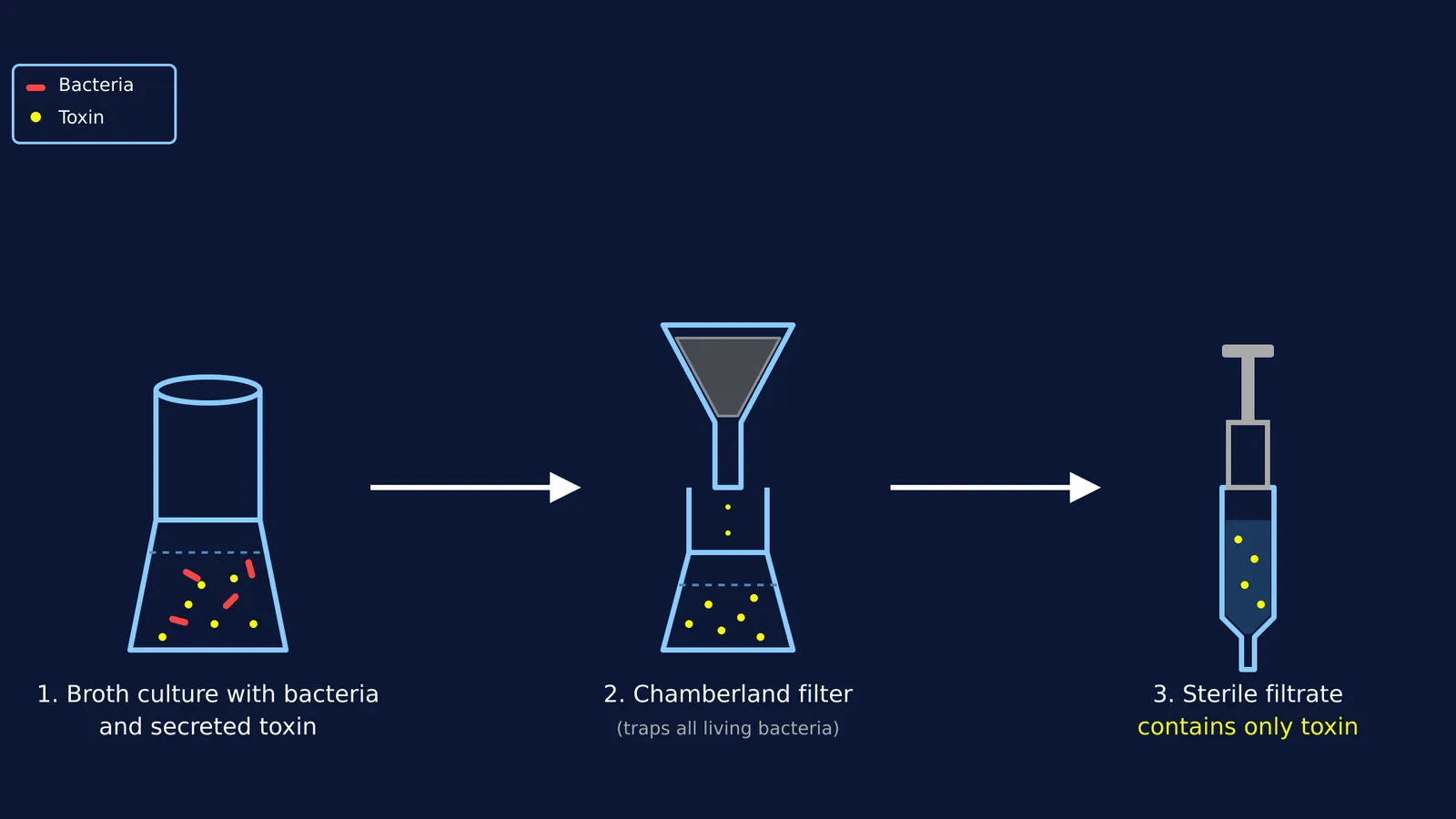
To test this hypothesis, they set up a rigorous and innovative experiment. They cultured the diphtheria bacilli in a liquid broth and allowed the bacteria to grow for several days. Then, they passed the broth through a Chamberland filter—a specialized unglazed porcelain filter designed by Charles Chamberland to trap all living bacterial cells while allowing liquids to pass through.
They injected this completely sterile, bacteria-free filtrate into laboratory animals. The animals quickly developed the exact clinical symptoms of diphtheria, including tissue damage and paralysis, and eventually died.
Because the injected liquid contained absolutely no living bacteria, Roux and Yersin proved that the disease was caused by a potent chemical substance secreted by the microbes. This was the first bacterial exotoxin ever identified.
Why was the discovery of the diphtheria toxin important?
This breakthrough fundamentally shifted the focus of microbiology and medicine. Instead of simply trying to find ways to kill the bacteria, scientists realized they needed to neutralize the circulating toxin.
This conceptual shift paved the way for Emil von Behring and Shibasaburo Kitasato to discover antitoxins in 1890. By 1894, Roux successfully applied this knowledge to human medicine, developing an effective anti-diphtheritic serum from immunized horses. When he tested this serum at a children's hospital in Paris, it reduced the mortality rate of the disease.
Roux's work laid the critical foundation for modern immunology and serum therapy. For students studying these historical milestones, seeing how discoveries connect is crucial. Just as you might read about Aziz Sancar and how cells repair damaged DNA or the classification of viruses, viroids and lichens: the misfits of five-kingdom biology, understanding the mechanism of toxemia is a core part of biology.
If you are reviewing these mechanisms, the Fermi Concept Library contains every concept in physics, chemistry, biology, mathematics and computing, each with its own lesson and its place in the map.
How should you study bacterial diseases for exams?
When preparing for biology exams, memorising a long list of diseases and their effects is often overwhelming. Instead of reading passively, use a structured framework to break down each disease into its logical parts.
Create a four-column study table for every infectious disease you review:
Pathogen: The exact scientific name of the causative agent, such as *Corynebacterium diphtheriae*.
Transmission: How the pathogen enters the body, such as through droplet infection.
Mechanism: What the pathogen does once inside, such as secreting an exotoxin that inhibits cellular protein synthesis.
Symptoms and Treatment: The specific clinical signs and the medical response, such as administering an antitoxin serum.
By categorising the information in this way, you move away from rote memorisation and toward a genuine understanding of the disease's lifecycle.
If you find yourself stuck on the difference between exotoxins and endotoxins, Fermi's AI tutor can help. It works out what you already know, builds a plan for the session, and teaches through it—writing on a board, drawing the figure, and checking understanding as it goes.
Applying this framework to historical examples like Roux and Yersin's experiment makes the abstract biology real and significantly easier to recall on exam day.


