

On this page
In 1975 the British biologist Edwin Southern published a way to pick out one stretch of DNA from millions of look-alike fragments. His paper, "Detection of specific sequences among DNA fragments separated by gel electrophoresis", appeared in the Journal of Molecular Biology80083-0), volume 98, pages 503-517. The key step was surprisingly humble: he soaked the DNA out of a gel and onto a membrane using a pile of dry paper. A decade later, the same blot gave us the first DNA fingerprints.
What problem was Edwin Southern trying to solve?
In the mid-1970s Southern was working at the Medical Research Council Mammalian Genome Unit in Edinburgh, according to the Lasker Foundation's account of his award. He wanted to find particular genes in the frog *Xenopus laevis*, whose genome has more than a billion base pairs.
Cut that much DNA and run it through a gel, and you get a smear of millions of fragments.
Southern's answer was to move the fragments onto a sheet of nitrocellulose, which clings to DNA, so that a radioactive probe could find the right one. When he accepted his Lasker Award in 2005, he summed it up himself: "My big contribution to science was the discovery that blotting paper could be used to soak liquid out of jelly" (Lasker Foundation).
How does a Southern blot work, step by step?
The stages below follow the NCERT Class 12 Biology chapter Molecular Basis of Inheritance; the transfer details come from the Lasker account and the Southern blot overview on Wikipedia.
A Southern blot is a method that moves size-separated DNA fragments from a gel onto a membrane so that a labelled probe can detect one specific sequence among them.
Isolate the DNA and cut it with restriction enzymes (the story of Hamilton Smith and restriction enzymes explains these molecular scissors).
Separate the fragments by size with gel electrophoresis.
Soak the gel in an alkaline solution to separate the two strands.
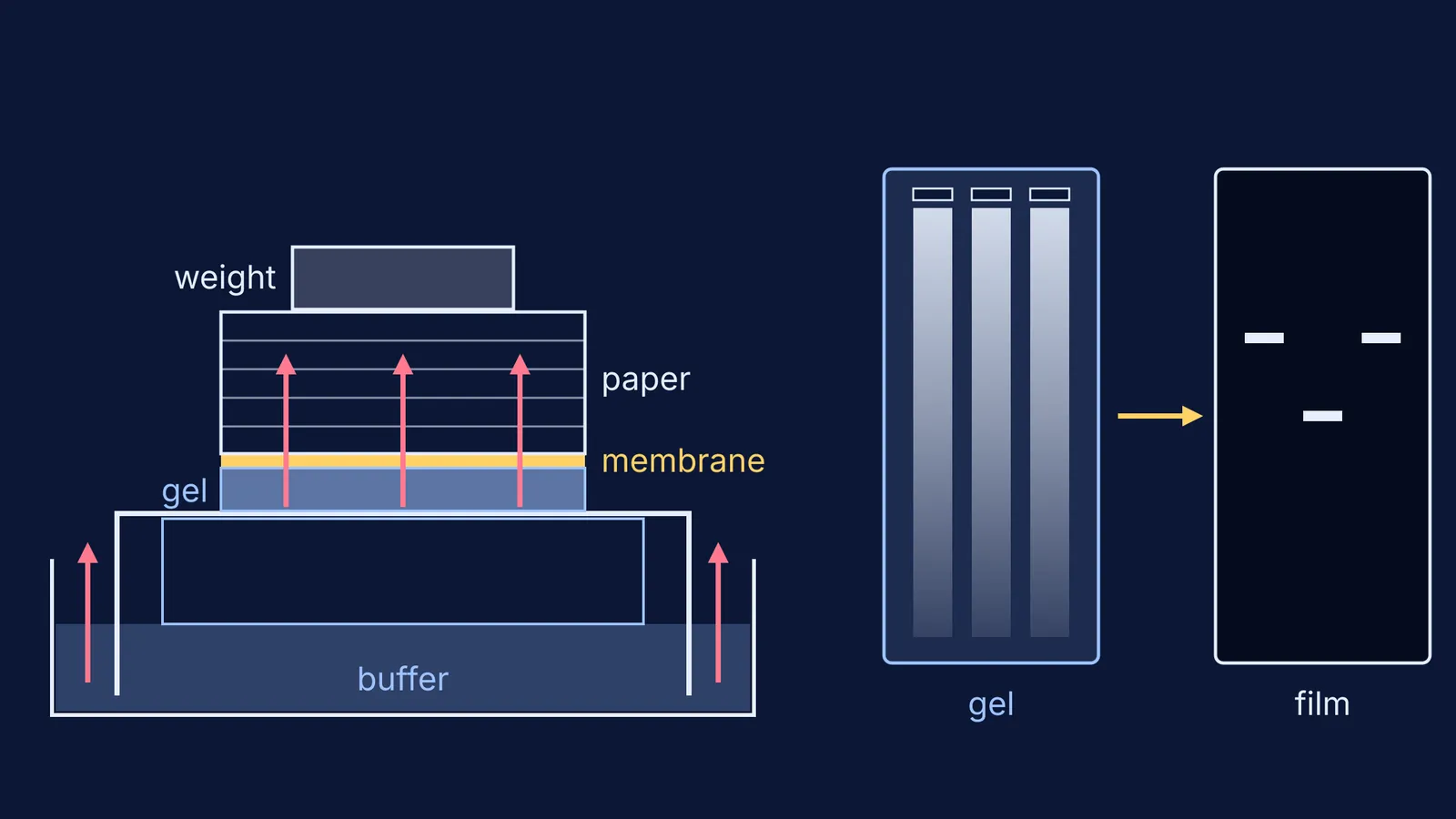
Blot: lay the membrane on the gel and pile dry paper on top. Buffer is drawn up through the gel by capillary action and carries the DNA onto the membrane in the same pattern.
Hybridise: add a labelled, single-stranded probe. It sticks only where it meets its complementary sequence.
Wash off the spare probe and expose the membrane to X-ray film. Only the bands that caught the probe show up.
A transfer method for RNA followed in PNAS in 1977, and later blots were named after compass directions as a pun on Southern's name.
How did the Southern blot lead to DNA fingerprinting?
Alec Jeffreys took up Southern's technique in 1977 to study the evolution of gene families, the Lasker Foundation records. He found short repeated sequences, called minisatellites, whose length varied from person to person, and by 1984 he had a probe that picked up many of them at once. He published the work in Nature in 1985 as "Hypervariable 'minisatellite' regions in human DNA", with Victoria Wilson and Swee Lay Thein.
In 1985 a DNA fingerprint settled an immigration dispute about a boy returning from Ghana to his family in the UK. In 1986 Jeffreys applied a related method, DNA profiling, to two rape-murders in Leicestershire, where police ran the first DNA-based manhunt (Lasker Foundation). Southern and Jeffreys shared the 2005 Lasker Award for Clinical Medical Research. More in our post on Alec Jeffreys and the first genetic fingerprint.
NCERT says the original technique used Southern blot hybridisation with a radiolabelled probe for VNTRs (variable number of tandem repeats), which range in size from 0.1 to 20 kb. The banding pattern differs between individuals except identical twins, and PCR has since made the method sensitive enough to work on DNA from a single cell.
How do you read a DNA fingerprint on a blot?
Suppose a probe lights up three bands in a crime-scene lane, at 2, 5 and 9 kb. This is a made-up example in the style of NCERT's Figure 5.16.
Line every lane up against the size ladder.
Suspect A shows bands at 2, 6 and 9 kb. The 5 kb band is missing, so A is excluded. Here, one clear mismatch is enough.
Suspect B shows bands at 2, 5 and 9 kb. Every band matches, so B cannot be ruled out. That is a match, not proof by itself; NCERT notes that many different probes are now used.
Before writing a long answer, check that you have:
named the membrane (nitrocellulose or nylon)
said why the DNA is denatured: a probe pairs only with single strands
said the probe is labelled and detected by autoradiography
given the identical-twins exception
If you can recite the six steps but cannot picture why the buffer moves upward, ask Fermi's AI tutor to draw the stack: it draws the figure and checks your understanding as it goes. For gaps in the basics, such as hybridisation or restriction enzymes, the Fermi Concept Library gives each biology concept its own lesson and its place in the map.
Next time you see a DNA fingerprint on the news, look for the blotting paper behind it.


