

On this page
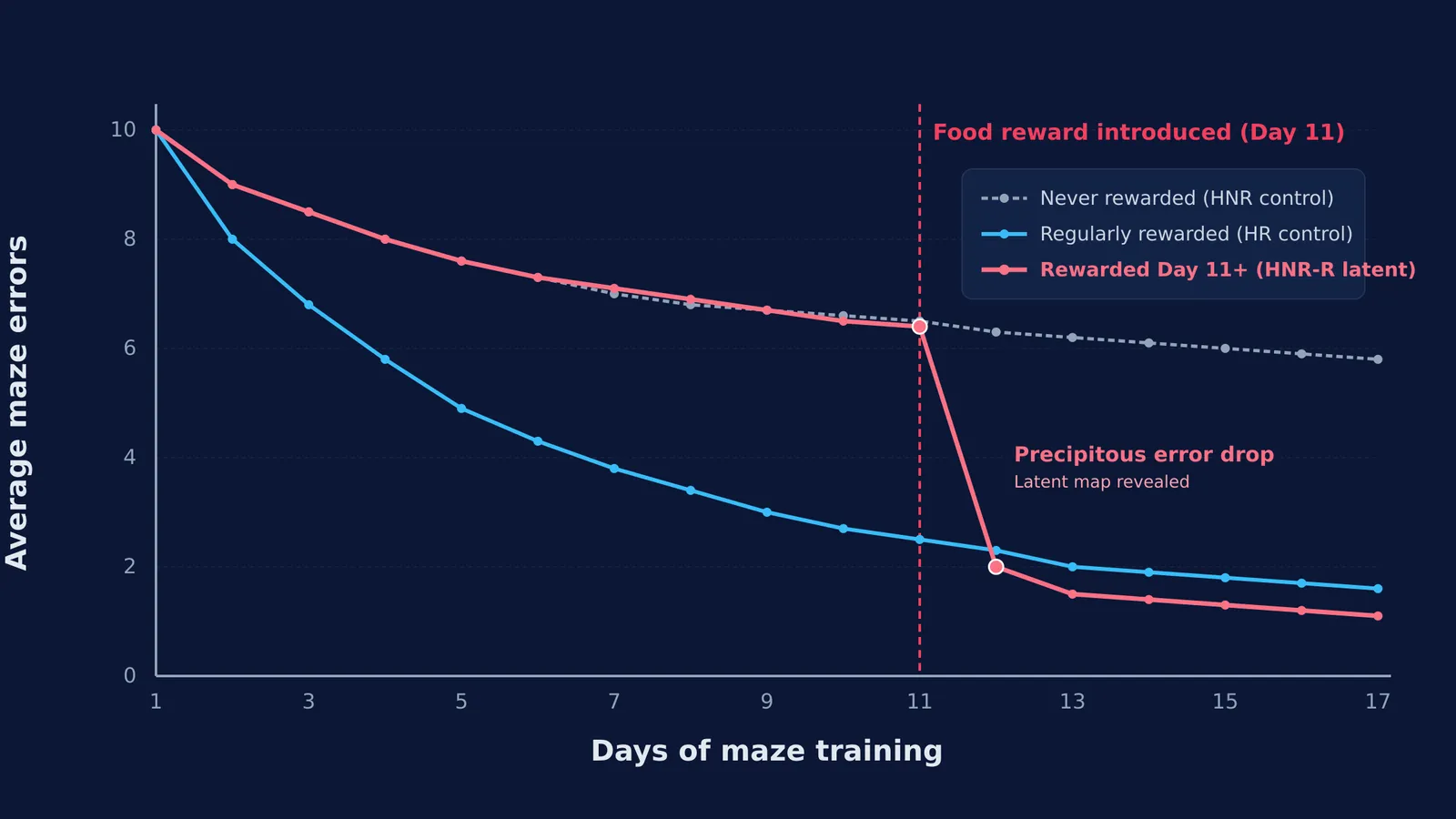
In 1930, psychologists Edward Tolman and Charles Honzik tested three groups of hungry rats in a 14-unit T-maze. The prevailing behaviourist view held that learning requires immediate reinforcement, such as food, to stamp in stimulus-response reflexes. The first group received food at the maze exit daily, steadily reducing errors across 17 days of trials. The second group never received food; their errors remained high, entering blind alleys roughly 6 to 7 times per run by the end of the test.
The third group produced a breakthrough. For 10 days, these rats explored the maze without reward, making as many errors as the unrewarded control group. On the 11th day, food was placed in the goal box. On the 12th day, their error rate plummeted from roughly 7 errors down to 2, instantly matching the rats rewarded from day one. Tolman named this latent learning in his 1948 paper: the rats had learned the maze layout silently, demonstrating their internal map only when motivated by food.
Why did the sunburst maze prove rats build cognitive maps?
To test whether rats merely memorised muscle movements, such as a sequence of left and right turns, Tolman, B. F. Ritchie, and Donald Kalish created the sunburst maze in their 1946 spatial study. They first trained rats on an elevated pathway to run through a winding alley to reach food.
Next, the researchers blocked the familiar path and opened 12 radiating corridors pointing outward like wheel spokes. If the rats relied on motor memory, they would pick paths adjacent to the original route. Instead, 36% of the rats chose Path 6, which pointed directly across the room toward where the food had been. They possessed an internal spatial map of the room. Decades later, neuroscientists discovered the physical basis for this map when John O'Keefe identified place cells90358-1) and researchers discovered grid cells, recognized by the 2014 Nobel Prize in Physiology or Medicine. You can see how May-Britt and Edvard Moser mapped space to explore these internal positioning networks.
What is the difference between strip maps and comprehensive maps?
In his 1948 paper, Tolman argued that the brain acts like a map control room rather than a telephone switchboard. A switchboard model views learning as rigid point-to-point wiring between stimuli and actions. In contrast, a map room builds an internal model of the environment. Tolman identified two kinds of mental representations:
Narrow strip-maps: A rigid path connecting start to goal. If that single route is blocked, the learner stalls.
Broad comprehensive maps: A relational layout connecting landmarks across a domain. If one path fails, the learner computes an alternate detour.
Tolman warned that severe stress, exhaustion, and rote drilling narrow our mental maps. For students preparing for exams like JEE or NEET, memorising a physics derivation as a fixed sequence creates a fragile strip-map. A minor twist in the problem causes a blank page. Effective problem-solving requires comprehensive conceptual maps, an approach supported by Sweller's cognitive load theory on structuring mental schemas.
How can students build broad cognitive maps instead of rote steps?
Building broad mental maps in science and mathematics requires moving from memorised procedures to relational understanding. Here is a four-step plan for complex syllabus topics:
Anchor core landmarks. Before calculating numbers, map the governing laws. Note how conservation of energy, Newton's third law, or equilibrium constraints frame the territory. Examining concept maps for science helps organize these relationships.
Force alternate routes. When solving a problem, test multiple methods. Can you solve a mechanics question with work-energy rather than kinematics? Exploring alternative paths establishes new connections in your mental layout.
Test for blocked paths. Vary problem constraints to see if your understanding adapts. What happens to an electric field if a conductor has a hollow cavity? Changing parameters reveals whether you hold a flexible map or a brittle script.
Survey the wider landscape. Connect specific formulas to foundational principles. The Fermi Concept Library arranges every concept in physics, chemistry, biology, mathematics and computing, each with its own lesson and its place in the map. When physical interactions are hard to picture, the Fermi Simulation Lab provides interactive simulations for the ideas that are easier to see than to read, building direct spatial intuition.
Start by selecting one challenging topic this week and sketching its governing principles as an interconnected map before solving individual practice problems.


