

On this page
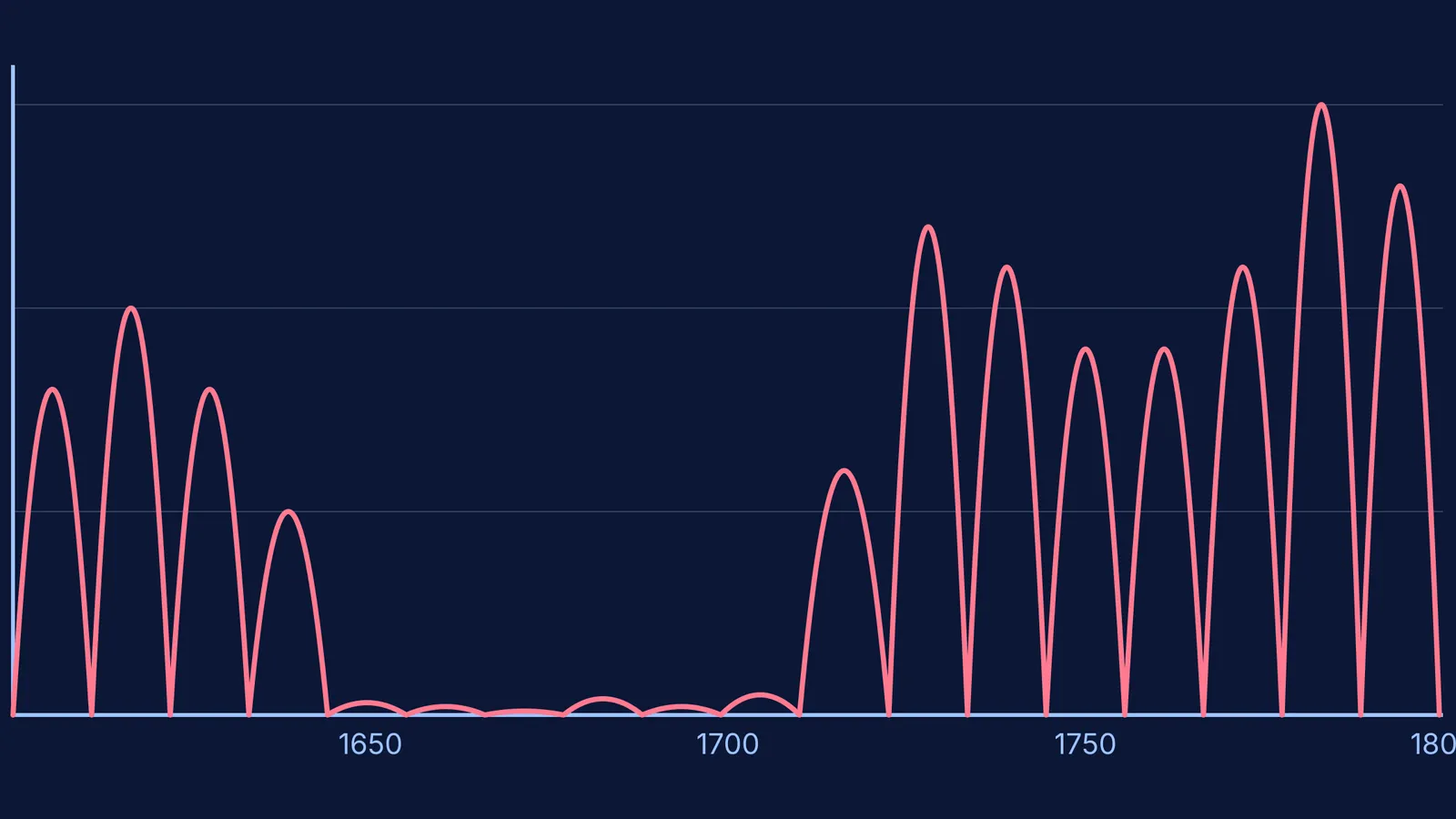
Between 1645 and 1715, the Sun went unusually quiet. While a typical 28-year stretch in modern times sees 40,000 to 50,000 sunspots, fewer than 50 were observed during the darkest part of this period, between 1672 and 1699 (Wikipedia). It took two centuries for English astronomer Edward Maunder to prove that this gap was a real physical event, not just lazy record-keeping by astronomers of the seventeenth century.
What is the Maunder minimum?
The Maunder minimum was a prolonged period of suppressed solar activity between 1645 and 1715 (Britannica). Sunspots—dark, cooler regions on the Sun's surface caused by intense magnetic fields—became exceedingly rare. Although the Sun normally follows a regular 11-year cycle of high and low activity, this rhythm nearly flatlined for seven decades, with any remaining sunspots heavily concentrated in the Sun's southern hemisphere until the final cycle of the period (Wikipedia).
To understand how these magnetic fields operate within the Sun, read about George Ellery Hale and the magnetic fields inside sunspots.
How did Edward Maunder find the missing sunspots?
Working at the Royal Observatory, Greenwich, Edward Walter Maunder and his wife Annie Russell Maunder spent decades photographing and measuring sunspots. In 1894, Edward built upon earlier work by Gustav Spörer to highlight the 17th-century sunspot drought (Britannica).
At the time, many scientists dismissed the gap, assuming early astronomers simply failed to count the spots or lacked the right equipment. Maunder argued that observers of the era, such as Giovanni Domenico Cassini and John Flamsteed, were highly skilled and would have recorded sunspots if they were there (Wikipedia). Furthermore, historical reports from solar eclipses during this time described a weak, unstructured solar corona, adding evidence to the quiet Sun theory.
For more on their observational work, discover Annie Maunder, sunspot photographs and the butterfly diagram.
Did the Maunder minimum cause the Little Ice Age?
The Maunder minimum coincided with the coldest stretch of the "Little Ice Age," a period from roughly 1300 to 1850 when temperatures across the Northern Hemisphere plummeted (Wikipedia). During extreme winters in the late 1600s, the Thames River in London froze so solidly that "frost fairs" were held on the ice.
While the timing is striking, modern science suggests the lack of sunspots was a contributing factor but not the sole cause. Low solar activity is known to shift the jet stream, causing localized cooling in Europe and North America while leaving other regions milder (Britannica). Recent research points to heavy, explosive volcanic activity, which began before the Maunder minimum, as the primary driver of the global cooling.
What do tree rings tell us about the Sun?
The phenomenon was finally confirmed and named the "Maunder Minimum" in 1976 by American astronomer John A. Eddy (Britannica). Eddy looked beyond historical drawings and analysed carbon-14 isotopes trapped in ancient tree rings to measure historical solar activity.
When solar activity is low, the Sun's magnetic field weakens, allowing more cosmic rays to hit Earth's atmosphere and create carbon-14 (Wikipedia). The tree rings from 1645 to 1715 showed a massive spike in carbon-14, proving physically that the Sun really did go quiet. Scientists also found matching evidence using beryllium-10 isotopes trapped in polar ice sheets, confirming that these prolonged lulls in solar activity happen more than once in history.
How can you learn from missing pieces?
Missing information in physics problems can leave students stuck and unable to start. Instead of staring at a blank page, you can use a structured approach:
List what is known and what is explicitly missing from the problem statement.
Identify the exact gap in your equations and see what variables you need to find.
Test hypotheses for why the data is absent—is it implied by a physical constraint (like a system starting at rest)?
If you struggle to find the next step, Fermi's AI tutor works out what you already know and builds a plan for the session. When you are stuck on a specific concept, it holds a line of reasoning across a whole session, notices where you are stuck, and decides whether to explain, ask, or show.
To see how magnetic fields behave around stars and planets, you can explore the Fermi Simulation Lab. For step-by-step guidance on solar physics numericals, try the Fermi Problem Library.


