

On this page
Eduard Adolf Strasburger (1844–1912) was a Polish-German botanist who helped lay the foundations of modern cytology. By turning his microscope on the cells of plants, he unravelled how they grow and divide, establishing terms that remain in biology textbooks today.
Who was Eduard Strasburger?
Strasburger was one of the most prominent botanists of the 19th century. He was appointed a professor of botany at the University of Jena in 1869, and later became head of the Botanisches Institut at the University of Bonn. His widely translated *Textbook of Botany*, first published in 1894, remained a standard reference for university students for over a century.
At the time he began his career, biologists were just beginning to understand the inner structure of cells. The idea that all living things are made of cells was accepted, but exactly how a cell multiplied to form two new cells was still a mystery. Strasburger focused his attention on the division of plant cells, a process he could observe directly. He also made significant contributions to plant physiology, such as proving that the upward movement of tree sap is a physical process driven by tension and evaporation, rather than a physiological pumping action.
How did he discover plant mitosis?
In his 1876 book, *On Cell Formation and Cell Division*, Strasburger provided the first accurate description of mitosis in plants (Wikipedia). He watched the nucleus of a parent cell break down and its contents separate into two halves, which then became the nuclei of the two new daughter cells.
His observations led him to a fundamental law of cytology. Expanding on the rule that all cells come from existing cells, Strasburger stated that "New cell nuclei can only arise from the division of other nuclei" (Wikipedia).
Along with other researchers like Sergei Nawaschin, Strasburger showed how genetic material is distributed equally when a cell divides. He also later demonstrated the process of double fertilisation in flowering plants, where one sperm cell fertilises the egg and another fuses with a second nucleus to form the endosperm. This work set the stage for our modern understanding of chromosomes and inheritance. (Decades earlier, Friedrich Miescher and the discovery of nuclein, or DNA had begun to reveal the chemical nature of the nucleus itself).
Why did he define the term cytoplasm?
As scientists learned more about the inside of the cell, they needed new words to describe what they saw. The living substance inside a cell was generally called "protoplasm".
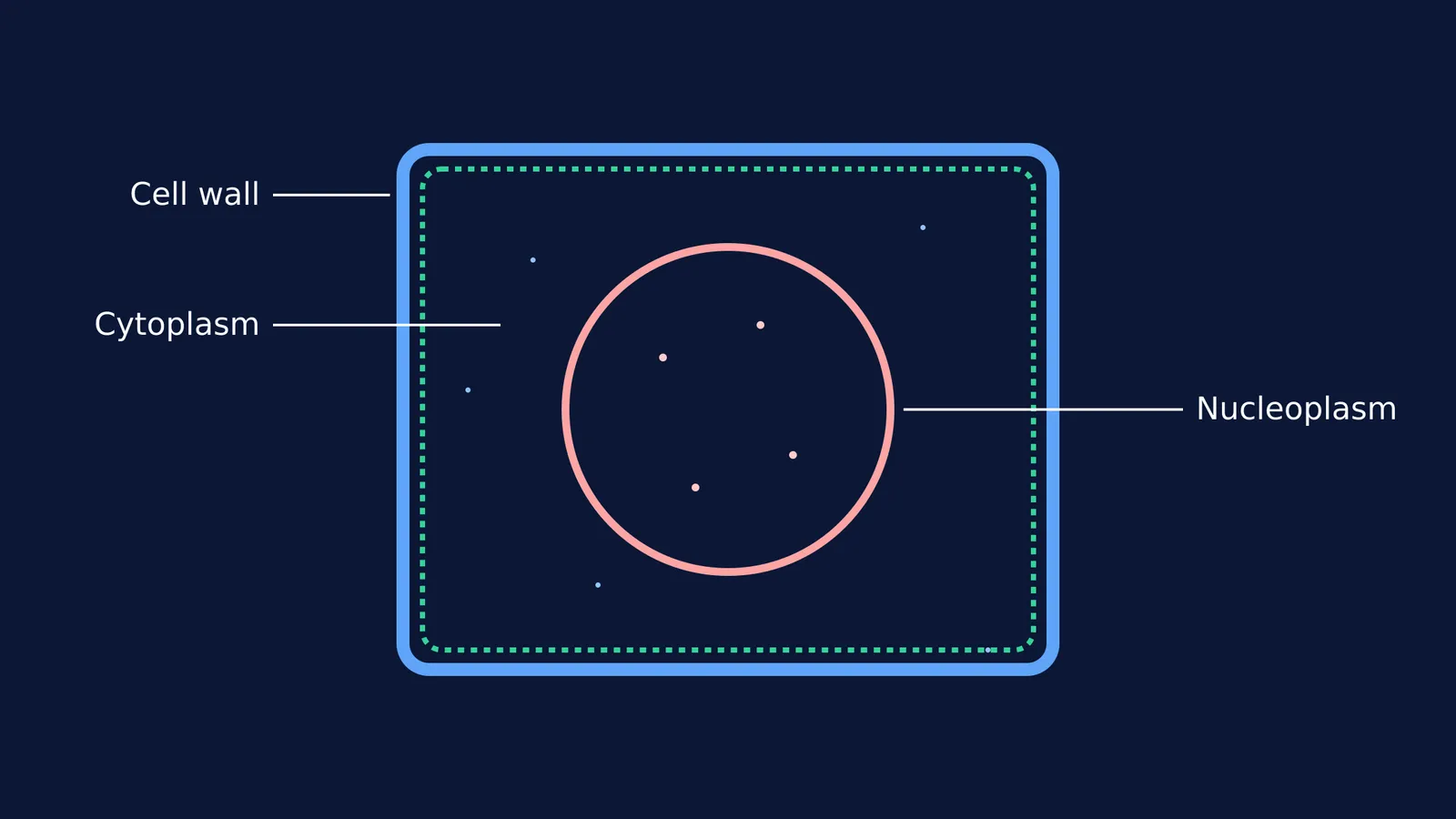
In 1882, Strasburger introduced two new terms to make a crucial distinction (Britannica):
Cytoplasm: The living substance of the main cell body, excluding the nucleus.
Nucleoplasm: The substance contained inside the nucleus.
These terms helped biologists separate the fluid where chemical reactions happen from the compartment that holds the genetic material. Later researchers, including George Palade and the ribosomes in the cell's protein factory, would go on to map the complex structures that fill the cytoplasm.
How do plant and animal mitosis compare?
When studying cell division, you will often need to compare how it works in plants versus animals. Use this quick checklist to review the key differences:
Centrioles: Animal cells use centrioles to organize the spindle fibres. Plant cells do not have centrioles but still form a spindle.
Cytokinesis: Animal cells divide by pinching inward (forming a cleavage furrow). Plant cells, because of their rigid cell walls, build a cell plate down the middle.
Shape: Animal cells become rounded before division. Plant cells keep their rigid shape throughout the process.
How can you study cell division with Fermi?
If you are learning about mitosis or meiosis for your biology exams, keeping the stages straight can be difficult.
The Fermi Simulation Lab provides interactive models of cell division so you can watch the chromosomes condense, align, and separate step by step. If you get stuck on a detail—such as how plant cells build a new cell wall compared to animal cells—Fermi's AI tutor can work out what you already know and explain the difference. You can also review the definitions of cytoplasm and nucleoplasm in the Fermi Concept Library.


