

On this page
Before the Konkan Railway, a train from Mumbai to Mangaluru went the long way round, inland. The coast in between is cut by rivers, steep valleys and the Sahyadri hills. Building a railway through it in a few years looked close to impossible. The engineer put in charge was E. Sreedharan. Here is how the project was organised, the numbers behind it, a worked physics example on its gradient, and what a student can learn from how his team worked.
How did the Konkan Railway project begin?
The Konkan Railway Corporation's history page says surveys for a west coast line began in the early 1970s, and in 1984 the Ministry of Railways authorised a detailed survey linking Roha with Mangalore. Money was the problem. The solution was a corporation in which the Centre and the beneficiary states would share the project and raise funds.
Sreedharan was then Member, Engineering, of the Railway Board. He was due to retire on 30 June 1990 and was chosen to head the new body. Konkan Railway Corporation Limited was incorporated on 19 July 1990, with Maharashtra, Goa, Karnataka and Kerala as partners and Sreedharan as Chairman and Managing Director. The foundation stone was laid at Roha on 15 September 1990.
The same page sets out the challenge: where 100 km over easy territory had taken 20 years, the corporation was first given five years for about 760 km of line, and then six months less.
How did his team organise the work?
The history page describes choices that are worth studying as much as the engineering:
The route was split into seven sectors of about 100 km each, every one under a Chief Engineer with real powers, to cut delays.
The field work was done largely by some 400 young engineers recruited straight from college.
At the peak of construction there were no more than 2,400 staff in the whole organisation.
Computer networks linked offices along the route so that decisions did not wait.
The page on the alignment adds that survey teams travelled on motorcycles, a first for the railways, and that Sreedharan and other senior engineers walked the entire route with their chief engineers. In Goa, where land was most crowded, engineers visited homes to look for ways to save them, and only 35 houses were disturbed.
What made the terrain so hard?
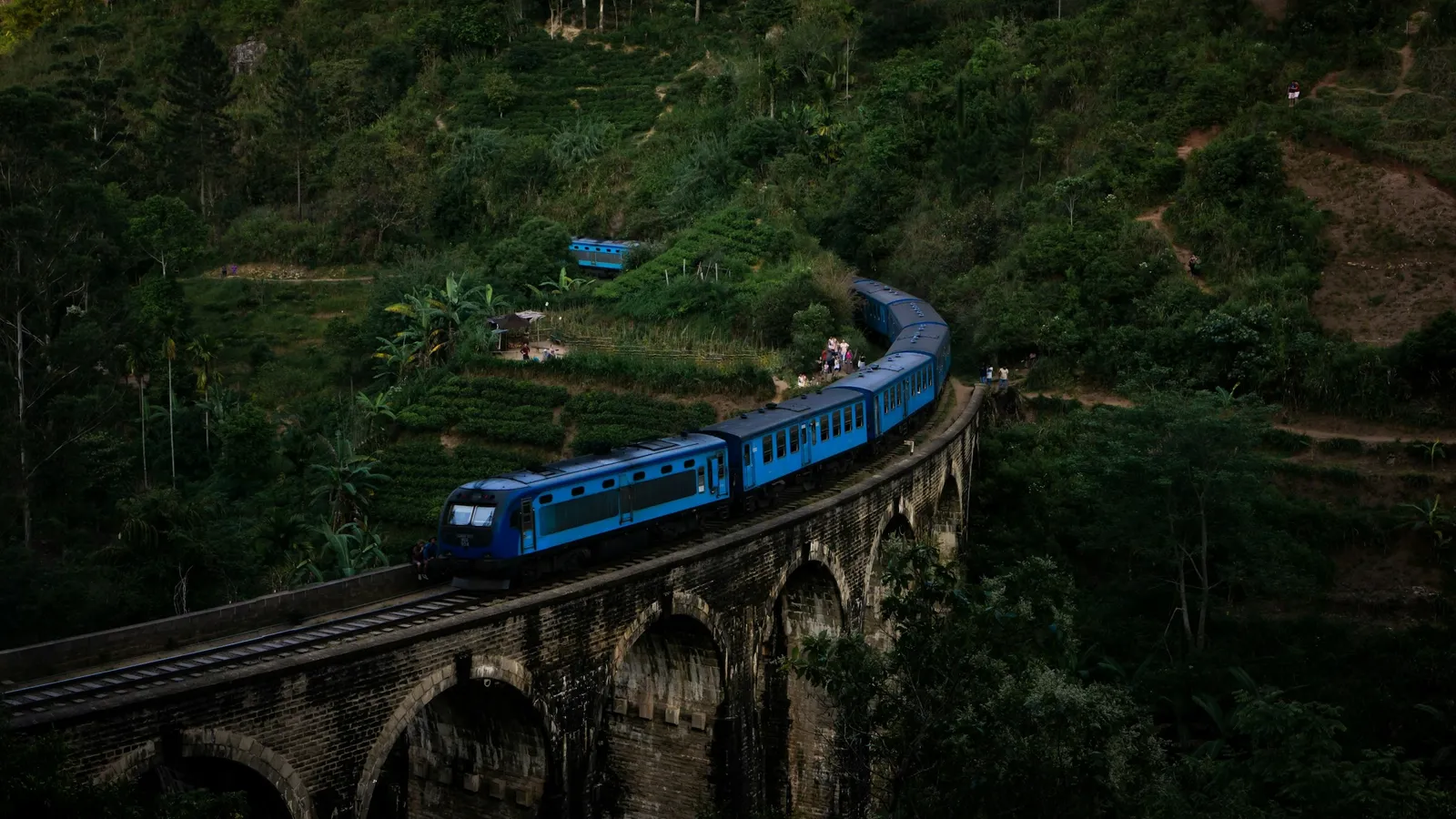
The corporation's page on construction challenges quotes a July 1997 report for the Swedish development agency SIDA by Karlis Goppers: with "2,000 bridges and 92 tunnels to be built through this mountainous terrain", the project was "the biggest and perhaps most difficult railway undertaking during the century, at least in this part of the world". The page also records an entire mountainside collapsing at Ukshi in July 1997 and tunnel collapses at Pernem the same year.
Its technical data page gives the finished line's numbers: 91 tunnels with a total length of 84.5 km, the longest being the 6.5 km Karbude tunnel near Ratnagiri; the longest bridge, 2,065.8 m across the Sharavati at Honnavar; a 64 m high viaduct over the Panval Nadi; and cuttings up to 50 m deep. The corporation's introduction page says the first train on the completed track was flagged off on 26 January 1998.
Worked example: what does a 1 in 150 gradient mean?
The technical data page lists the ruling gradient, the steepest normally allowed, as 1 in 150, or 0.67%. That means a rise of 1 m for every 150 m travelled along the track.
Take a sample train of mass 1,000 tonnes (a made-up round number) and g = 9.8 m/s².
Angle. sin θ = 1/150 ≈ 0.00667, so θ ≈ 0.38°. For angles this small, sin θ and tan θ are almost equal.
Extra force needed. The component of weight along the slope is mg sin θ = (1,000,000 kg × 9.8) / 150 ≈ 65,300 N, about 65 kN, on top of rolling resistance.
Extra power at 20 m/s (72 km/h). P = Fv ≈ 65,300 × 20 ≈ 1.3 × 10⁶ W, about 1.3 MW.
Compare a 1 in 100 slope. mg/100 = 98,000 N. That is 50% more force for the same train.
This is why the engineers accepted so many tunnels and viaducts. A flatter line lets heavier trains run with less power.
How much distance did the line save?
The same page lists the savings. Mumbai to Mangaluru fell from 2,041 km to 914 km, a saving of 2,041 − 914 = 1,127 km, which is 1,127 / 2,041 ≈ 55% of the old distance. The travel time it gives fell from 41 hours to 15 hours. The project cost is listed as Rs 3,555 crore.
What mistakes do students make with slope problems?
Using cos θ for the slope force. The force along the incline is mg sin θ; mg cos θ is the part pressing into the track.
Reading "1 in 150" as 150%. It is 1/150, about 0.67%.
Forgetting tonnes to kilograms. 1 tonne = 1,000 kg.
If inclined-plane set-ups still trip you up, the Fermi Problem Library has worked problems with a step-by-step solver that explains the reasoning rather than printing an answer.
How was Sreedharan honoured?
The Government of India's Padma lists show him receiving the Padma Shri in 2001, under civil service, and the Padma Vibhushan in 2008, under science and engineering. For another engineer who shaped Indian infrastructure, read about M. Visvesvaraya.
What can a student take from how he worked?
Organisation is engineering too. Small sectors with clear authority mattered as much as the machines.
See the ground yourself. Walking the route meant decisions were based on what was there, not only on maps.
Trust young people with responsibility. Hundreds of fresh graduates did the field work.
Respect the people affected. Saving homes in Goa added curves, and the team accepted that cost.
Next step: redo step 2 of the worked example for a 1 in 200 gradient and work out how much force is saved.


