On this page
In December 1938, Dennis Hoagland, professor of plant nutrition at the University of California, and Daniel Arnon, then a junior plant physiologist, published The Water-Culture Method for Growing Plants Without Soil as Circular 347. Growing crops in water was being hyped in newspapers, and the foreword says thousands of inquiries had reached the university.
Who was Dennis Hoagland?
According to the National Academy of Sciences biographical memoir by Walter P. Kelley, Hoagland was born in Golden, Colorado, on 2 April 1884 and died in Oakland, California, on 5 September 1949. He studied chemistry at Stanford and returned to Berkeley as an assistant professor in 1913.
During the First World War he studied giant kelp as a source of potassium, and wondered how the seaweed took up so much potassium from seawater. Using the large-celled alga Nitella, he showed that uptake is a metabolic process that depends on oxygen and the energy of respiration, not simple osmosis: the sap inside some plant cells can hold an ion at many times its concentration outside (same memoir). It follows on from Wilhelm Pfeffer's measurement of osmotic pressure: living roots do work.
Kelley adds that Hoagland "repeatedly emphasized that there is no such thing as the best nutrient solution."
What is in Hoagland solution?
The circular's lab version, "Solution 1", is made from 1 molar (1 M) stock solutions. For each litre of nutrient solution you add 1 mL of potassium dihydrogen phosphate (KH2PO4), 5 mL of potassium nitrate (KNO3), 5 mL of calcium nitrate (Ca(NO3)2) and 2 mL of magnesium sulphate (MgSO4), according to Circular 347.
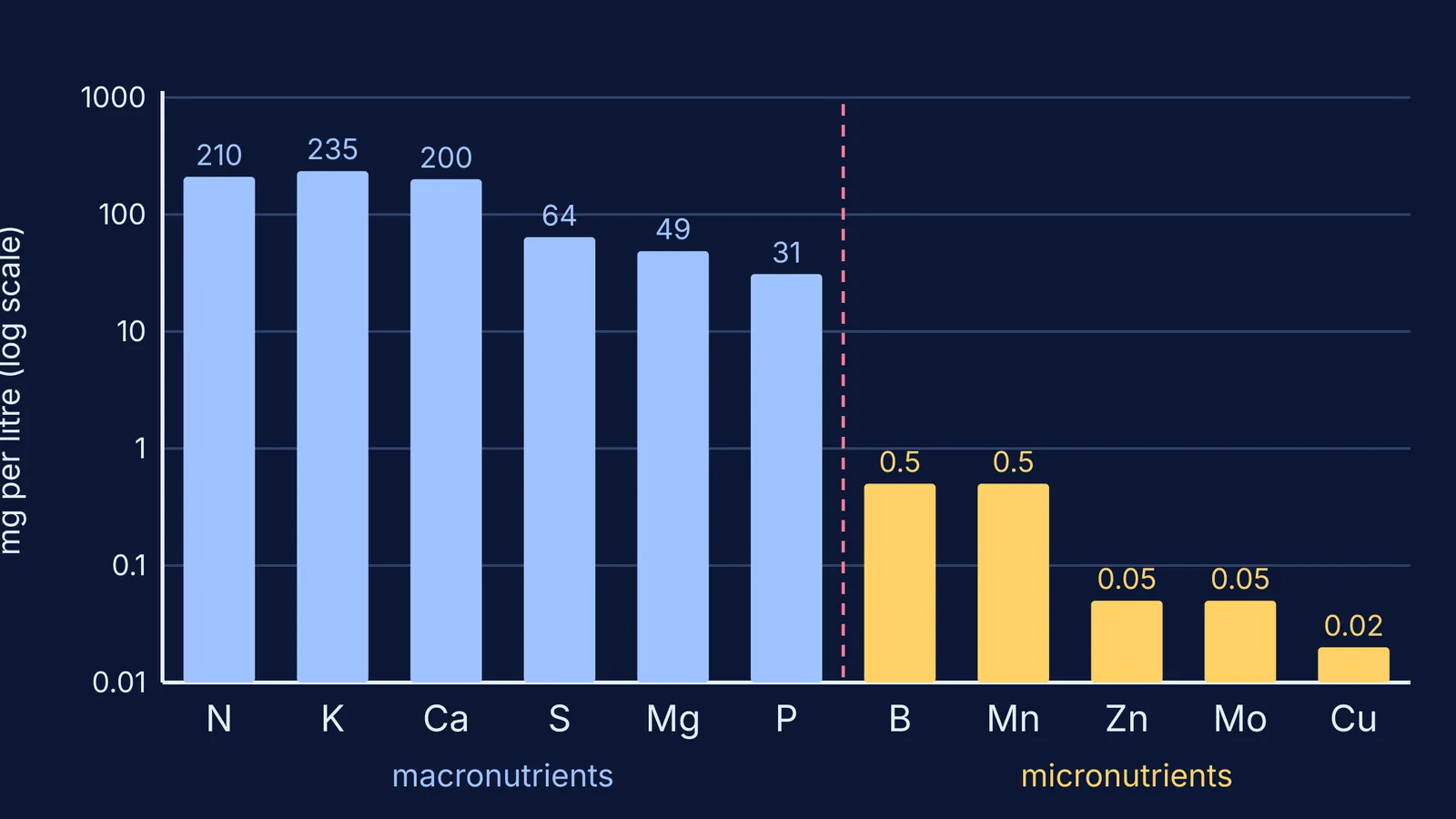
Add 1 mL per litre of a supplement giving 0.5 parts per million (ppm) of boron and manganese, 0.05 ppm of zinc and molybdenum, and 0.02 ppm of copper. Iron goes in separately, as 1 mL per litre of 0.5 per cent iron tartrate once or twice a week, and the pH is brought to about 6.
The circular listed the elements then known to be indispensable: nitrogen, phosphorus, potassium, sulphur, calcium, magnesium, iron, boron, manganese, copper and zinc, adding that molybdenum might soon join them.
How do you convert the recipe to milligrams per litre?
The trick is that 1 mL of a 1 M stock in 1 litre gives 1 millimolar (mM). Using the Circular 347 recipe and standard atomic masses:
Nitrogen: 5 mM from KNO3 plus 2 × 5 = 10 mM from Ca(NO3)2 gives 15 mM. Multiply by 14.0 g/mol: about 210 mg per litre.
Potassium: 1 mM + 5 mM = 6 mM, times 39.1 g/mol: about 235 mg per litre.
Calcium: 5 mM, about 200 mg per litre. Sulphur: 2 mM, about 64. Magnesium: 2 mM, about 49. Phosphorus: 1 mM, about 31.
By mass, potassium outweighs copper more than ten thousand times, yet both are essential. If conversions like this trip you up, the Fermi Problem Library has worked problems with a step-by-step solver that explains the reasoning rather than printing an answer.
Why does Hoagland solution matter?
First, hydroponics. The US Department of Agriculture's National Agricultural Library defines hydroponics as growing plants in a water-based nutrient solution rather than soil, and credits Hoagland and Arnon with a complete hydroponic nutrient solution in 1938. Yet the circular was cautious: in a side-by-side Berkeley tomato trial, soil yield was "not markedly different" from tank yield.
Second, deciding which elements a plant truly needs: with pure, known ingredients you can remove one element and watch. In 1939 Arnon and P. R. Stout published a paper in Plant Physiology on which elements are essential in minute quantities. As a University of Wisconsin soil science course page summarises their criteria, the element must be needed for the plant to complete its life cycle, must not be replaceable by another element, and must be directly involved in the plant's metabolism. It links to Justus von Liebig's law of the minimum: the scarcest essential element limits growth.
How can you test an essential element yourself?
The circular gives six "minus" solutions, each lacking one element, with Solution 1 as the control. A school-project plan, done with your teacher since these are lab chemicals:
Grow identical seedlings in two containers of Solution 1, made with distilled water as the circular advises.
Move one set into the minus-nitrogen solution: per litre, 5 mL of 0.5 M potassium sulphate, 2 mL of 1 M magnesium sulphate, 10 mL of 0.05 M monocalcium phosphate and 200 mL of 0.01 M calcium sulphate, plus the same iron and micronutrient supplement.
Keep light, temperature, volume and aeration the same.
Every few days, record height, leaf count and leaf colour.
Note which differences you can link to the missing nitrogen.
To see how molarity, ions and mineral nutrition connect, the Fermi Concept Library gives every concept in chemistry and biology its own lesson and its place in the map.
Next time you see a hydroponic nutrient bottle, read the label: you will recognise most of the 1938 list.