

On this page
In the late 19th century, devastating diseases were wiping out cattle and human populations across regions of Africa. Sir David Bruce, a Scottish pathologist and microbiologist, travelled to the continent and fundamentally transformed our understanding of tropical diseases. He showed that these illnesses were not caused by the environment, but by microscopic parasites transmitted by insects.
His work laid the foundation for controlling vector-borne diseases and established a model of transmission that biologists still use today.
What causes nagana?
In 1894, Bruce was sent to Zululand (in modern-day South Africa) to investigate a severe cattle disease known locally as nagana. Working alongside his wife and scientific collaborator, Mary Elizabeth Bruce, he examined the blood of infected animals and discovered motile, vibrating protozoan parasites. These pathogens were later named *Trypanosoma brucei* in his honour).
Bruce established that the tsetse fly acted as a carrier of the living parasite from one animal to another. He and his wife collected blood samples from infected cattle, donkeys, horses, and dogs to confirm the presence of the pathogen). Today, it is understood that domestic and wild animals act as the main reservoir for human-pathogenic trypanosomes), maintaining the disease in the environment.
Who was Mary Elizabeth Bruce?
Mary Elizabeth Bruce was a vital partner in David Bruce's scientific achievements. A skilled microbiologist, she was his major scientific collaborator on almost all of his research expeditions. Throughout their time in Zululand and Uganda, she helped collect blood samples and co-authored around thirty of his technical papers).
Her contributions were essential to the discovery of both *Trypanosoma brucei* and the link between the tsetse fly and sleeping sickness. She worked alongside her husband until their final days; remarkably, David Bruce died four days after his wife) in 1931, during her memorial service.
What causes sleeping sickness?
Following his success with nagana, Bruce was sent to Uganda in 1903 to lead the Royal Society's Sleeping Sickness Commission). Human African trypanosomiasis, or sleeping sickness, was causing a devastating epidemic in the region.
Bruce and his team established that the disease, which was commonly popularised as "negro lethargy", was transmitted by the tsetse fly, *Glossina palpalis*).
How does the tsetse fly transmit the parasite?
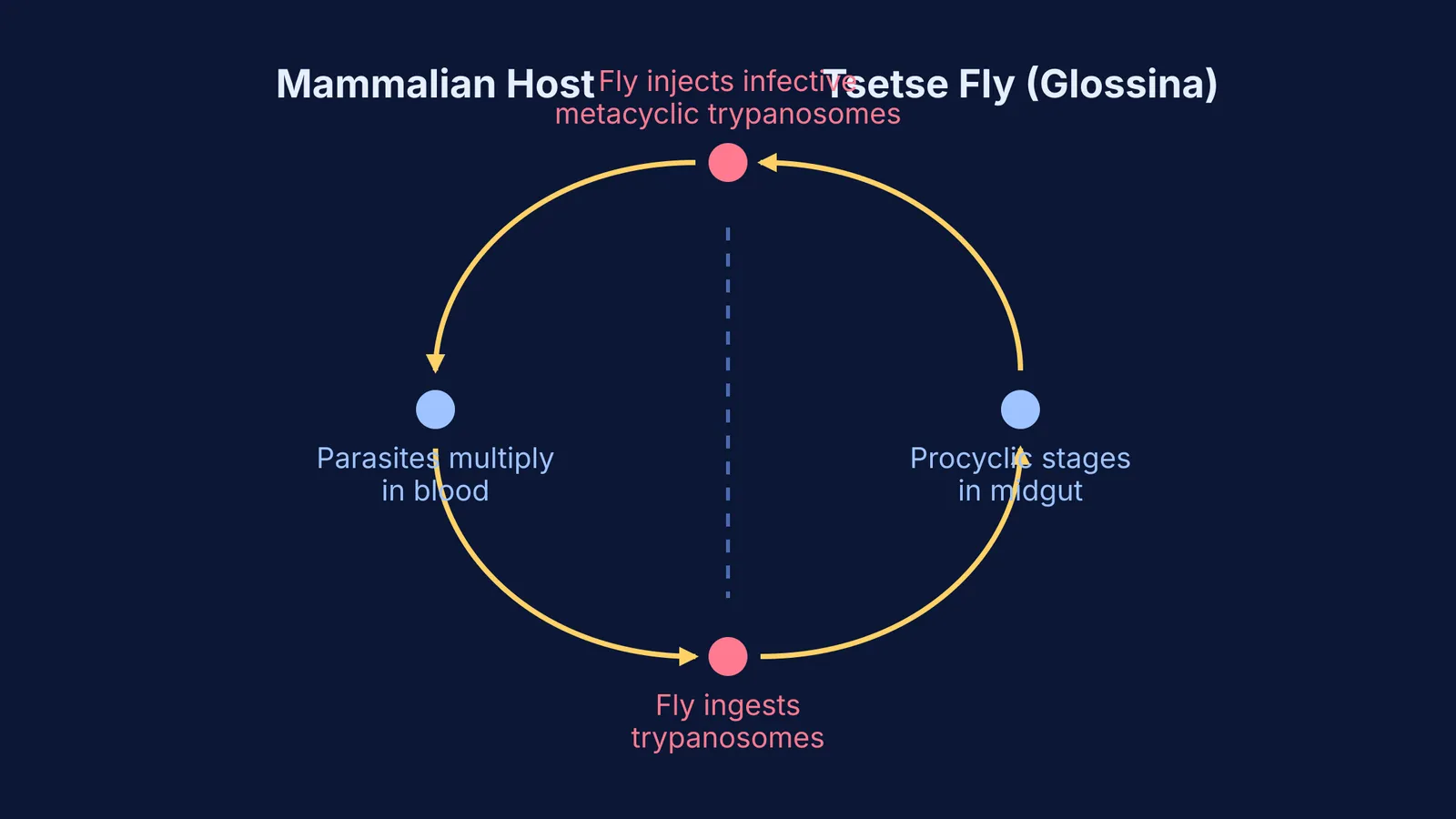
During subsequent research between 1908 and 1912, Bruce and his colleagues established the complete developmental stages) of the trypanosome in the tsetse fly.
The parasite undergoes a full developmental cycle within the insect:
Ingestion: The fly takes a blood meal containing trypanosomes from an infected mammalian host.
Midgut: The parasites multiply and transform into their procyclic stage within the fly's midgut.
Salivary glands: They migrate to the fly's salivary glands and transform into metacyclic forms, which is the stage that is infectious.
This cyclical development takes about three weeks before the fly becomes infective again. Once infective, the fly injects the metacyclic trypanosomes into a new host during its next blood meal.
What was David Bruce's legacy?
Beyond his work on trypanosomes, Bruce made other critical discoveries. In 1887, while serving in Malta, he discovered the bacterium that causes Malta fever, which is now known as brucellosis. The pathogen, *Brucella melitensis*, and the bacterial genus *Brucella* were named after him).
For his immense contributions to tropical medicine and microbiology, Bruce was nominated for the Nobel Prize 31 times) over the course of his career, although he was never selected. He was knighted in 1908 and was later upgraded to a Knight Commander of the Order of the Bath.
How can you map vector-borne diseases?
When studying infectious diseases for biology exams, memorising isolated facts can be difficult. Instead, you can use Bruce's discoveries to map out a clear framework for any vector-borne disease. Ask yourself these four questions:
The Pathogen: What microscopic agent causes the illness? (e.g., *Trypanosoma brucei*).
The Vector: How does it travel between hosts? (e.g., the tsetse fly).
The Reservoir: Where does it hide in nature without causing symptoms? (e.g., wild animals).
The Target Host: Who gets sick? (e.g., humans or cattle).
Mapping diseases this way makes it much easier to remember the life cycle. If you are struggling to picture these complex transmission cycles, the Fermi Concept Library has lessons on every concept in biology to help you connect the dots.
Understanding the biology of these parasites is just as critical as knowing about viruses, viroids and lichens or the mechanisms of eukaryotic RNA polymerases. By breaking the cycle into its component parts, you can turn a complex disease into a logical, memorable system.


