

On this page
In 1842, a young Charles Darwin solved a geological puzzle that had baffled scientists for decades: how do ring-shaped coral islands, known as atolls, exist in the middle of the deep, open ocean? Biologists already knew that reef-building corals are delicate organisms that can only survive in shallow, sunlit waters. Yet, these massive coral rings rise up from ocean floors that are miles deep, far beyond the reach of any sunlight. Darwin proposed a simple, elegant mechanism: the coral is actually growing on top of a volcanic island that is slowly sinking.
This insight—now known as the subsidence theory of coral reef formation—showed how small, continuous biological growth could keep pace with massive geological changes over immense stretches of time. It stands as one of the great early triumphs of deductive scientific reasoning.
How do coral atolls form?
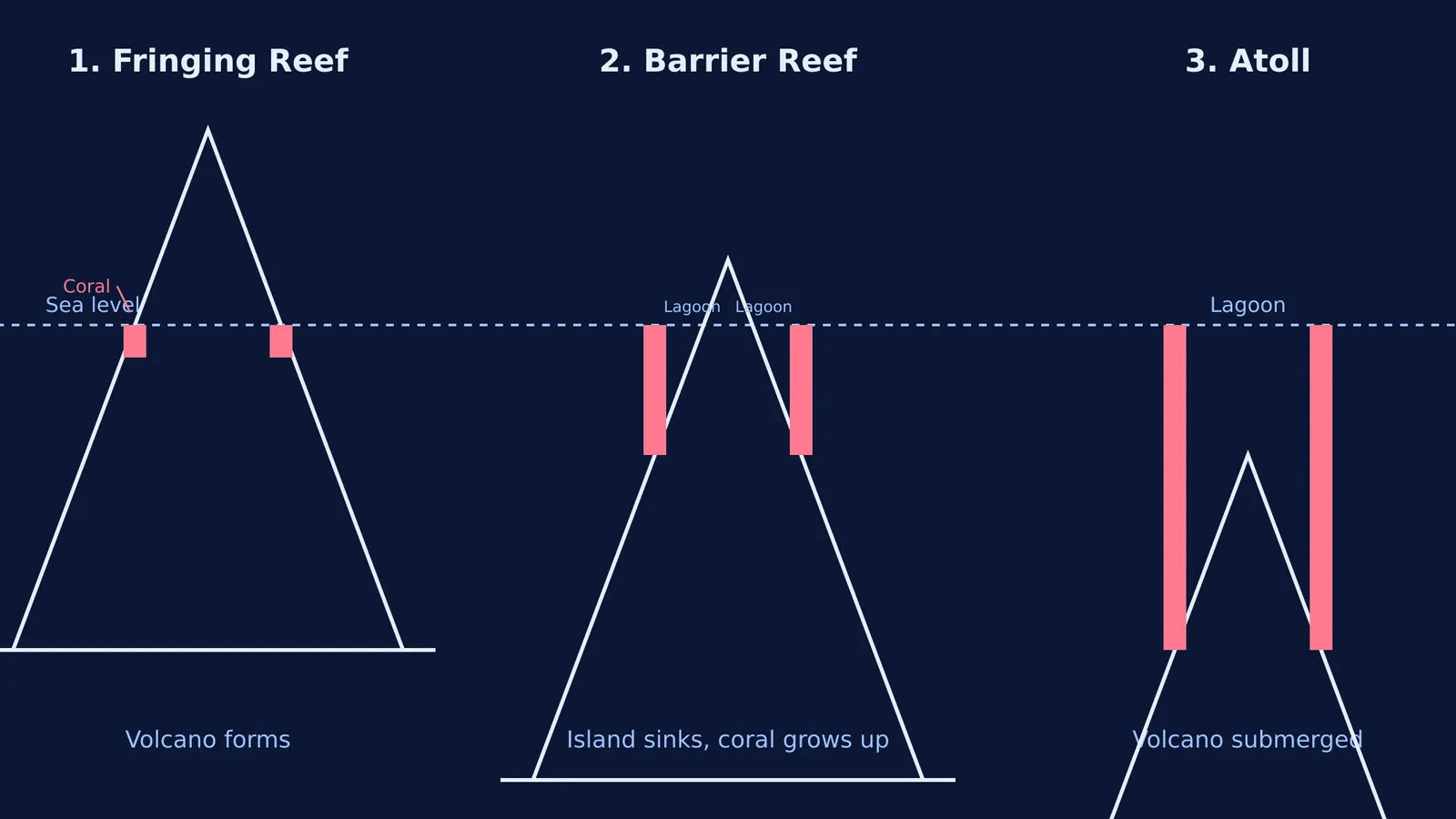
During his famous voyage on the HMS *Beagle* (1831–1836), Darwin observed diverse coral formations across the Pacific and Indian Oceans. As the ship navigated through treacherous reef-filled waters, he meticulously studied the living coral and the underlying geology. He realised that the three main types of reefs he encountered were not distinct phenomena, but rather sequential stages of a single, continuous geological process driven by subsidence:
Fringing Reefs: The cycle begins when a new volcanic island erupts from the ocean floor. Coral larvae settle in the warm, shallow waters right along the rocky shoreline, forming a "fringing reef" that is directly attached to the island.
Barrier Reefs: Over millions of years, the underlying oceanic crust cools and becomes denser, causing the massive volcanic island to slowly sink (subside) into the mantle. To stay in the vital sunlight, the living coral continues to grow vertically. As the island shrinks and the coral builds upward, a wide body of water—a lagoon—opens up between the sinking shoreline and the upward-growing reef.
Atolls: Eventually, the entire volcanic island sinks completely beneath the ocean surface. The coral, having kept pace with the subsidence for millennia, forms a continuous, ring-shaped barrier surrounding a central lagoon where the mountain peak used to be.
This model perfectly aligned with later discoveries in plate tectonics, explaining why we often see long chains of increasingly submerged islands as oceanic plates move slowly away from hotspots that build island chains.
How was Darwin's theory proven?
Darwin knew his theory made a specific, testable prediction: if an atoll is just a thick coral crown sitting on a sunken volcano, then drilling deep enough into the reef should eventually hit solid volcanic rock.
Definitive proof arrived over a century later, in 1952. Prior to nuclear testing, the U.S. Geological Survey conducted deep exploratory drilling at Enewetak Atoll in the Marshall Islands to understand the foundation's stability. Scientists drilled down through an astonishing 4,154 feet (1,266 metres) of pure coral limestone before finally striking unweathered basalt, the volcanic basement rock.
Even more telling, the coral fossils found at the very bottom of this deep core were from shallow-water species dating back to the Eocene epoch, roughly 50 million years ago. This meant the rock at the bottom was once near the surface. Darwin's model was completely correct: the reef had started at the ocean's surface and built itself up, inch by inch, as the tectonic floor slowly gave way beneath it. The concept of crustal movement didn't just solve the puzzle of atolls; it eventually contributed to the broader geological understanding of seafloor spreading.
How can we observe like Darwin?
Darwin's triumph with coral reefs is a masterclass in scientific reasoning. He could not sit and watch a single island sink over a million years. Instead, he observed spatial differences across the ocean (a fringing reef here, an atoll there) and logically arranged them into a chronological timeline.
When studying complex science, you often have to piece together a complex process from scattered static clues. Here is a framework for thinking like Darwin:
Assume a continuum: If you see three seemingly different structures (like the three reef types), ask if one could naturally turn into the other over time. Look for transitional stages.
Find the engine: What is the constant force driving the change? For Darwin, it was the steady downward motion of the Earth's crust paired with the upward biological growth of the coral organisms.
Make a bold prediction: A good mental model tells you exactly what to look for next. If the theory is true, what else must be true? (e.g., "there must be a mountain under this limestone").
When a system is hard to picture mentally, interactive tools can help you see the moving parts. The Fermi Simulation Lab provides interactive simulations for the ideas that are easier to see than to read, allowing you to watch complex physical and biological processes unfold in real time.
Understanding subsidence isn't just about memorising different reef types; it is about learning how to see the deep history hidden in the natural landscape around us.


