

On this page
Watch a tabla player's right hand and you will see it land on a black circle in the middle of the drumhead. That patch, built up layer by layer from a paste, is a big part of why the tabla and the mridangam ring with a clear pitch while most drums just thud. C. V. Raman worked this out in experiments in Calcutta in 1919 and set out the full results in 1934.
In his 1934 paper in the Proceedings of the Indian Academy of Sciences, Raman wrote that these drums contained "the solution in a practical form of the acoustical problem of transforming a circular drum-head giving inharmonic overtones into a harmonic musical instrument." Here is what that means, and how you can check it yourself.
Why do most drums not sound musical?
A plucked string vibrates at its fundamental frequency and at whole-number multiples of it: 2, 3, 4 times and so on. Those overtones are called harmonics, and our post on standing waves in strings and pipes works through why.
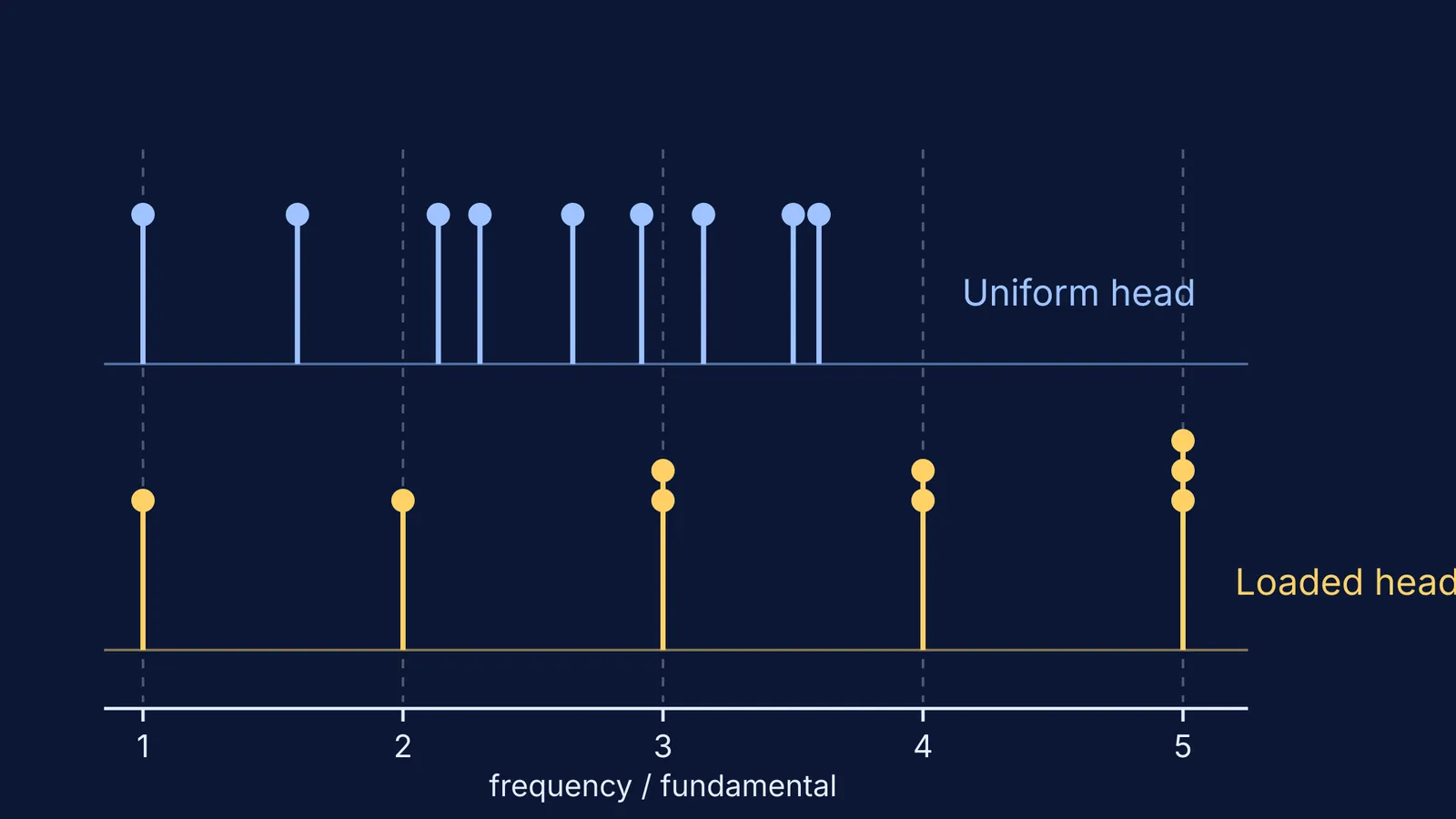
A plain, evenly stretched circular drumhead does not behave like that. Raman's chart of the "normal modes of uniform membrane" puts its first nine modes at 1.000, 1.594, 2.136, 2.296, 2.653, 2.918, 3.156, 3.501 and 3.600 times the fundamental (Raman, 1934). None of these overtones is a whole-number multiple, so the sound has no single clear pitch. That is what "inharmonic" means.
What does the black patch on the tabla and mridangam do?
Raman described how the right-hand head is made. It starts as three layers of skin. All but one are cut away, leaving rings round the edge, and the head is then "loaded symmetrically with a firmly adherent composition" said to be iron oxide mixed with charcoal, starch and gum. The layer is thickest at the centre and thins towards the edge, and makers keep testing the tone as they lay it on (Raman, 1934).
Adding mass changes the frequencies of the head's modes. With the load spread the way drum-makers spread it, Raman's chart of the "harmonic drum" puts the same nine modes at 1, 2, 3, 3, 4, 4, 5, 5 and 5 times the fundamental.
The leather ring at the edge does a second job. Raman described it as a kind of damper for the high overtones, which vibrate relatively more strongly near the edge. A broad ring gave "a muffled tone of short duration", and a narrow ring a longer, brighter one. The heavy wooden shell also helps the tone last.
How did Raman prove the drum was harmonic?
He used sand, the same trick behind Ernst Chladni's sound figures. Touch the head lightly at chosen points, strike it, and the sand gathers along the lines that stay still. Raman showed the head dividing into 1, 2, 3, 4 or 5 parts, matching the first five harmonics of a stretched string. He first reported the drums in a short 1920 note in Nature, Musical Drums with Harmonic Overtones, written with Sivakali Kumar.
Others later worked on the mathematics. In 1938, K. Nagabhushana Rao modelled loaded membranes and found that a load concentrated at the centre could not fully reproduce the observed tones, pointing instead to a widely spread load like the one actually used. This drum work ran alongside Raman's better-known research on light, which our post on C. V. Raman and the Raman effect covers.
Worked example: a plain drum and a mridangam tuned to 200 Hz
Take a fundamental of 200 Hz and multiply it by the ratios from the two mode charts in Raman's 1934 paper.
Plain drumhead: 200, 319, 427, 459, 531, 584, 631, 700 and 720 Hz. The overtones crowd together and none is a multiple of 200.
Loaded head: 200, 400, 600, 600, 800, 800, 1000, 1000 and 1000 Hz. That is five pitches, each a whole-number multiple of 200, just like a string.
Check one yourself: 1.594 × 200 = 318.8, so the plain drum's second mode is about 319 Hz. A string would put it at 400 Hz.
If there is a tabla or mridangam at home or school, ask its owner first, then try Raman's test for the second tone. Rest one finger gently along a diameter near the rim. Strike sharply with a finger of the other hand on the perpendicular diameter. The clear ringing tone is the head vibrating in two halves. A palm brought down flat on the centre and lifted quickly gives what Raman called the deep "hum-tone", the fundamental.
Vibration modes are easier to see than to read about, and the Fermi Simulation Lab has interactive simulations for ideas like these. When a standing-wave numerical goes wrong, the Fermi Problem Library has worked problems with a step-by-step solver that explains the reasoning rather than printing an answer.
Next time you hear a mridangam, listen for the five tones Raman counted.


