On this page
On 28 July 1995 the journal Science published the complete DNA sequence of the bacterium *Haemophilus influenzae* Rd: 1,830,137 base pairs, read from start to finish (Fleischmann et al., Science, 1995). The paper's abstract describes it as "the only complete genome sequence from a free-living organism". For the first time, every letter of an organism that lives on its own had been read.
The work came from The Institute for Genomic Research (TIGR), which J. Craig Venter founded in 1992 (J. Craig Venter Institute). Venter and Hamilton Smith were among the authors; Smith's earlier story is in our piece on Hamilton Smith and restriction enzymes. What was new in 1995 was not the bacterium. It was the method.
What is shotgun sequencing?
Whole-genome shotgun sequencing means breaking a genome into many random overlapping pieces, reading each piece, and using a computer to put the pieces back together by matching their overlaps (Fleischmann et al., 1995).
The step it skipped was mapping the chromosome first. The 1995 abstract says the shotgun approach "eliminates the need for initial mapping efforts", so it could be used on the many microbes that had no map at all.
Think of shredding several copies of a newspaper article into random strips, then rebuilding it from strips that share words. No strip knows where it belongs. The overlaps do.
How did Venter's team rebuild the genome from 24,304 pieces?
The step-by-step methods are reprinted in the team's patent on the sequence (US patent 6,528,289). Here is what they did:
They broke the DNA by sound waves (sonication) and kept fragments 1.6 to 2.0 kb long, which they cloned into plasmids.
Eight people ran 28,643 sequencing reactions over about 3 months, using an average of fourteen automated sequencing machines a day. The average usable read was 485 bases for the main primer.
Software called TIGR Assembler took 24,304 sequence fragments and joined them in 30 hours of computer time on one processor. That gave about 210 stretches of continuous sequence, called contigs, which were then merged into 140.
The 140 contigs left 42 physical gaps and 98 sequence gaps. The team ordered and closed them with targeted work: Southern-blot fingerprints, protein-database matches, longer clones held in lambda phage, and PCR.
Repeats were the hard part: the six look-alike ribosomal RNA operons could not be placed by overlap alone, so longer clones spanning them were used.
The finished genome had 1,743 predicted coding regions (BioNumbers entry citing Fleischmann et al.).
How much random reading is enough?
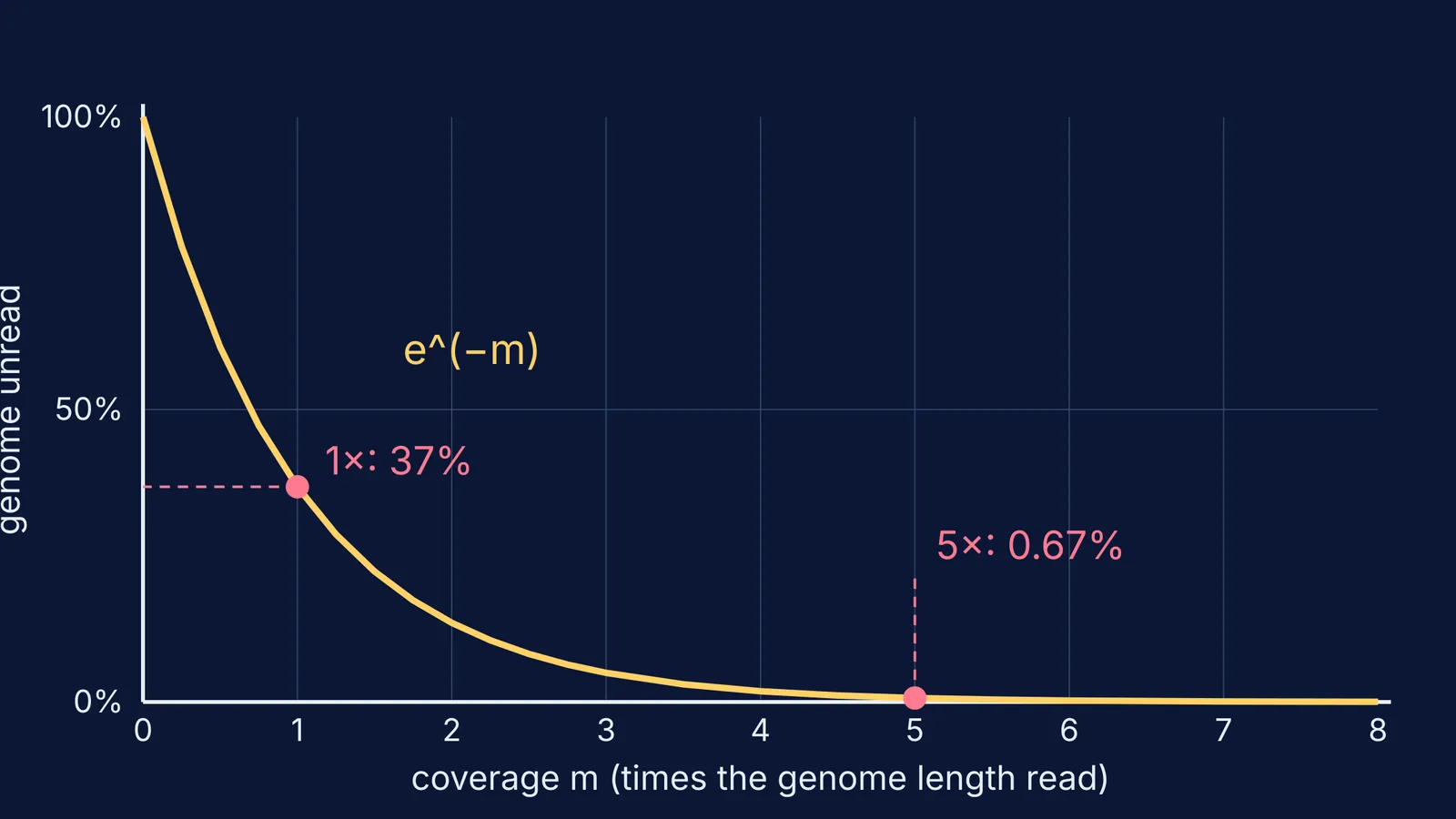
The maths behind the plan came from Eric Lander and Michael Waterman (Genomics, 198890007-9)). The 1995 team used it like this (US patent 6,528,289). If n reads of length w are taken at random from a genome of length L, the coverage is m = nw/L. The fraction of bases that no read touches is about e^(−m).
The team's own numbers: at 1× coverage about 37% of the genome is still unread. At 5× only 0.67% is unread, which they estimated as about 128 gaps averaging about 100 bases.
Try it with the real genome length and the 460-base average read the team used for planning:
1× coverage. 1,830,137 ÷ 460 ≈ 3,979 reads. Unread fraction e^(−1) ≈ 0.37, so about 673,000 bases are still missing.
3× coverage. About 11,936 reads. e^(−3) ≈ 0.050, so about 91,000 bases are missing.
5× coverage. About 19,893 reads. e^(−5) ≈ 0.0067, so about 12,300 bases are missing, scattered in small gaps.
Each extra pass of reading shrinks the missing part by a factor of e, about 2.7, so each new pass finds fewer new bases. That is why the 1995 team stopped the random phase and closed the remaining gaps by targeted work.
Why did the first bacterial genome matter?
It showed that you could read a whole genome without mapping it first. Venter then scaled the idea up. His company Celera's human genome paper in February 2001 reported a 2.91-billion-base-pair sequence of the gene-rich (euchromatic) part of the human genome, made by whole-genome shotgun from about 27 million reads generated over nine months; its assemblies also used data from the publicly funded genome project (Venter et al., Science, 2001). For the textbook side, read our piece on DNA fingerprinting and the Human Genome Project; for how one stretch of DNA is read, see Frederick Sanger's sequencing work.
What can you take from it as a student?
Overlap your pieces. When revising a long chapter, start each session with a little of the last one, so the parts join up.
Close the last gaps on purpose. After mixed practice, work directly on the weak topics left over.
Learn the e^(−m) idea once. The same exponential shows up in radioactive decay and first-order reactions.
If the exponential or the biology is shaky, the Fermi Concept Library gives each idea in physics, chemistry, biology and mathematics its own lesson. You can then work through problems in the Fermi Problem Library, where a step-by-step solver explains the reasoning rather than just printing an answer.