

On this page
Between 1620 and 1624, Dutch inventor Cornelis Drebbel built what is widely considered the world's first navigable submarine (Wikipedia). While earlier thinkers like William Bourne had discussed concepts for underwater vessels, Drebbel was the first to actually build and pilot a working model (Britannica).
Who built the first submarine on the Thames?
Cornelis Drebbel was a prolific and unconventional inventor, alchemist, and engineer. Around 1604, he moved to England, likely at the invitation of King James I, and was accommodated at Eltham Palace. He astonished the English court with demonstrations of perpetual motion machines, hydraulic organs, and optical instruments. He even developed a mercury thermostat for a chicken incubator, creating one of the first recorded feedback-controlled devices (Wikipedia).
When he turned his attention to underwater travel, Drebbel built three successive models of his submarine, each larger than the last, iterating on his design based on real-world testing. He tested the final model in the River Thames, right in the heart of London.
During its public demonstrations, the submarine travelled from Westminster to Greenwich and back. It remained submerged at a depth of 12 to 15 feet for up to three hours (Wikipedia). Thousands of Londoners watched from the banks of the Thames, expecting the men inside to drown. Instead, the vessel surfaced safely. King James I himself joined a test dive beneath the Thames, becoming the first monarch in history to travel underwater. Despite the success, the British Admiralty did not show enough enthusiasm for a military application, and it remained a scientific curiosity rather than a tool of war.
How did Cornelis Drebbel's submarine work?
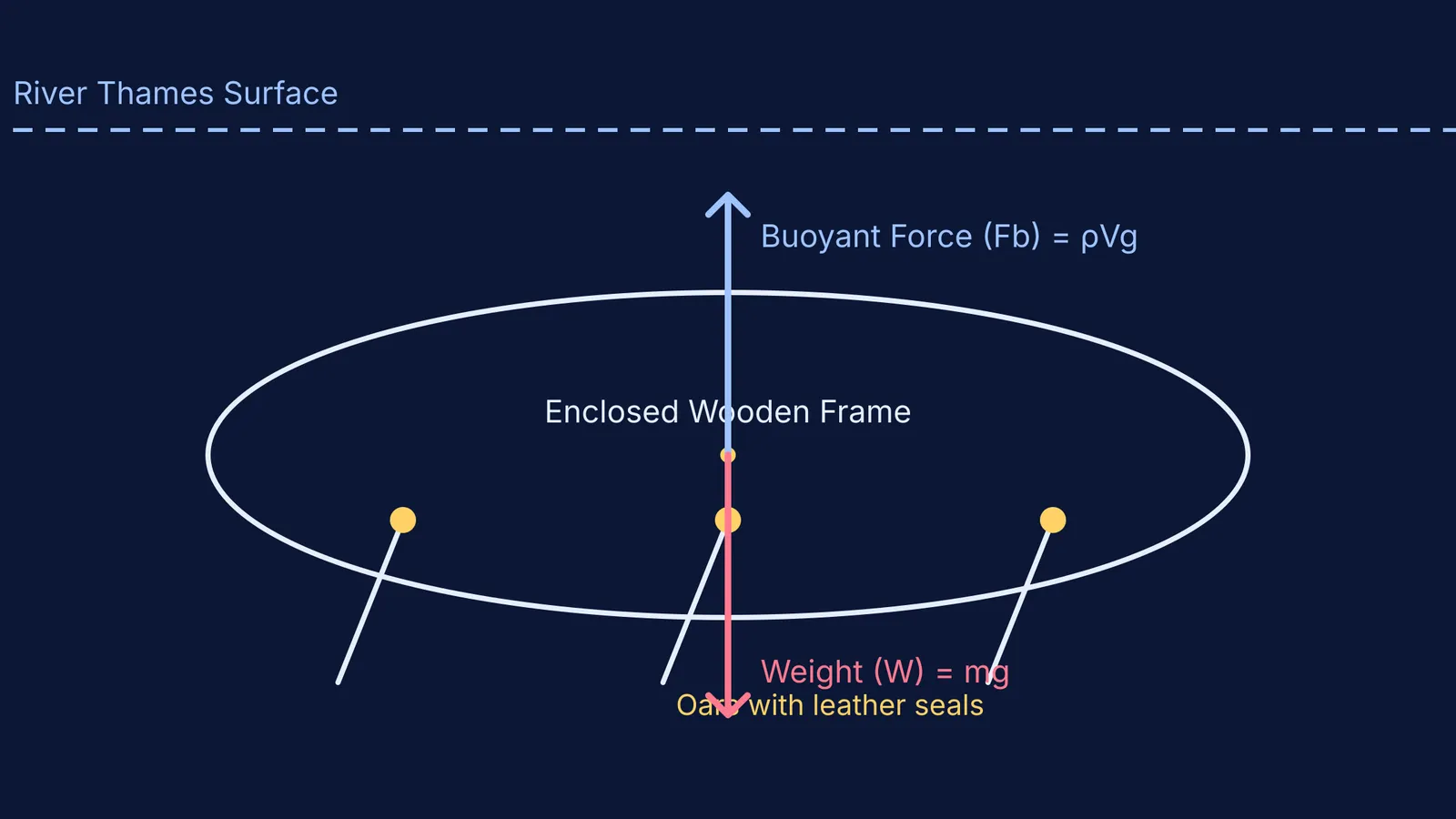
Unlike modern submarines driven by propellers and nuclear reactors, Drebbel's vessel relied on human power and 17th-century materials. Its design was essentially a steerable wooden frame that was completely enclosed. To make the hull watertight, Drebbel covered the entire wooden frame in greased leather (Britannica).
The final version of the submarine was powered entirely by oarsmen. It featured six oars and was capable of carrying 16 passengers (Wikipedia). The oars extended through the sides of the hull, and tight-fitting leather flaps kept the water out while allowing the oars to be pulled back and forth to propel the craft against the river's currents (Britannica).
While later inventors would use systems like goatskin bags to submerge their vessels, and modern submarines use complex ballast tanks, Drebbel's exact method for sinking and surfacing remains less clearly documented in surviving technical blueprints. However, his successful maneuvers proved that he had mastered the fundamental mechanics of displacing water and propelling a heavy, sealed craft below the surface.
How can you learn physics like an inventor?
Drebbel did not have modern equations for buoyancy or fluid dynamics, but his invention perfectly applied the physical principles we still learn today. To build a submarine, you have to understand Archimedes' principle, how density and displaced water allow an object to float or sink, and how to maintain a delicate balance of forces. This is exactly how Denis Papin understood pressure to build early steam digesters, or how the Montgolfier brothers understood hot air to take flight in their first hot air balloons.
Inventors do not start with a completed formula; they start with a problem and break it down into its fundamental parts. When students try to memorise physics equations without understanding the physical reality they describe, they often get stuck as soon as a question changes slightly.
If you are studying these same principles today, you do not have to guess how they work in the real world. The Fermi Simulation Lab has interactive simulations for the ideas that are easier to see than to read, letting you experiment with buoyancy and pressure yourself. When you need help connecting these concepts to exam problems, Fermi's AI tutor works out what you already know, builds a plan for the session, and teaches through it, so you sit down to a clear next step.


