

On this page
In 1912, American naturalist Clarence Birdseye arrived in Labrador, Canada, to trade furs. On Arctic expeditions documented by the Library of Congress, he watched Inuit fishermen pull fish from ice holes into a -40 °C (-40 °F) gale. In that bitter wind, the wet fish froze solid in seconds.
Months later, when Birdseye thawed and cooked them, he found they tasted fresh and firm. That observation puzzled him because early twentieth-century frozen food in American cities was notoriously awful. Commercial cold-storage plants froze meat over days in chill rooms. When defrosted, those meats turned grey and soft, leaking watery liquid called drip loss. Birdseye realized the secret lay in freezing speed.
Why does slow freezing ruin food while quick freezing preserves it?
Food tissue is mostly water, accounting for 70 to 90 percent of the mass of fish, meat, and vegetables. As reviewed in research on ice crystal nucleation and growth, when that water freezes, its physical quality depends on two competing processes: crystal nucleation and crystal growth.
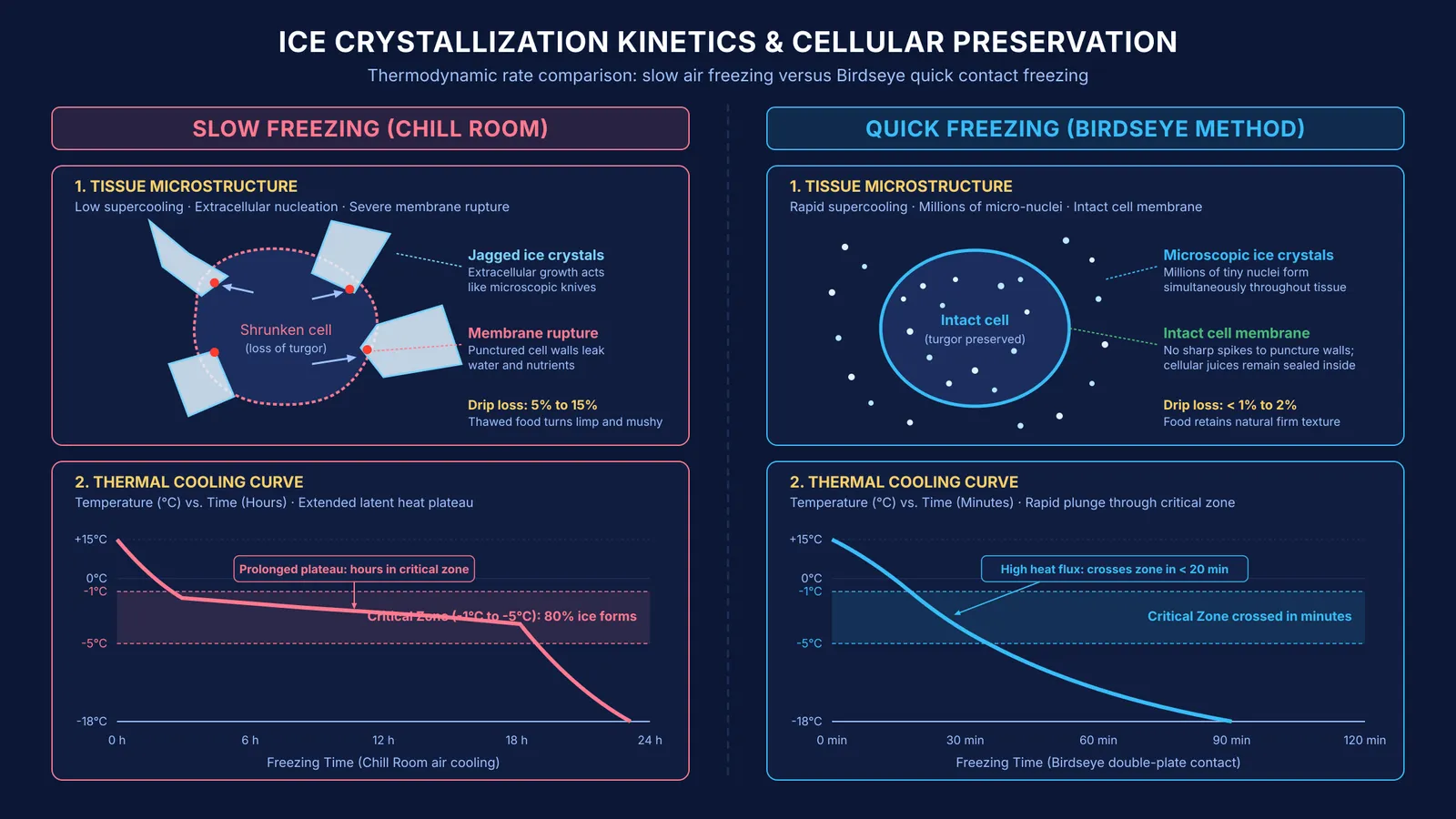
Nucleation forms an initial solid ice seed from supercooled water, while crystal growth adds water molecules onto that existing seed. Biological tissue freezes over a temperature band between -1 °C and -5 °C (30 °F to 23 °F), known as the zone of maximum ice crystal formation. In this critical zone, roughly 80 percent of the water inside food turns to ice.
When food cools slowly, only a few nucleation sites form. Because cellular solutes depress the freezing point of intracellular fluids more than extracellular fluids, ice begins forming outside cells first. Water is drawn out of cells across the cell membrane transport boundary, shrinking the cells and feeding massive crystal growth. These jagged extracellular crystals act like tiny knives, puncturing cell membranes. Upon thawing, the damaged cells cannot hold their water, causing a 5 to 15 percent drip loss that leaves a limp mush.
Quick freezing reverses this damage. When temperature plunges through the critical zone, rapid supercooling triggers nucleation at millions of points simultaneously inside and outside cells. Crystals remain microscopic and rounded, leaving membranes intact so thawed food retains its natural texture.
How did Birdseye build the first quick-freezing machine?
Translating his Arctic insight into a machine required solving heat conduction. Air conducts heat poorly, which is why conventional cold rooms took days to freeze thick cartons through to their centres.
In 1924, Birdseye founded Birdseye Seafoods and built a double-belt freezer, later developing a multi-plate freezer. His apparatus compressed packaged food between hollow metal plates chilled by evaporating ammonia at -25 °F (-32 °C) or calcium chloride brine at -45 °F (-43 °C). Clamping metal plates directly against cartons eliminated insulating air pockets. The Library of Congress records that this system froze a two-inch-thick package of meat to 0 °F in about 90 minutes.
On August 12, 1930, Birdseye received U.S. Patent 1,773,079 for his "Method of Preparing Food Products." In his 1929 paper in *Industrial & Engineering Chemistry*, Clarence Birdseye published microscopic tissue sections proving that rapid freezing kept cell boundaries intact. Birdseye eventually earned 168 patents, building the equipment and refrigerated transport that made frozen food practical.
How can you test freezing rates in a kitchen experiment?
You can observe this cellular rupture directly with a quick kitchen experiment:
Cut two identical thin slices of fresh cucumber.
Place Sample A inside a lidded container in your home freezer. The surrounding air layer insulates it, creating slow freezing.
Place Sample B directly onto a heavy steel baking tray pre-chilled in the same freezer. Direct metal contact acts like Birdseye's plates, maximizing conduction.
Once frozen solid, remove both slices and let them thaw on paper towels until fully defrosted.
Sample A will leak fluid and collapse into a limp gel because ruptured cell walls lost turgor pressure. Sample B will stay crisp and release little water, showing how Newton's law of cooling and conduction rates govern preservation.
How do phase transitions connect to your STEM problem-solving?
Birdseye's work shows how thermodynamics solves practical problems. The rate of heat conduction and latent heat removal here follows the same boundary conditions seen in the time for ice to form on a pond.
When students study heat conduction and phase transitions, visualising how latent heat arrests temperature drop during crystallization is often challenging. The Fermi Simulation Lab offers interactive simulations for ideas that are easier to see than to read, showing how temperature profiles evolve across a conducting boundary.
To practice heat transfer numericals and rate calculations, the Fermi Problem Library provides worked problems with a step-by-step solver that explains the reasoning rather than printing an answer.


