On this page
In 1742, Christian Goldbach wrote a letter to Leonhard Euler that led to a deceptively simple rule: every even number greater than 2 is the sum of two prime numbers. For over 280 years, the best minds in mathematics have tried and failed to prove what became known as the Goldbach Conjecture.
The closest anyone has come to solving it is Chen Jingrun, a Chinese mathematician whose resilience turned him into a national hero in the 1970s.
Who was Chen Jingrun?
Born in Fuzhou in 1933, Chen grew up during the Second Sino-Japanese War. Despite living in poverty, his total obsession with mathematics defined his early life. While in high school, his teacher described mathematics as the queen of sciences and the Goldbach Conjecture as the "pearl on her crown". While his classmates laughed at the idea of solving it, Chen took the challenge to heart. His singular focus meant he often overlooked the ordinary aspects of life, but this dedication was exactly what allowed him to attack such a notoriously difficult problem.
His career changed when he became a librarian at Xiamen University. There, he studied the work of Hua Luogeng, China's leading mathematician, even reading during air raids. Chen succeeded in improving some of Hua's results, which led to a post at the Institute of Mathematics at the Chinese Academy of Sciences.
What is Chen's Theorem?
By the mid-20th century, mathematicians were using "sieve methods" to filter out composite numbers in search of primes. But classical sieves hit a theoretical wall known as the parity barrier: they could not reliably distinguish between integers with an even number of prime factors and those with an odd number of prime factors.
In 1966, Chen pushed the weighted sieve method to its absolute limit. He proved that every sufficiently large even number can be written as the sum of either two primes, or a prime and a semiprime.
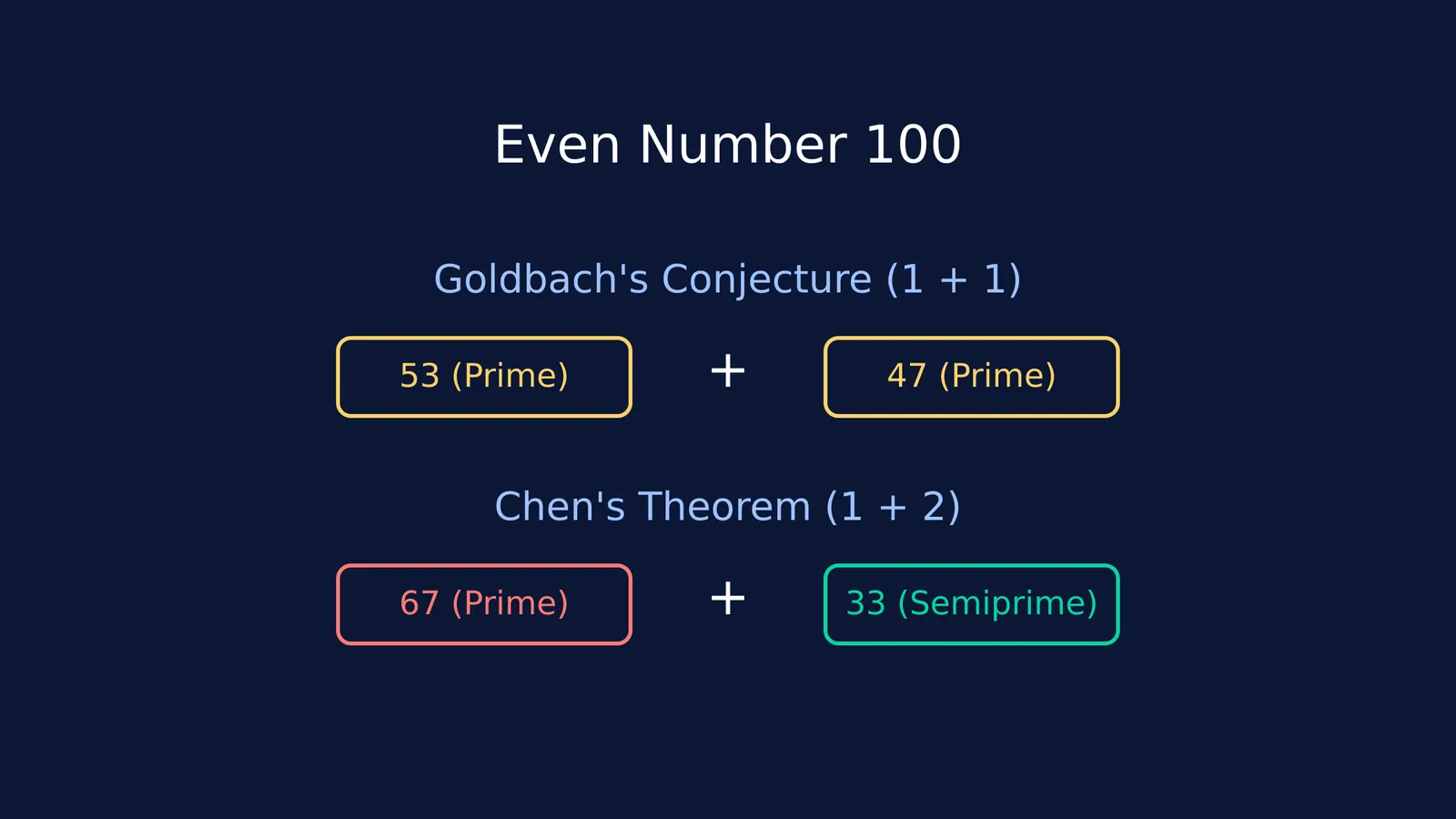
In number theory, the original Goldbach conjecture is often called the "1+1" problem (one prime plus one prime). Chen's Theorem achieved "1+2". It established that any large even number N can be partitioned as either a sum of two primes, or as N = p + q1 × q2, where p, q1, and q2 are all primes. This represented the most profound advancement in the history of the problem. While it does not fully solve Goldbach's original proposition, navigating the parity barrier in this way cemented Chen's place in number theory.
For instance, the number 100 can be written as 67 + 33, where 67 is prime and 33 is the semiprime product of 3 and 11. His paper also brought us closer to the Twin Prime Conjecture, proving there are infinitely many primes p such that p + 2 is either a prime or a semiprime.
How did Chen work?
Chen's 1966 announcement of the theorem was a mathematical breakthrough, but it is inseparable from the extraordinary hardship under which he produced the full proof. During the Cultural Revolution in China, Chen faced severe persecution, including physical abuse and forced manual labor.
Despite failing health and living in a windowless boiler room without electricity, Chen continued his research in secret. He carried out the phenomenally complex calculations for his proof working through the night by the light of a kerosene lamp. His work was so meticulous and demanding that he filled countless sacks with paper containing his calculations, all carefully verified. He finally published the full details of his work in 1973. In 1978, a piece of reportage literature about his struggles and dedication was published, transforming him into a national hero and inspiring a generation of students to pursue science.
Why is the 1+1 problem still unsolved?
Despite Chen's monumental success, the final leap from "1+2" to "1+1" remains unsolved today. Mathematics likely requires entirely new tools to bypass the parity barrier that halts current sieve methods. Until then, number theorists continue to search for new problems that link mathematicians in the quest for a solution.
When you hit your own walls in abstract math or number theory, getting unstuck requires seeing the hidden structure. If you are struggling to map out a proof or follow a long derivation, you can bring the problem to the Fermi Problem Library. Instead of just printing the final line, Fermi's AI tutor works through the steps with you, explaining the logical leap from one line to the next.
To build a stronger foundation in primes, combinatorics, or algebraic structures, you can explore the Fermi Concept Library, where every concept sits in a map of prerequisites.
Chen Jingrun's work shows that profound discoveries often require immense dedication. Whether you are dealing with a tough syllabus or a centuries-old conjecture, breaking the problem down is the first step to solving it.