

On this page
In the winter of 1901 to 1902, two French physiologists testing a sea anemone poison on dogs found that a small first dose could leave an animal dangerously more sensitive to the next one. Charles Richet named this anaphylaxis, the starting point for the science of allergy.
How did Charles Richet discover anaphylaxis?
The story starts at sea. In his 1913 Nobel lecture, Richet said that during a cruise on the yacht of Prince Albert of Monaco, the Prince advised him to study the poison of Physalia, the Portuguese man-of-war, together with Georges Richard and Paul Portier. The Monaco Oceanographic Institute places that voyage in the summer of 1901, on the second Princess Alice.
Back in Paris, with no Physalia to hand, Richet switched to the tentacles of Actinia, sea anemones common on Europe's rocky shores. The poison acted slowly, taking three or four days to show whether a dose was fatal. Some dogs survived, and Richet reused them weeks later because, in his words, "as they seemed normal, I made use of them for a new experiment."
What happened to Neptune, the dog in the experiment?
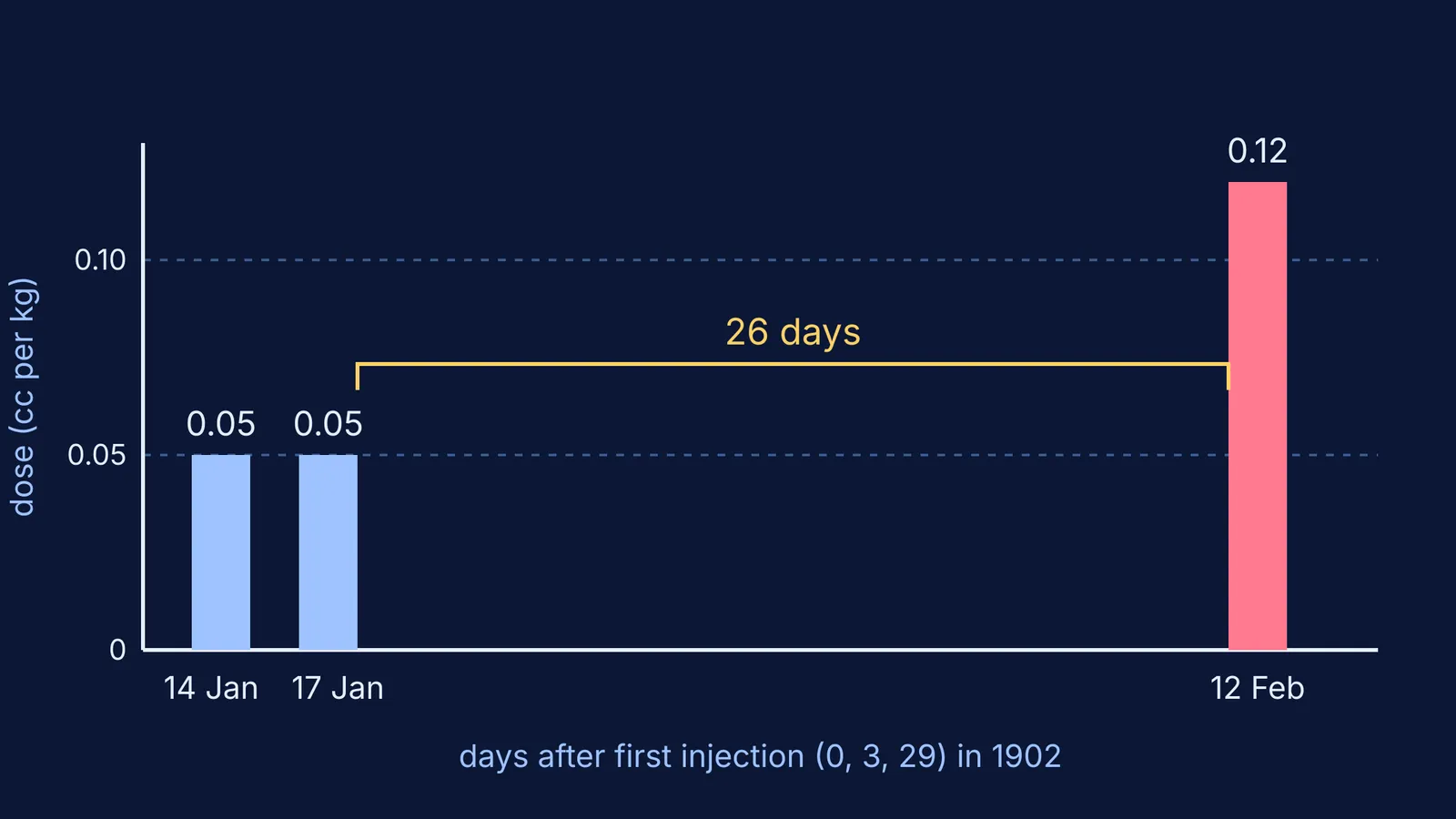
A 2024 history in Immunological Reviews, drawing on Paul Portier's lab book, describes the clearest case (Daëron and colleagues, 2024). Neptune was a yellow dog weighing 13.5 kg.
14 January 1902: 0.05 cc/kg of toxin. Half an hour later, the lab book says, the dog "walked very happily in the lab".
17 January: another 0.05 cc/kg, with no apparent effect.
12 February: Neptune was "in perfect health, happy, and active" and received 0.12 cc/kg. The lab book records "Immediate vomiting" and ends: "Dies half an hour later."
That last dose came 29 days after the first. Richet and Portier, the review adds, used 28 dogs and reported to the Société de Biologie on 17 February 1902.
What does anaphylaxis mean?
Richet explained the word himself in his Nobel lecture. Phylaxis is Greek for protection, so anaphylaxis means the opposite: a state in which an organism "is rendered hypersensitive, instead of being protected".
He listed three things that can happen when the same dose of a poison is given again:
Stability: nothing has changed, and the reaction is the same.
Habituation: the body is less sensitive, so a bigger dose is needed for the same effect.
Anaphylaxis: the body is more sensitive than before.
By 1902, he said, they had three main facts: a previously injected animal is far more sensitive than a new one; its symptoms after the second injection differ from those after the first; and three or four weeks must pass before the sensitive state appears. He also stressed that sensitised dogs reacted to doses as small as 0.005 per kilo, against a lethal dose for a fresh dog of about 0.1 per kilo.
How did anaphylaxis lead to allergy science?
The idea spread fast. Richet's lecture notes that in 1903 Maurice Arthus showed rabbits given serum became hypersensitive to a second injection three weeks later, so the effect held for proteins that were not poisonous at all. The 2024 review adds that in 1906 Clemens von Pirquet coined "allergy", from Greek words meaning "other reaction", though he meant any change in reactivity after immunisation. The twist, it notes, is that immune serum was found in the same years to save children, as with Emil von Behring's diphtheria antitoxin, and to harm. Richet received the 1913 Nobel Prize in Physiology or Medicine "in recognition of his work on anaphylaxis".
The World Allergy Organization defines anaphylaxis as "a serious systemic hypersensitivity reaction that is usually rapid in onset and may cause death" (WAO Anaphylaxis Guidance 2020). The same guidance names foods, insect venom and medicines as the main triggers and estimates lifetime prevalence at 0.3 to 5.1%, depending on method and place. Today it is treated as a medical emergency.
How do you explain Richet's experiment in an exam answer?
Use a three-part frame: dose, gap, response. Worked example: a dog survives a small injection of a toxin; four weeks later, a much smaller dose of the same toxin kills it within minutes. Name and explain the effect.
Dose: the first exposure is small and causes little or no harm.
Gap: weeks pass. Richet found three to four weeks were needed.
Response: the next exposure triggers a fast, severe reaction unlike the first. This is anaphylaxis, "against protection", described by Richet and Portier in 1902.
Slips to avoid:
Calling it immunity. Immunity means less reaction on re-exposure; anaphylaxis means more.
Forgetting the gap. Neptune's second dose, three days after the first, did nothing (Daëron and colleagues).
Mixing up the words. Richet named anaphylaxis in 1902; von Pirquet named allergy in 1906.
For where anaphylaxis sits next to antigens, antibodies and vaccines, see our guide to human health, disease and immunity. If those terms still blur together, the Fermi Concept Library gives every biology concept its own lesson and shows its place in the map.


