

On this page
In the late nineteenth century, the idea of a woman practicing medicine in Argentina was almost unthinkable. The nation's four universities barred women from their medical faculties, and few girls received a formal secondary education. Yet, in 1889, Cecilia Grierson dismantled this barrier, graduating as the first female physician in Argentina (Wikipedia).
Grierson was initially trained as a teacher. The early death of her father had forced her to help manage a rural school, and she formally graduated from a girls' normal school in 1878. However, after the loss of a close friend, she resolved to pursue medicine. To do so, she had to confront a deeply entrenched system that was designed to keep women out.
What were the barriers to women studying medicine?
The resistance to Grierson's ambition was structural and bureaucratic. One of the most significant hurdles was the requirement to understand Latin—a subject taught almost exclusively in boys' schools. Grierson was forced to provide formal written justifications explaining why she wanted to become a doctor.
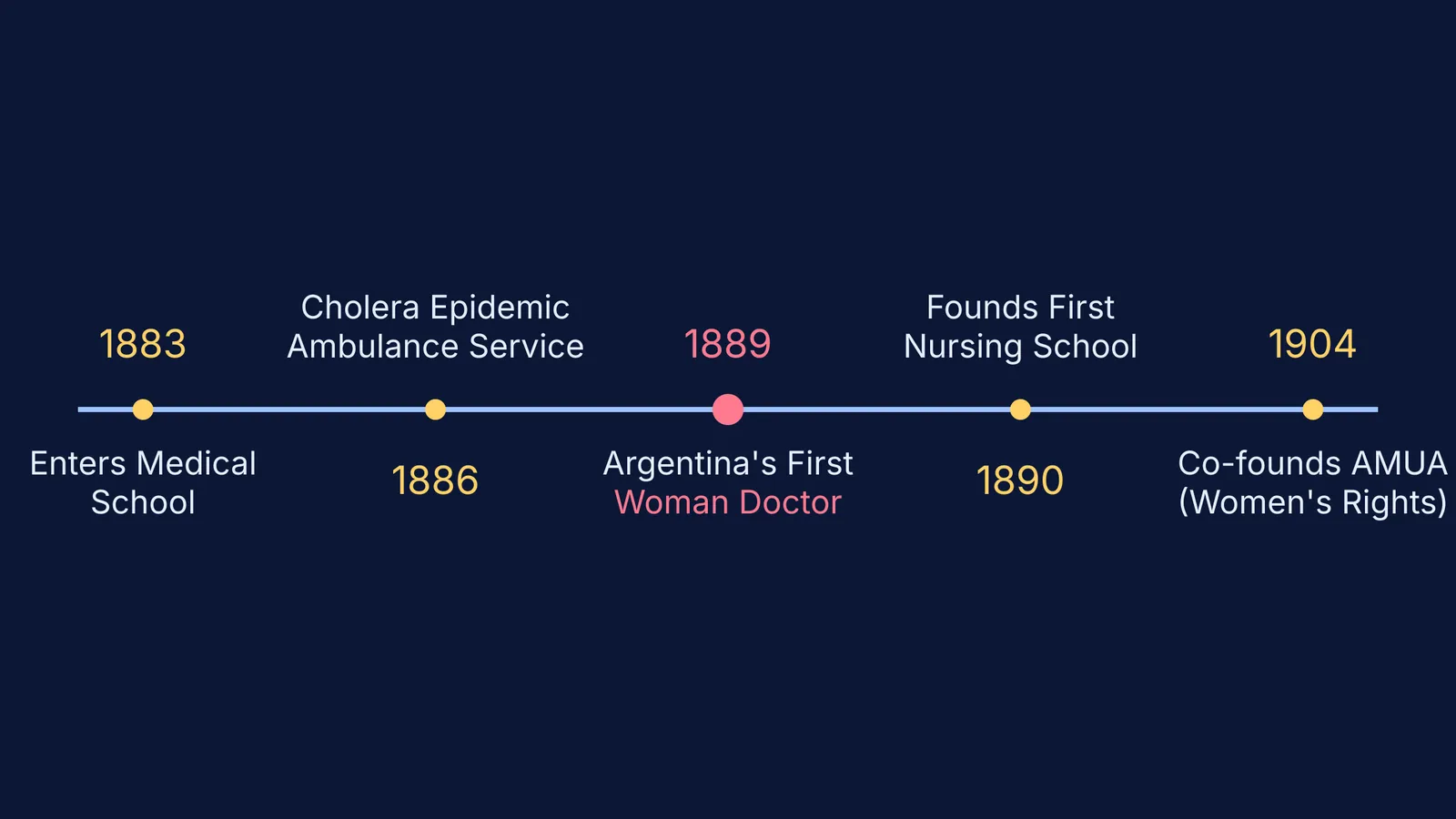
Another pioneering woman, Élida Passo, had entered the faculty to study pharmacy and subsequently medicine, but tragically died in 1893 before completing her medical diploma. Grierson persevered through the isolation and harassment, taking unpaid laboratory roles to gain experience. In 1889, she successfully defended her thesis on gynaecology, making history.
When you study biology today, the challenges are usually about mastering complex ideas rather than fighting for the right to sit in the room. If you need to trace the mechanisms of human reproduction or anatomy, the Fermi Concept Library covers every concept in biology so you can explore the underlying science clearly.
How did she change patient care in Argentina?
Grierson’s impact began long before she held her degree. During a devastating cholera epidemic in 1886, she volunteered in an isolation unit in Buenos Aires. There, she witnessed the dire need for systematic patient care and logistics. She pioneered the use of ambulance alarm bells—an innovation previously restricted to fire brigades—to speed up medical transport.
Her experiences during the epidemic convinced her that doctors alone could not sustain a healthcare system. In 1890, just a year after qualifying, she founded the Nursing School of the Hospital Británico de Buenos Aires. This was Argentina's first formal nursing academy (UNLP). She designed a curriculum that included childcare, first aid, and patient treatment, directing the school until 1913.
Grierson also introduced kinesiology and massage therapy to Argentina, writing a widely read textbook on practical massage. Much like Ibn al-Nafis and the flow of blood through the lungs challenged ancient anatomical assumptions, Grierson challenged the operational assumptions of her era’s hospitals, transforming nursing into a respected, scientific profession.
How did Grierson fight for women's rights?
The hostility Grierson faced in academia turned her into a lifelong advocate for equality. She realised that medical authority was intrinsically linked to political and social rights.
In 1900, she founded the Argentine Women's Council. Through this organisation, she presented draft bills to the National Congress proposing maternity leave and social welfare benefits for working-class women. In 1904, she co-founded the Association of Argentine University Women, which campaigned against the inferior legal status of women, advocating for civil rights, education access, and the legalisation of divorce. She eventually broke away from the council when it took a conservative turn.
Her career was defined by building the institutions that the state refused to provide. By the time the medical community was beginning to understand the pathology of conditions like dementia—such as the work of Alois Alzheimer and the plaques in a patient's brain—Grierson had already spent decades treating patients and fighting for vulnerable populations on a largely pro bono basis.
A framework for overcoming institutional barriers
Grierson’s life offers a blueprint for navigating spaces that were not built for you. If you are facing structural resistance in your education or career, consider her strategy:
Identify the hidden prerequisites: Grierson realised that Latin was used as an unwritten barrier to exclude girls. Find out what specific skills or qualifications are acting as gatekeepers in your field and acquire them independently.
Volunteer for the hard problems: By stepping into the 1886 cholera epidemic, Grierson made herself indispensable. Difficult, high-stakes situations often bypass traditional hierarchies.
Build parallel institutions: When existing structures proved inadequate, Grierson did not just complain; she founded the first nursing school and the first university women's association.
Document your methods: She wrote textbooks on nursing, massage, and the education of the blind, ensuring her knowledge outlasted her direct involvement.
If you are tackling a daunting syllabus and do not know where to start, having a structured approach is vital. Fermi's AI tutor can work out what you already know and build a plan for the session, so you sit down to a clear next step instead of a blank page. Grierson proved that with the right preparation and immense resolve, even the firmest closed doors can be forced open.


