

On this page
Before the era of electric lighting, streets and homes were dimly lit by open gas flames that flickered yellow. In the late nineteenth century, an Austrian chemist named Carl Auer von Welsbach transformed everyday lighting by bringing brilliant white light to the gaslight era. His invention, the Welsbach mantle, relied on his deep understanding of rare-earth elements.
Who was Carl Auer von Welsbach?
Born in Vienna on 1 September 1858, Carl Auer von Welsbach was the son of the director of the Imperial printing office (Wikipedia). After serving in the Austro-Hungarian Army, he studied mathematics, physics, and thermodynamics in Vienna before moving to the University of Heidelberg in 1880. There, he studied spectroscopy under the direction of Robert Bunsen.
Bunsen had invented a laboratory gas burner that produced a very hot, non-luminous flame. This burner was perfect for spectroscopy because it did not interfere with the coloured light emitted by the chemical samples being tested. This experience sparked Welsbach's lifelong interest in finding materials that could emit bright, stable light when heated. He returned to Vienna and became a master of separating chemically similar rare-earth elements, turning his laboratory discoveries into commercially successful products that transformed society. If you are interested in the physics of early artificial lighting, read about Joseph Swan and the carbon filament light bulb.
How did Welsbach discover neodymium and praseodymium?
In the late nineteenth century, chemists were struggling to organise the rare-earth metals. It was widely believed that a substance called "didymium" was a single element. Welsbach suspected otherwise and set out to prove it.
In 1885, he used a tedious method called fractional crystallization to separate didymium into two distinct fractions (Wikipedia). Because rare-earth elements have nearly identical chemical properties, they are notoriously difficult to separate. Welsbach relied on tiny differences in solubility. By dissolving the salts, letting a small fraction crystallize, and repeating the process exactly 167 times, he successfully proved that didymium was a mixture of two new elements.
He named the green-coloured salt praseodymium (from the Greek *prasinos* for "green", and *didymos* for "twin") and the pink-coloured salt neodymium ("new twin"). When studying physical chemistry, understanding equilibrium and the logic behind fractional separation can be tricky; the Fermi Problem Library has worked problems with a step-by-step solver that explains the reasoning rather than printing an answer.
What is the Welsbach mantle made of?
Welsbach’s most famous invention was the gas mantle, an innovation that kept the gaslight era alive even as early electric bulbs were being developed. His first patent in 1885 used a mixture of 60% magnesium oxide, 20% lanthanum oxide, and 20% yttrium oxide (Wikipedia). However, this early mantle was physically fragile and produced a harsh, greenish-tinted light.
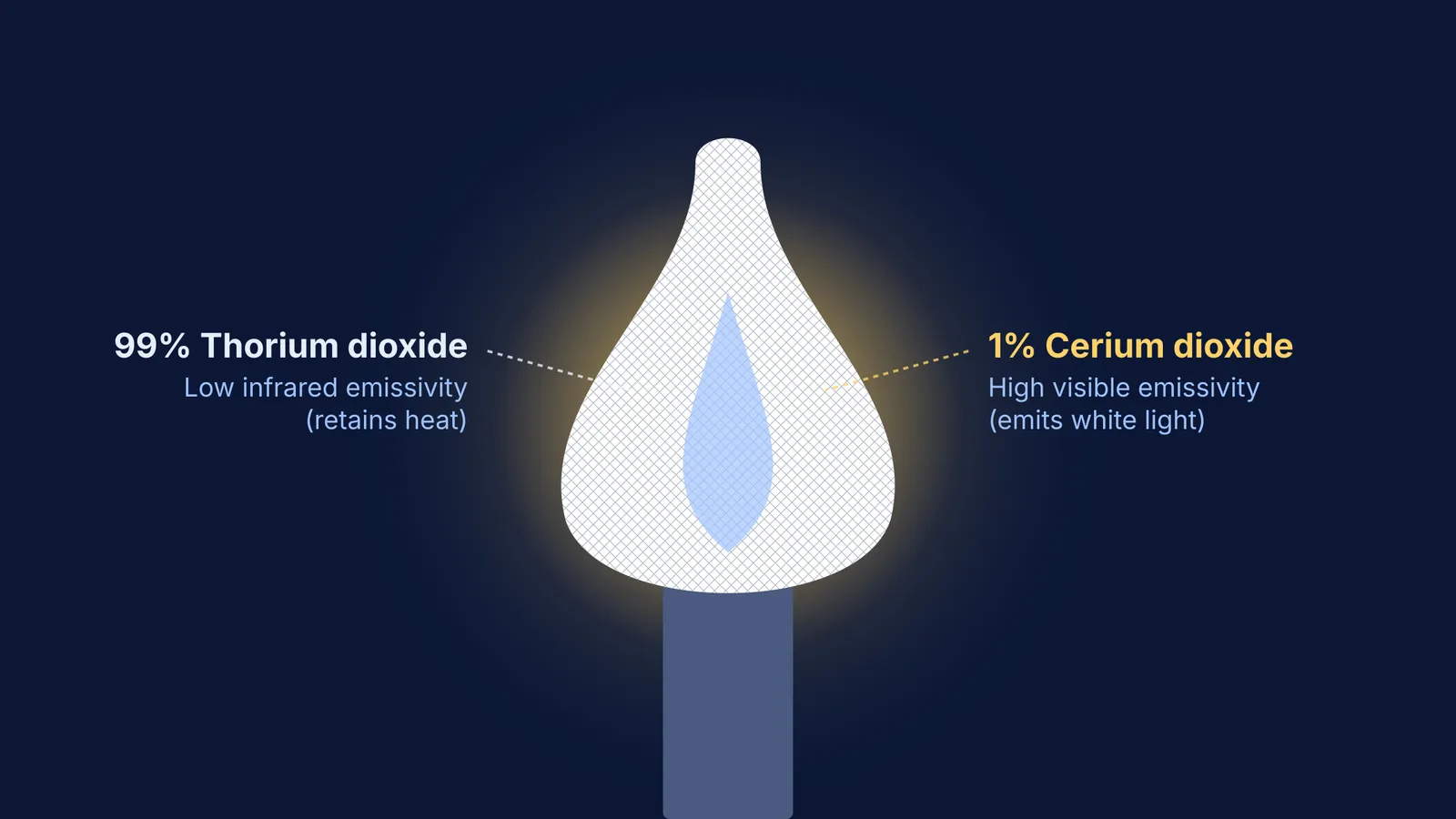
By 1891, he had perfected a completely new formula that became the global industry standard: 99% thorium dioxide and 1% cerium dioxide (Wikipedia). To manufacture the mantle, a pear-shaped mesh of silk, cotton, or rayon is soaked in a solution of these metallic nitrates. When the mantle is heated by a flame for the first time, the organic fabric burns away completely in a matter of seconds. What remains is a delicate but rigid ceramic skeleton of metal oxides that hangs like a small cloak over the burner.
How do rare earths produce light?
The brilliance of the Welsbach mantle is a classic demonstration of selective emissivity in physics. A standard object (approximating a "black body") heated in a flame emits a broad spectrum of radiation. At typical flame temperatures, most of this energy is wasted as invisible infrared radiation (heat), leaving only a dim glow in the visible spectrum.
The Welsbach mixture circumvents this waste by acting as a selective radiator. To understand how the mantle beats a standard flame in luminous efficiency, follow the energy step by step:
The flame provides heat: The gas burns, supplying chemical energy to create a high-temperature but non-luminous environment.
Thorium prevents heat loss: The 99% thorium dioxide (Wikipedia) acts as the structural refractory base. Thorium dioxide has an exceptionally low emissivity in the infrared spectrum. Because it cannot radiate heat efficiently, the ceramic skeleton retains its thermal energy and reaches a much higher temperature than a normal object would in the same flame.
Cerium converts the energy to light: The 1% cerium dioxide acts as the light-emitting activator. Unlike thorium, cerium has a very high emissivity in the visible spectrum (specifically in the blue and green ranges). Powered by the extreme heat trapped by the thorium matrix, the cerium converts the thermal energy directly into brilliant white light.
The 99-to-1 ratio is highly sensitive. If more than 1% cerium is added, the overall infrared emissivity of the mantle increases. The structure begins to radiate away its heat too quickly, lowering the temperature of the mantle and causing the visible light output to drop sharply.
Understanding why some elements emit visible light while others waste energy as heat requires a solid grasp of atomic structure and thermodynamics. If you are learning the principles behind electron transitions, emissivity, and radiation, the Fermi Concept Library has every concept in physics, chemistry, biology, mathematics and computing, each with its own lesson and its place in the map. The quest for efficient, bright white light eventually led scientists from gas mantles to solid-state physics; you can read about Akasaki, Amano, Nakamura and the blue LED behind white LED light.


