

On this page
Every day, your bloodstream carries a vital but dangerous cargo: cholesterol. Packed into Low-Density Lipoprotein (LDL) particles, cholesterol is essential for building cell membranes and regulating hormones. But if too much LDL stays in the blood, it clogs arteries and causes premature atherosclerosis and heart attacks.
Since the early days of Santorio Santorio and the weighing chair of metabolism, scientists have tried to understand how the body regulates its internal chemistry. For decades, however, no one understood exactly how cells cleared cholesterol from the bloodstream.
The answer came from Michael S. Brown and Joseph L. Goldstein, whose research fundamentally changed our understanding of heart disease and earned them the 1985 Nobel Prize in Physiology or Medicine.
How does the body clear cholesterol from the blood?
To solve the cholesterol mystery, Brown and Goldstein studied Familial Hypercholesterolemia (FH), a severe hereditary disease. Patients with FH suffer from dangerously high levels of blood cholesterol, often experiencing heart attacks at a very young age.
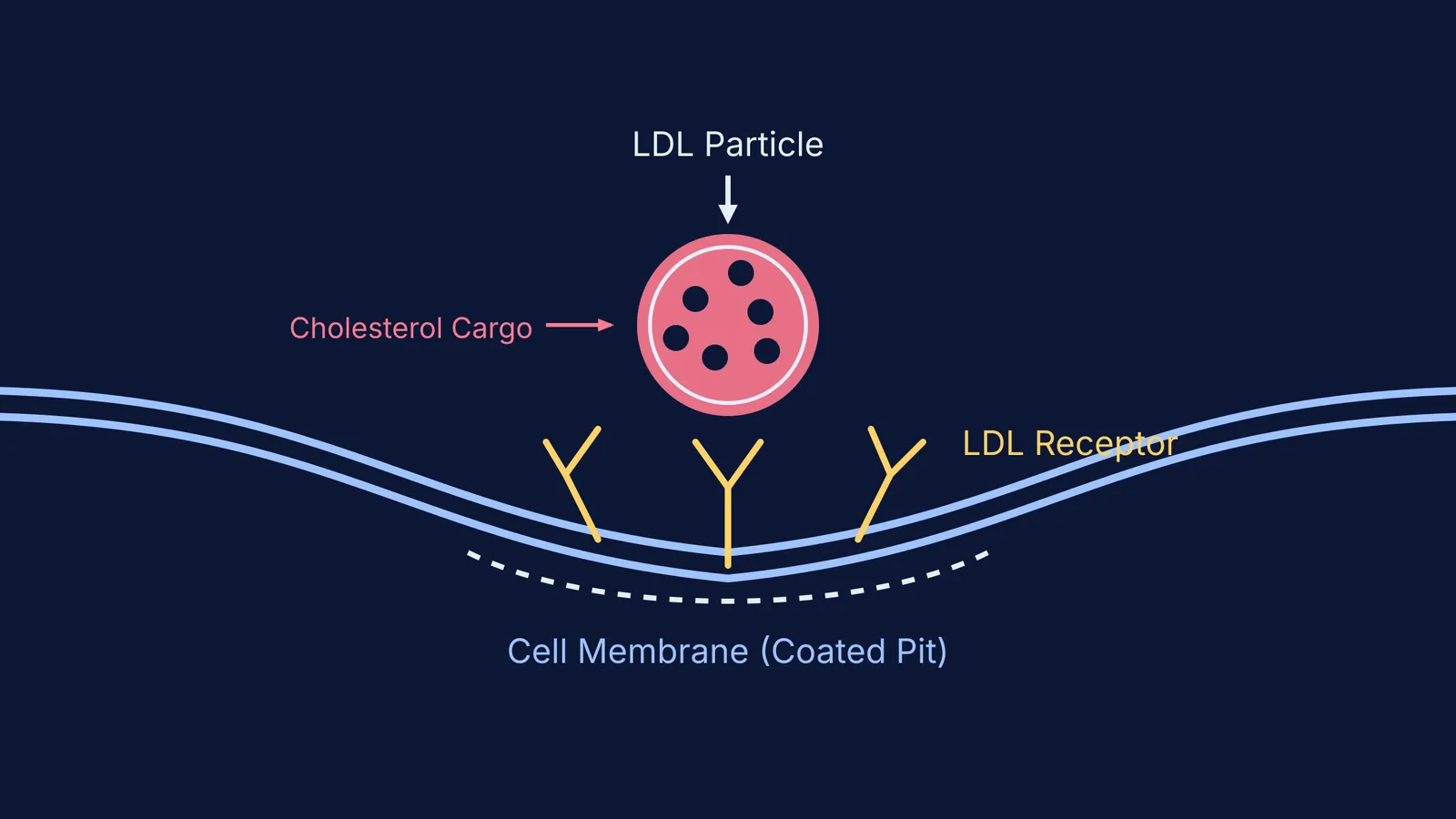
Through their research, Brown and Goldstein discovered that normal cells have specific "docking stations" on their surface, known as LDL receptors. They identified that patients with FH suffer from a complete or partial lack of functional LDL receptors (Nobel Prize Press Release, 1985).
They detailed an elegant mechanism known as receptor-mediated endocytosis. When an LDL particle drifts by, it binds to an LDL receptor located in a specialized region of the cell membrane called a "coated pit." The cell then internalizes this pit, bringing the LDL particle inside to release its cholesterol. After dropping off its cargo, the empty receptor is recycled back to the cell surface to grab another particle.
How did this lead to statins?
Brown and Goldstein did not just map the receptor; they uncovered the sophisticated feedback loop that controls it.
Cells can either synthesize their own internal cholesterol or take it from the blood. The researchers found that when a cell takes up enough cholesterol, it inhibits its own internal cholesterol synthesis. At the same time, it reduces the number of LDL receptors it produces on its surface (Nobel Prize Press Release, 1985).
This single insight changed modern medicine. It revealed that if you could slow down the liver's internal cholesterol production, the cells would compensate by producing more LDL receptors. These extra receptors would then sweep the excess LDL out of the bloodstream.
This mechanism led to the development of a new class of drugs called statins. By forcing the liver to increase its LDL receptors, statins successfully lower blood cholesterol levels. Brown and Goldstein famously speculated that their results hold the promise that one day people might "have their steak and live to enjoy it too." For extreme cases of FH where receptors are entirely missing, their research also provided the medical rationale for liver transplantation to give patients functional receptors.
A framework for mastering biological mechanisms
When you study topics like membrane receptors vs intracellular receptors, it is easy to get lost in the terminology. But biology is not just a list of vocabulary words; it is a system of logical feedback loops.
If you are struggling to map out how a cellular pathway works, Fermi's AI tutor can help. Rather than just giving you the answer, the tutor holds a line of reasoning across a session. It notices where you are stuck and decides whether to explain, ask, or show—drawing the figure and checking your understanding as you trace the mechanism step by step.
Next time you encounter a complex biological process, use this three-step pathway check:
Find the trigger: What starts the process? (For the LDL receptor, it is a cell needing cholesterol).
Follow the physical movement: Where do the molecules go? (LDL binds to the receptor, enters a coated pit, and releases its cargo inside).
Locate the feedback switch: How does the pathway turn itself off? (High cholesterol levels inside the cell shut down both internal synthesis and new receptor production).
When you understand the trigger and the feedback switch, the names in the middle stop being a list to memorise and become the moving parts of an elegant machine.


