On this page
Most area formulas need a height or an angle. Brahmagupta's needs only the four side lengths, provided the corners all sit on one circle.
What is Brahmagupta's formula?
For a cyclic quadrilateral with sides a, b, c and d, the area K is √[(s−a)(s−b)(s−c)(s−d)], where s = (a + b + c + d)/2 is the semiperimeter (Wolfram MathWorld).
A quadrilateral is cyclic when a single circle passes through all four vertices. A quick test you know from school: its opposite angles add up to 180°, the condition MathWorld writes as A + B = π. If you want a refresher on why that is true, our post on circles and cyclic quadrilaterals in Class 9 walks through the theorem.
The formula is symmetric, so the order in which you list the sides does not matter.
Who was Brahmagupta, and how did he state it?
Brahmagupta was born in 598 and wrote the Brahmasphutasiddhanta in 628, at Bhillamala (modern Bhinmal), according to the MacTutor History of Mathematics biography. He also became head of the astronomical observatory at Ujjain. The same book holds his rules for arithmetic with zero, which we covered in Brahmagupta's rules for zero, and the one he got wrong.
He wrote in verse, with no algebraic symbols. In the translation by Saraswati Amma, quoted by S. G. Dani in a paper on quadrilateral mensuration, verse XII.21 reads: "The gross area of a triangle or quadrilateral is the product of half the sum of the opposite sides. The exact area is the square-root of the product of the four sets of half the sum of the sides (respectively) diminished by the sides."
Read the second sentence slowly and you can see the modern formula: "half the sum of the sides" is s, "diminished by the sides" gives s−a, s−b, s−c, s−d, and you take the square root of their product.
How do you use Brahmagupta's formula? A worked example
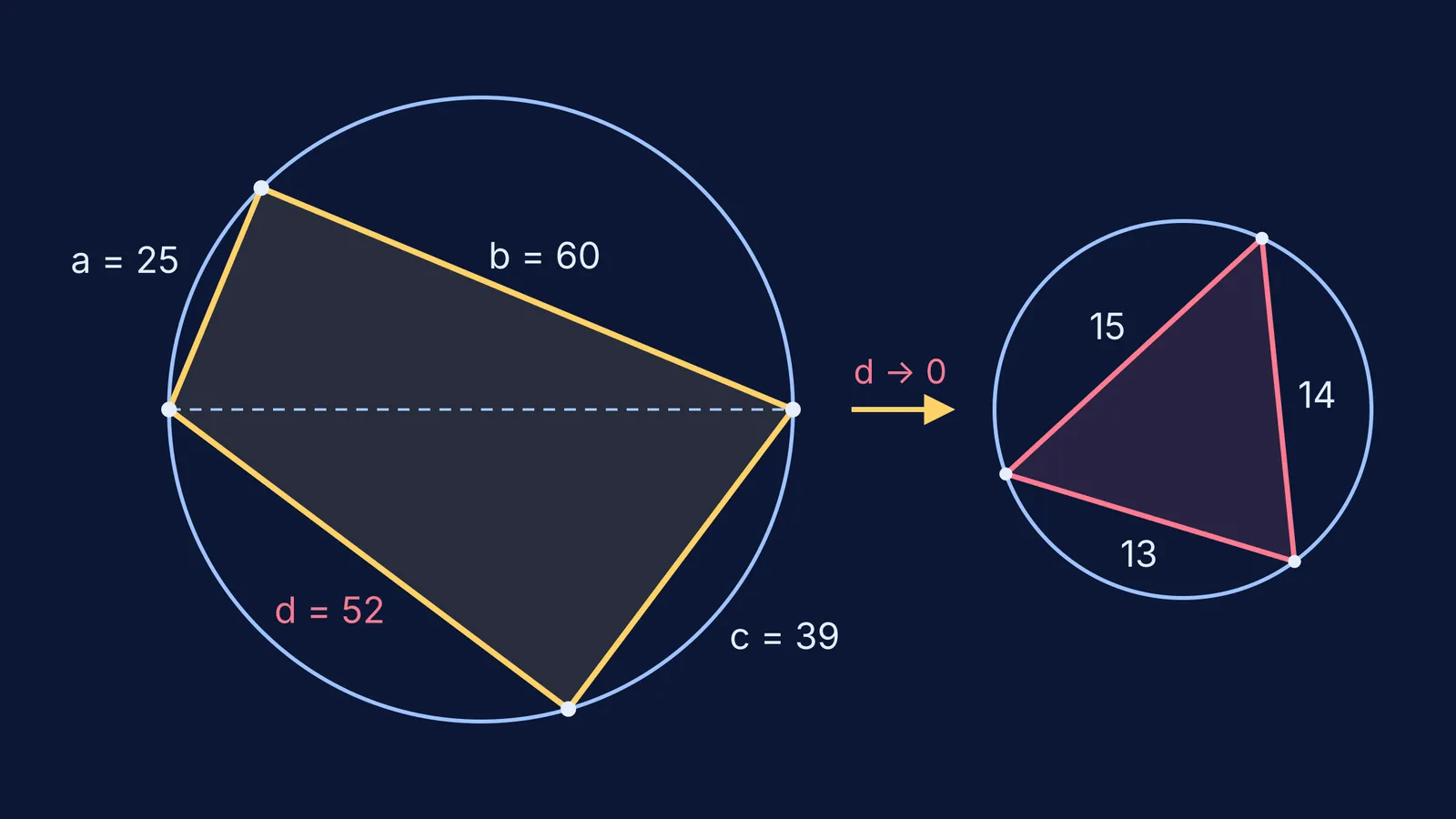
Take a quadrilateral ABCD inscribed in a circle of diameter 65, with AB = 25, BC = 60, CD = 39 and DA = 52 (the figure at the top of this page). Follow these steps.
Check it is cyclic. Here the diagonal AC is a diameter, so the angles at B and D are both 90° and add to 180°.
Find s: (25 + 60 + 39 + 52)/2 = 176/2 = 88.
Subtract each side: 88 − 25 = 63, 88 − 60 = 28, 88 − 39 = 49, 88 − 52 = 36.
Multiply: 63 × 28 × 49 × 36 = 3,111,696.
Take the square root: K = 1764.
Now check it another way. The diameter splits the shape into two right triangles. Triangle ABC has legs 25 and 60, area 750. Triangle ACD has legs 39 and 52, area 1014. Together: 1764, the same answer.
For comparison, Brahmagupta's "gross" rule (half the sum of each pair of opposite sides, multiplied) gives 32 × 56 = 1792, close but not exact. That is why he gave both.
How does Brahmagupta's formula become Heron's formula?
A triangle can be treated as a quadrilateral with one side of length zero, and every triangle fits in a circle, so setting d = 0 turns Brahmagupta's formula into Heron's formula (Wikipedia, Brahmagupta's formula).
With d = 0, the factor (s − d) becomes just s, and you get K = √[s(s−a)(s−b)(s−c)]. Try it on a triangle with sides 13, 14 and 15: s = 21, and √(21 × 8 × 7 × 6) = √7056 = 84. If the Class 9 version is new to you, see Heron's formula in Class 9.
What if the quadrilateral is not cyclic?
Then Brahmagupta's formula gives the wrong answer, and always too big a one. The general version, Bretschneider's formula, subtracts a term: K = √[(s−a)(s−b)(s−c)(s−d) − abcd cos²θ], where θ is half the sum of either pair of opposite angles (Wikipedia). For a cyclic quadrilateral θ is 90°, so the extra term vanishes, which is why a cyclic quadrilateral has the largest area of any quadrilateral with the same sides (MathWorld).
A rhombus with side 5 and a 60° angle shows the trap. Brahmagupta's formula says √(5 × 5 × 5 × 5) = 25. The true area is 5 × 5 × sin 60° ≈ 21.65. Bretschneider fixes it: opposite angles 60° + 60° give θ = 60°, cos²θ = 0.25, and √(625 − 625 × 0.25) = √468.75 ≈ 21.65.
If you are unsure why opposite angles of a cyclic quadrilateral add to 180°, that is a concept gap, and the Fermi Concept Library has a lesson for each mathematics concept with its place in the map. For practice sums, the Fermi Problem Library has a step-by-step solver that explains the reasoning rather than printing an answer.