

On this page
A seedling on a windowsill leans towards the light. In 1880 Charles Darwin knew the tip sensed the light while a lower part did the bending, but not what travelled between them. In 1913 the Danish plant physiologist Peter Boysen Jensen answered part of that with two everyday materials: a layer of gelatin, which lets dissolved chemicals through, and a flake of mica, a mineral that chemicals cannot cross.
His paper, "Über die Leitung des phototropischen Reizes in der Avenakoleoptile" (on how the light stimulus is conducted in the oat coleoptile), appeared in Berichte der Deutschen Botanischen Gesellschaft, volume 31, pages 559-566. Boysen Jensen was born in 1883 and was professor of plant physiology at the University of Copenhagen from 1927 to 1948, according to Store norske leksikon.
What did Darwin already know about phototropism in 1880?
Charles Darwin and his son Francis published *The Power of Movement in Plants* on 6 November 1880, according to Darwin Online. Working with seedlings of canary grass (*Phalaris*) and oats (*Avena*), they found that covering the tip stopped the bending, even though the bending happened lower down. Their conclusion, in the book's own words: "We must therefore conclude that when seedlings are freely exposed to a lateral light some influence is transmitted from the upper to the lower part, causing the latter to bend." What that influence was, the book could not say.
What did Boysen Jensen do with gelatin and mica?
He ran two tests on oat coleoptiles, the sheath that covers a young grass shoot. The Kimball biology pages on tropisms and the LibreTexts biology textbook both describe them.
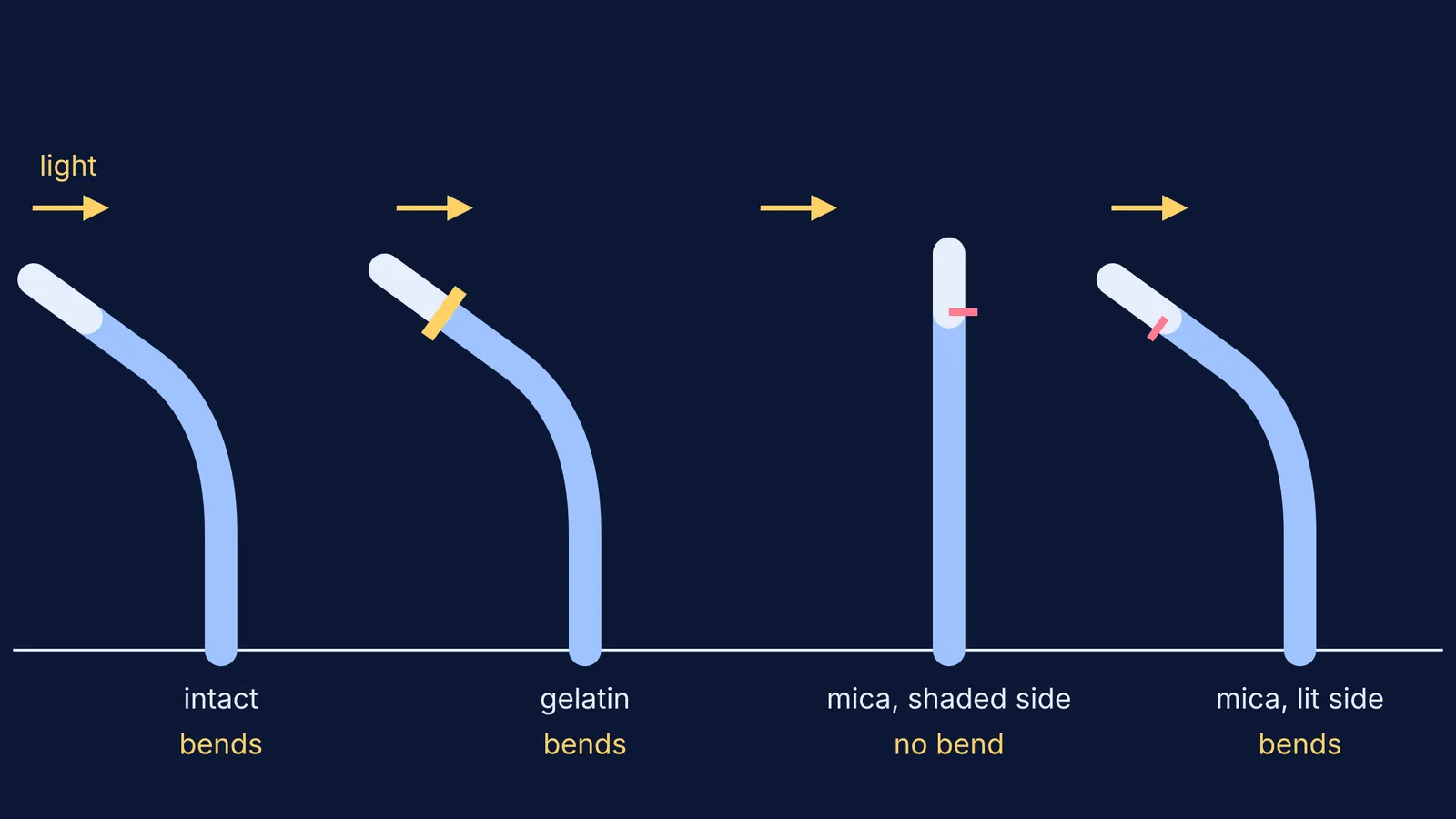
Gelatin. He cut off the tip, covered the stump with a layer of gelatin and put the tip back. Lit from one side, the seedling still bent towards the light.
Mica. He made a cut just below the tip on one side and slipped in a thin sheet of mica. Bending stopped only when the mica was on the shaded side. With the mica on the lit side, the seedling still bent towards the light.
The gelatin result means the signal does not need living cells to be joined up: it can cross a non-living layer, as a dissolved chemical would. The mica result says where it travels.
Why does the side of the mica matter?
A shoot bends towards light because cells on the shaded side grow longer than cells on the lit side. If the growth-promoting chemical runs down the shaded side, blocking that side removes the extra growth there, and the shoot stays straight. Blocking the lit side leaves the shaded flow intact, so the bend still happens. The refined experiment showed that the signal travels on the shaded side, as the LibreTexts chapter notes.
Students often mix this up. If you remember "the bend comes from extra growth on the dark side", you can work out which mica position matters instead of memorising it.
How did this lead to Went and auxin?
Boysen Jensen showed that the signal was a chemical. He did not collect it. Frits Went later put cut coleoptile tips on small blocks of agar, let the substance soak in, and showed that a block alone could restart growth in a tipless coleoptile, and that a block set on one edge made it bend; the substance was named auxin, as the Kimball tropisms page explains. The same page notes that the auxin plants actually use turned out to be indole-3-acetic acid (IAA). Read the next chapter in our story of Frits Went, oat seedlings and the discovery of auxin.
How do you write this experiment in an exam answer?
Examiners want the setup, the result and the conclusion for each step, in order. Use this four-line plan:
Darwin (1880): tip covered, no bending; an influence passes from the tip to the region below.
Boysen Jensen, gelatin (1913): tip cut off and replaced over gelatin, bending continues; the influence is a chemical that can diffuse.
Boysen Jensen, mica (1913): mica on the shaded side, no bending; mica on the lit side, bending; the chemical moves down the shaded side.
Went: tips on agar blocks, the block alone restarts growth, and a block on one edge causes bending; the chemical can be collected, and it was named auxin.
Test yourself before you look back: what happens if mica replaces the gelatin in step 2? (No bending: nothing can cross.) What if the tip is removed and nothing is put back? (No bending: there is no source of the chemical.)
If you need to place auxin among the other plant hormones, our guide to matching each plant growth regulator to its effects and our explainer on phototropism, geotropism and other tropic movements in Class 10 cover the syllabus side.
If one link in the chain, such as why extra growth on one side makes a shoot bend, still feels shaky, the Fermi Concept Library has a lesson for every concept in biology, each placed in a map of related ideas. You can also ask Fermi's AI tutor to draw the figure and check your understanding as you go.


