

On this page
Biruté Galdikas's research in Borneo has fundamentally changed what we know about how great apes live, learn, and reproduce. Since establishing her base, her work has highlighted just how fragile the orangutan's survival is, while offering a unique window into the biology of learning.
What did Biruté Galdikas discover about orangutans in Borneo?
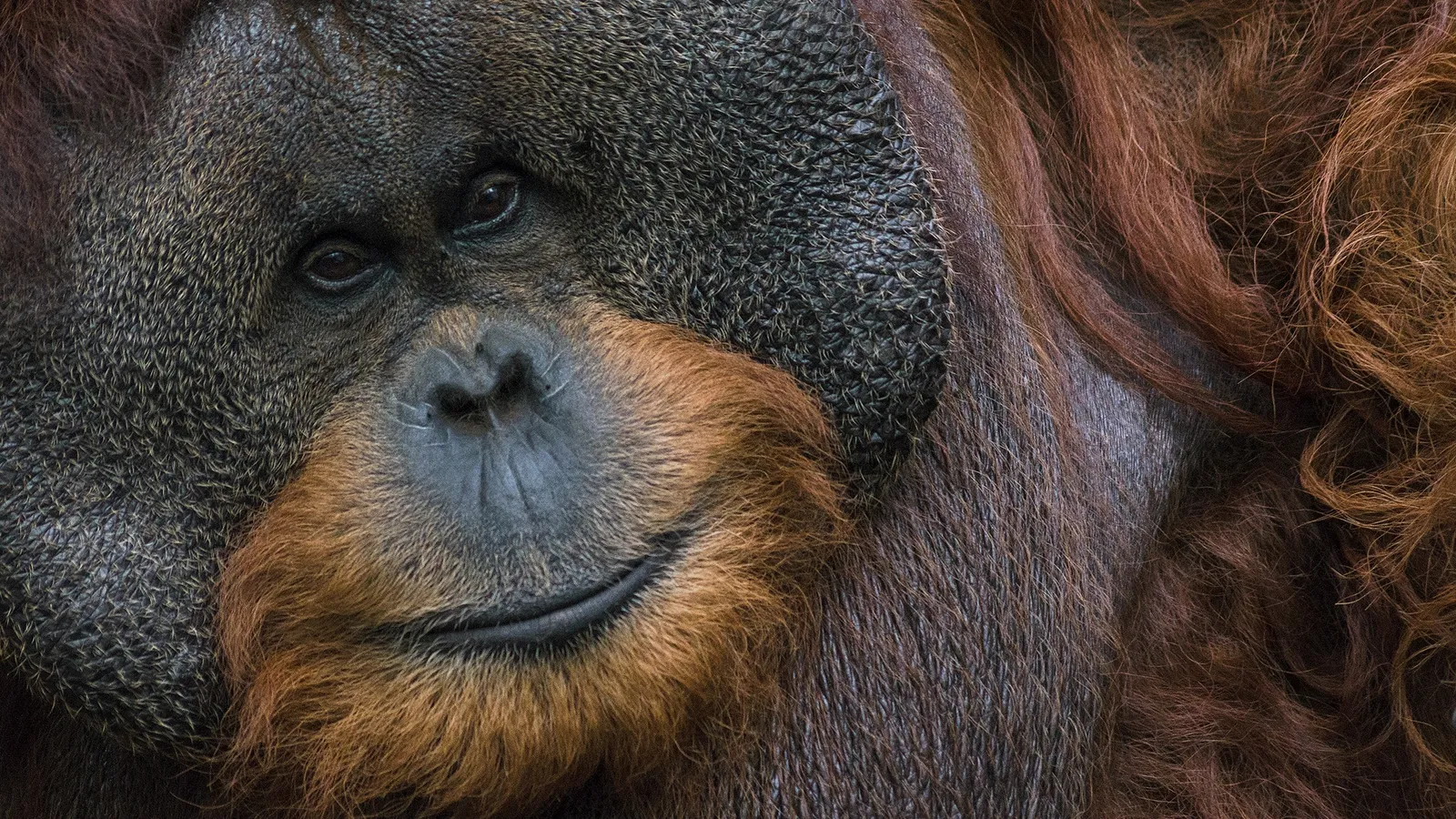
Dr. Biruté Galdikas began her landmark study of orangutans in 1971 at Camp Leakey in Tanjung Puting, Borneo (Orangutan Foundation International). Before her arrival, very little was known about the lives of wild orangutans because they are solitary and spend most of their time high in the dense rainforest canopy. Her research established that wild female orangutans give birth only once every 7.7 years (Orangutan Foundation International). This is the longest interbirth interval of any land mammal.
Because they reproduce so slowly, an orangutan population cannot easily recover from threats like deforestation or hunting. A 40-year longitudinal study (1971–2011) of orangutans at Camp Leakey showed that this slow rate of reproduction is driven by the poor quality of their natural diet; when given extra food, they gave birth more frequently than wild orangutans (Springer). If a forest environment is destroyed, the small, isolated groups that survive are at severe risk of disappearing entirely, much like the isolated groups studied in Sewall Wright and genetic drift: why small populations wander.
Why is the orangutan interbirth interval so long?
Unlike many animals that rely purely on instinct from the moment they are born, an orangutan must learn complex, localized survival skills to live in the rainforest canopy. A young orangutan stays close to its mother for up to 8 to 10 years (Orangutan Foundation International).
During this extended period, the mother acts as a full-time teacher. She teaches her offspring how to build safe sleeping nests high in the trees, bending and weaving branches every night. More importantly, she demonstrates how to identify various food sources across the changing seasons. The Bornean rainforest does not fruit all year round, so a young orangutan must memorize a mental map of where and when to find specific fruits, leaves, and bark to survive the lean months.
Understanding how an animal actively learns to survive is a key part of studying biology and ecology, echoing the foundational approaches seen in Niko Tinbergen and the four questions of animal behaviour.
What can we learn from how orangutans learn?
We often expect to master a tough subject in a short time, but deep learning requires time, repetition, and guided practice. An orangutan mother acts as a constant guide, pointing out what is safe and what is not, ensuring her young one builds a solid foundation of knowledge before navigating the canopy alone.
When you are learning biology, chemistry, or physics, having a guide who knows what you need to focus on changes how you learn. Fermi's AI tutor teaches rather than answers: it holds a line of reasoning across a session, notices where you are stuck, and decides whether to explain, ask or show. It works out what you know and builds a plan for the session, so you sit down to a clear next step.
When you encounter new concepts in ecology or conservation, you do not have to memorize them blindly. You can explore the Concept Library to see how species, habitats, and life cycles connect, building your own mental map just as a young orangutan builds a map of the forest.
How can you apply the orangutan's focus to your studies?
If you are preparing for important exams, take a lesson from the orangutan's long, deliberate apprenticeship. Rushing through material rarely leads to real understanding. Here is a framework to pace your learning:
Focus on the fundamentals: Just as a young orangutan learns the basic, reliable foods first, master the core concepts in your textbook before moving to complex, multi-step problems. If you skip the basics, you will struggle when the questions become harder.
Accept the learning curve: Do not panic if a difficult topic takes time to make sense. True mastery is a slow process, and encountering friction is a normal part of building long-term memory.
Embrace active observation: The young ape watches its mother closely before trying to build a nest. When studying, read through worked examples carefully before attempting to solve a new problem on your own.
Use guided practice: Find a mentor, a teacher, or a tool that helps you think through a problem step by step instead of just giving you the final answer.
Orangutans are a powerful reminder that survival in a complex environment depends heavily on what you learn and who guides you along the way.


