

On this page
South Africa’s Witwatersrand region, near Johannesburg, experiences some of the most frequent and intense thunderstorms on Earth. In the early 1930s, a South African physicist named Basil Schonland realised that this natural laboratory offered a unique opportunity. Lightning had long been a mystery—a sudden flash too bright and fast for the human eye to track. Scientists understood it was a massive electrical discharge, much like the static spark that jumps from a doorknob to your hand, but nobody knew exactly how an electrical path was carved through kilometres of insulating air.
By employing a specialised high-speed camera, Schonland and his colleague H. Collens produced the first photographic evidence of the multi-stage mechanism behind a lightning strike. Their 1934 paper, "Progressive Lightning", published in the Proceedings of the Royal Society, proved that the brilliant flash we see is not a single instantaneous spark, but rather the climax of a complex sequence of events.
How did the Boys camera photograph a lightning strike?
Standard cameras of the 1930s could only capture a lightning bolt as a static, smeared line. To freeze events happening in millionths of a second, Schonland and Collens used an instrument invented by Sir Charles Vernon Boys. The Boys camera did not rely on a fast mechanical shutter; instead, it used two lenses mounted on a disk that revolved at high speed in opposite directions.
As the lenses rapidly spun, they exposed a fixed photographic plate (Proceedings of the Royal Society). Because the lenses were moving, the two images of the lightning were slightly distorted in opposite directions across the film. By comparing the differences between the two pictures and knowing the exact rotational speed of the lenses, the researchers could calculate both the direction and the velocity of the developing discharge with microsecond precision. For the first time, researchers had a tool fast enough to watch a lightning bolt assemble itself.
What is a stepped leader in a lightning strike?
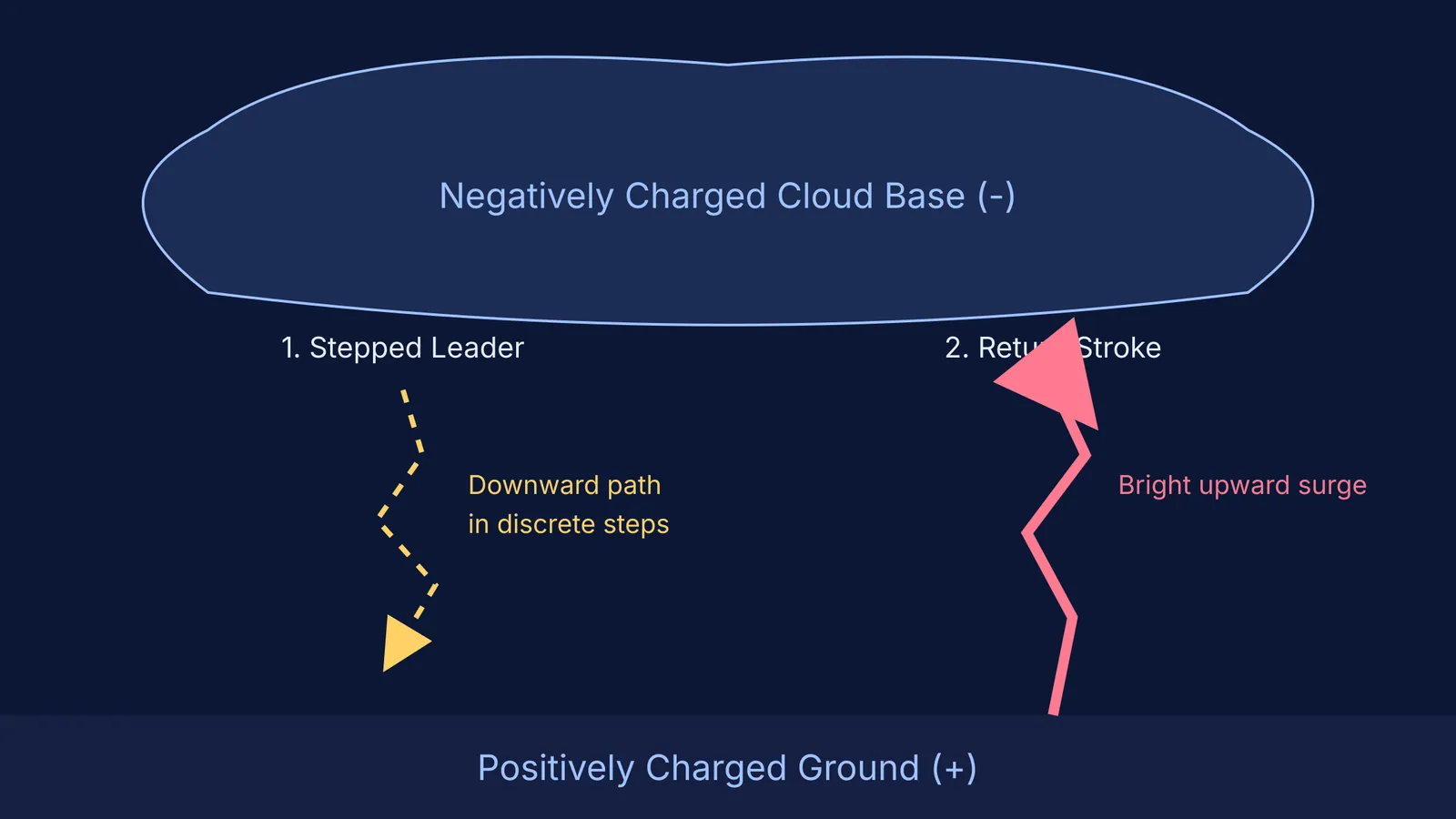
Before Schonland's work, it was generally assumed that a lightning bolt simply arced directly from the cloud to the earth. The Boys camera photographs revealed a far more intricate process. Schonland and Collens discovered that a lightning strike to the ground is initiated by a faint, downward-moving discharge called the "stepped leader".
This initial leader does not flow in a continuous stream. Instead, it descends from the negatively charged cloud base in discrete steps. Each step is approximately 50 metres long, followed by a pause of about 50 microseconds (Proceedings of the Royal Society). The leader branches out as it seeks the path of least electrical resistance through the air. Because the stepped leader carries a relatively low current and its light is dim, it is invisible to the naked eye.
When you are Reading electric and magnetic field lines without common mistakes, the stepped leader represents the breakdown of the air's insulation as the immense electric field overcomes it. This concept is fundamental to the study of atmospheric electricity, a topic you can explore in the Fermi Concept Library, which covers every concept in physics, chemistry, biology, mathematics and computing, each with its own lesson and its place in the map.
What is the return stroke?
As the stepped leader nears the ground, its strong negative charge repels electrons in the earth, drawing a surge of positive charge upwards. This creates an intense electric field that pulls an "upward leader" from a tall object, such as a tree, a building or a lightning rod.
When the downward stepped leader and the upward leader meet, the electrical circuit is closed. A massive surge of positive current then travels violently back up the pre-ionised channel carved by the stepped leader. This upward surge is known as the "return stroke". The return stroke travels upwards at an average speed of 2 × 10⁷ metres per second (Proceedings of the Royal Society). It is this return stroke, carrying tens of thousands of amperes of current, that produces the blinding flash and the explosive thunderclap we experience during a storm.
A framework for understanding lightning protection
Schonland’s discovery did more than solve a physics puzzle; it provided the scientific foundation for modern lightning protection. If you are examining a building's lightning defence system, you can analyse it through the sequence of the progressive lightning model:
The approach: The stepped leader descends from the storm cloud, searching for the easiest path to ground.
The interception: A lightning rod does not attract the leader from miles away, but its sharp point concentrates the local electric field, reliably launching an upward leader earlier than the surrounding roof structure.
The connection: The upward leader from the rod meets the downward stepped leader, completing the circuit above the building rather than through it.
The safe path: The violent return stroke travels through the heavy copper or aluminium down-conductors of the protection system, safely dissipating its immense energy into the earthing rods buried in the ground.
If you find it difficult to picture how these high-speed invisible charges interact, the Fermi Simulation Lab provides interactive simulations for the ideas that are easier to see than to read. By dissecting the microsecond anatomy of a spark, Basil Schonland turned lightning from a terrifying mystery into a predictable, measurable phenomenon.


