On this page
If a weightlifter builds big muscles, will their children be born stronger? Most people now say no, but for most of the nineteenth century many biologists, including Darwin in some cases, thought acquired traits could be inherited. August Weismann argued they could not, explained why with a theory of the germ plasm, and ran a famous experiment to test the opposite view. This post explains his theory, works through his mouse data, and links his ideas to what you study as meiosis.
Who was August Weismann?
Weismann was a German zoologist. William Locy's 1908 history Biology and Its Makers gives his birth year as 1834, and Nature published his obituary in November 1914. He worked at the University of Freiburg. The collected English edition of his Essays upon Heredity includes his inaugural lecture as Pro-Rector of the university, "On Heredity", given in the university hall on 21 June 1883.
What is the germ plasm theory?
Weismann divided the cells of an animal into two kinds. Reproductive cells, he wrote in that 1883 lecture, are "without significance for the life of the individual", yet "they alone possess the power of preserving the species". The other cells, the body or somatic cells, do the work of living but are not passed on.
In his 1885 essay on the continuity of the germ plasm, he stated the core idea: heredity is brought about "by the transference from one generation to another, of a substance with a definite chemical, and above all, molecular constitution". This germ plasm passes from the reproductive cells of one generation to those of the next. The body is built from it each time but does not feed changes back into it.
The consequence was sharp. If he was right, he wrote, "the whole principle of evolution by means of exercise (use and disuse), as proposed by Lamarck, and accepted in some cases by Darwin, entirely collapses."
How did Weismann test the inheritance of mutilations?
People at the time offered stories of animals born without tails because their parents had lost them. Weismann decided to test the claim directly. In the essay "The Supposed Transmission of Mutilations", in the same collection, he describes the experiment.
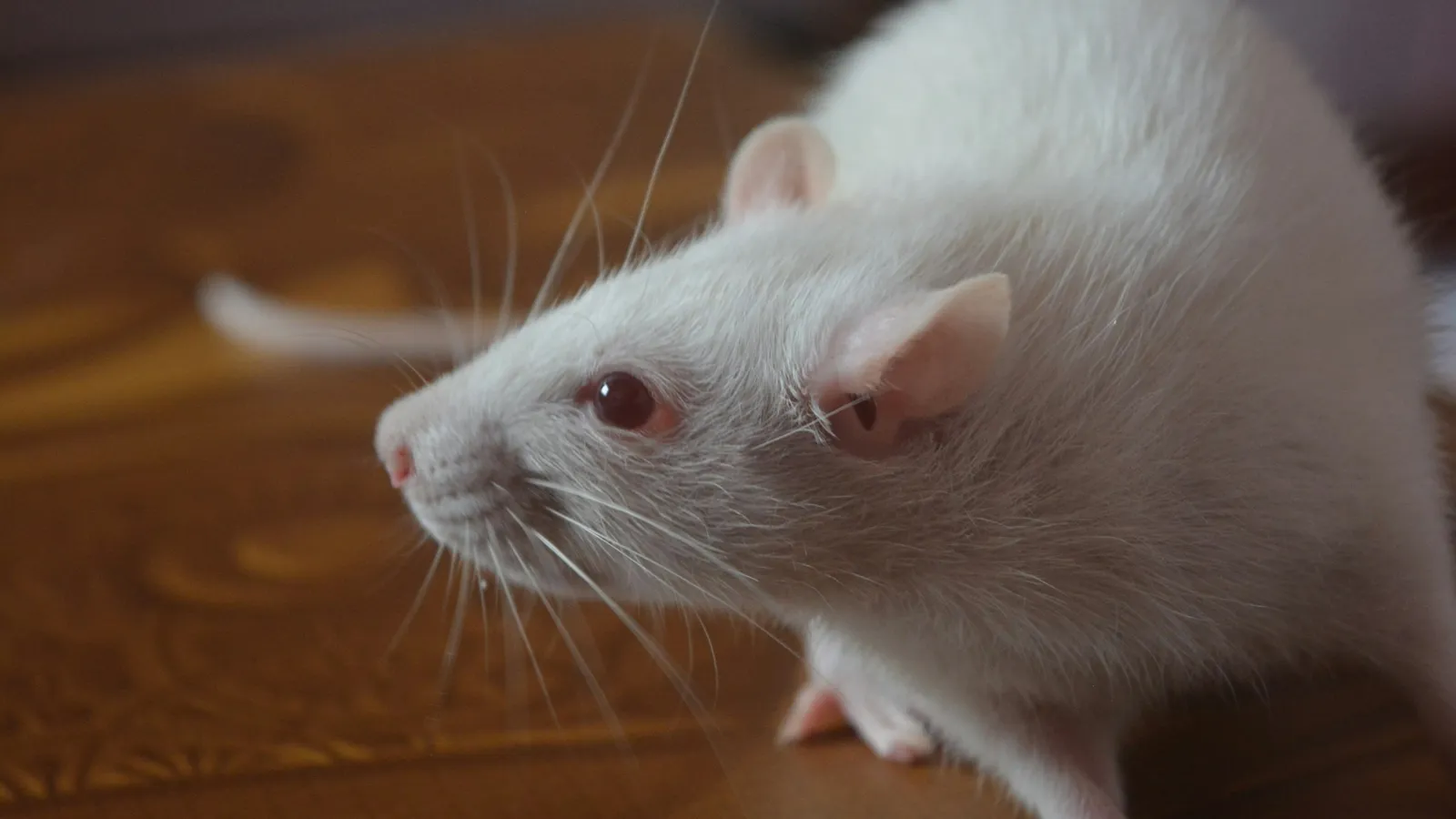
In October 1887 he took seven female and five male white mice and cut off all their tails on 17 October.
The first litters were born on 16 November. Mouse pregnancy, he noted, lasts only 22 to 24 days, so these young developed while both parents were tailless.
He kept breeding, cutting the tails of each new generation of parents, through five generations.
Worked example: checking Weismann's numbers
Weismann reports the young born to each generation of tailless parents up to 16 January 1889:
First generation of parents: 333 young.
Second: 237 young.
Third: 152 young.
Fourth: 138 young.
Fifth: 41 young.
Add them: 333 + 237 = 570; 570 + 152 = 722; 722 + 138 = 860; 860 + 41 = 901. That matches his total of 901. Not one had a rudimentary tail. He measured them too: a newborn mouse's tail is 10.5 to 12 mm long, and none was shorter than 10.5 mm.
Check the timing as well. From 17 October to 16 November is 30 days. With a pregnancy of at most 24 days, those first young were conceived at least six days after the tails were cut.
Weismann was careful about what this proved. He asked whether the experiments, taken alone, settled the question for good, and answered "Certainly not". A critic could object that five generations were too few, and that an effect might appear only after ten or a hundred. He rested his case on the experiment together with other facts, not on the mice alone. Our post on Lamarck's theory of evolution explains the idea he was testing.
How did Weismann predict reduction division?
Here is a puzzle. If each parent passes on its full germ plasm, then a fertilised egg has double the amount, and the amount would keep doubling every generation. In his 1887 essay on polar bodies, Weismann proposed two kinds of nuclear division. In an "equal division", each daughter nucleus gets the full set. In a "reducing division", each daughter nucleus "receives only half the number of ancestral germ-plasms possessed by the mother-nucleus." He argued that germ cells must go through such a reducing division.
That is the idea behind meiosis, which halves the chromosome number before fertilisation restores it. Our guide to the cell cycle, mitosis and meiosis covers the modern details.
Common mistakes
Saying the tail experiment alone disproved Lamarck. Weismann himself said it did not, taken alone, because five generations might be too few.
Confusing germ plasm with DNA. Weismann did not know about DNA. His germ plasm was a hypothetical hereditary substance, later identified with chromosomes and genes.
Mixing up somatic and germ cells. Mutations in body cells can cause disease in a person but are not passed to children. Only changes in the germ line can be.
If questions on meiosis or the germ line still trip you up, the Fermi Problem Library has a step-by-step solver that explains the reasoning rather than just printing an answer.
Practice routine: write a three-step argument, in your own words, for why a parent's trained muscles are not inherited, using the terms somatic cell, germ cell and meiosis.
Next step: add up Weismann's five numbers yourself, then write one sentence on why five generations is a stronger test than one.