On this page
In 2014, the International Mathematical Union awarded the Fields Medal to Artur Avila, making him the first Latin American and the first lusophone (Portuguese speaker) to receive the highest honour in mathematics. Born in Rio de Janeiro in 1979, Avila did not follow the traditional route of moving to North America or Europe for his mathematical training. Instead, he earned his PhD at the age of 21 from Brazil's Instituto Nacional de Matemática Pura e Aplicada (IMPA) (Wikipedia).
He was recognised for his "profound contributions to dynamical systems theory, which have changed the face of the field" (IMU, 2014). Today, he holds positions at IMPA and the University of Zurich, and his work continues to shape how we understand chaos and stability.
What is a dynamical system in mathematics?
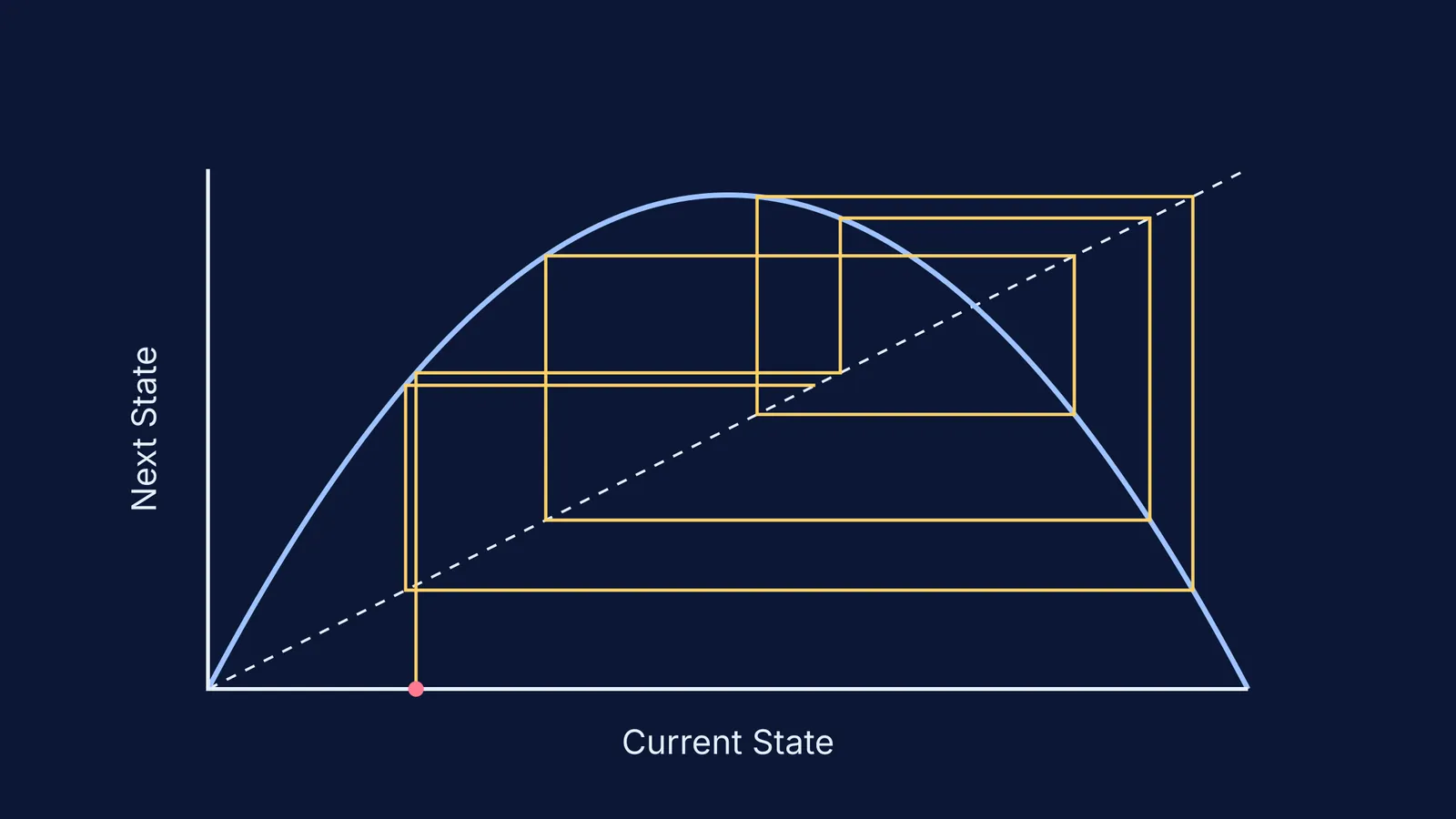
A dynamical system is a set of rules that describes how a state evolves over time. If you know the state of the system right now, the rules tell you what its state will be in the next instant. A swinging pendulum, the population of a species from year to year, the weather, and planetary orbits are all examples of dynamical systems.
Mathematicians study these systems to predict their long-term behaviour. They ask whether a system will eventually settle down, repeat in a stable orbit forever like simple harmonic motion, or become chaotic. In a chaotic system, a microscopic change in the starting conditions leads to completely different outcomes, making long-term prediction impossible.
This mathematical landscape can be hard to picture from equations alone. The Fermi Simulation Lab has interactive simulations for the ideas that are easier to see than to read. You can watch how small changes in a system alter its path in real time, making the difference between stability and chaos visible.
What was the "Ten Martini Problem"?
One of Avila's most famous breakthroughs was solving the "Ten Martini Problem" with his collaborator Svetlana Jitomirskaya. The problem concerned the almost Mathieu operator, a mathematical model used to describe an electron in a two-dimensional crystal lattice under a magnetic field.
In 1981, the mathematician Mark Kac offered ten martinis to anyone who could prove that the energy spectrum of this operator is a Cantor set—a fractal structure with infinitely many gaps—for all irrational frequencies and non-zero coupling constants. For decades, mathematicians made only partial progress. In 2009, Avila and Jitomirskaya published the complete proof in the *Annals of Mathematics*, confirming the fractal nature of the spectrum (Crossref).
Why did Artur Avila win the Fields Medal?
Avila was awarded the 2014 Fields Medal not just for solving isolated problems, but for using the powerful idea of "renormalization" as a unifying principle across different areas of mathematics. Renormalization involves zooming in on a system at smaller and smaller scales and finding self-similar structures. By applying this concept from physics to mathematics, Avila was able to prove fundamental results about the stability of chaotic systems.
When tackling complex topics like spectral theory or even your daily physics assignments, knowing where to begin is often the hardest part. A student brings a topic, a course, a problem set or a scanned assignment, and Fermi's AI tutor works out what they already know, builds a plan for the session, and teaches through it — checking understanding as it goes.