

On this page
On 17 October 1906, German physicist Arthur Korn achieved what many at the time considered a miracle of modern science: he sent a photograph over a 1,800-kilometre telegraph circuit 1. The image, a portrait of Crown Prince William, was transmitted from Munich.
Korn's *Bildtelegraph* (picture telegraph) was not the first attempt to send images by wire, but it was the first to successfully transmit a continuous-tone photograph rather than just a black-and-white line drawing. By replacing crude mechanical styluses with light-sensitive materials, Korn laid the foundations for the modern fax machine.
How did Arthur Korn send a photograph by wire in 1906?
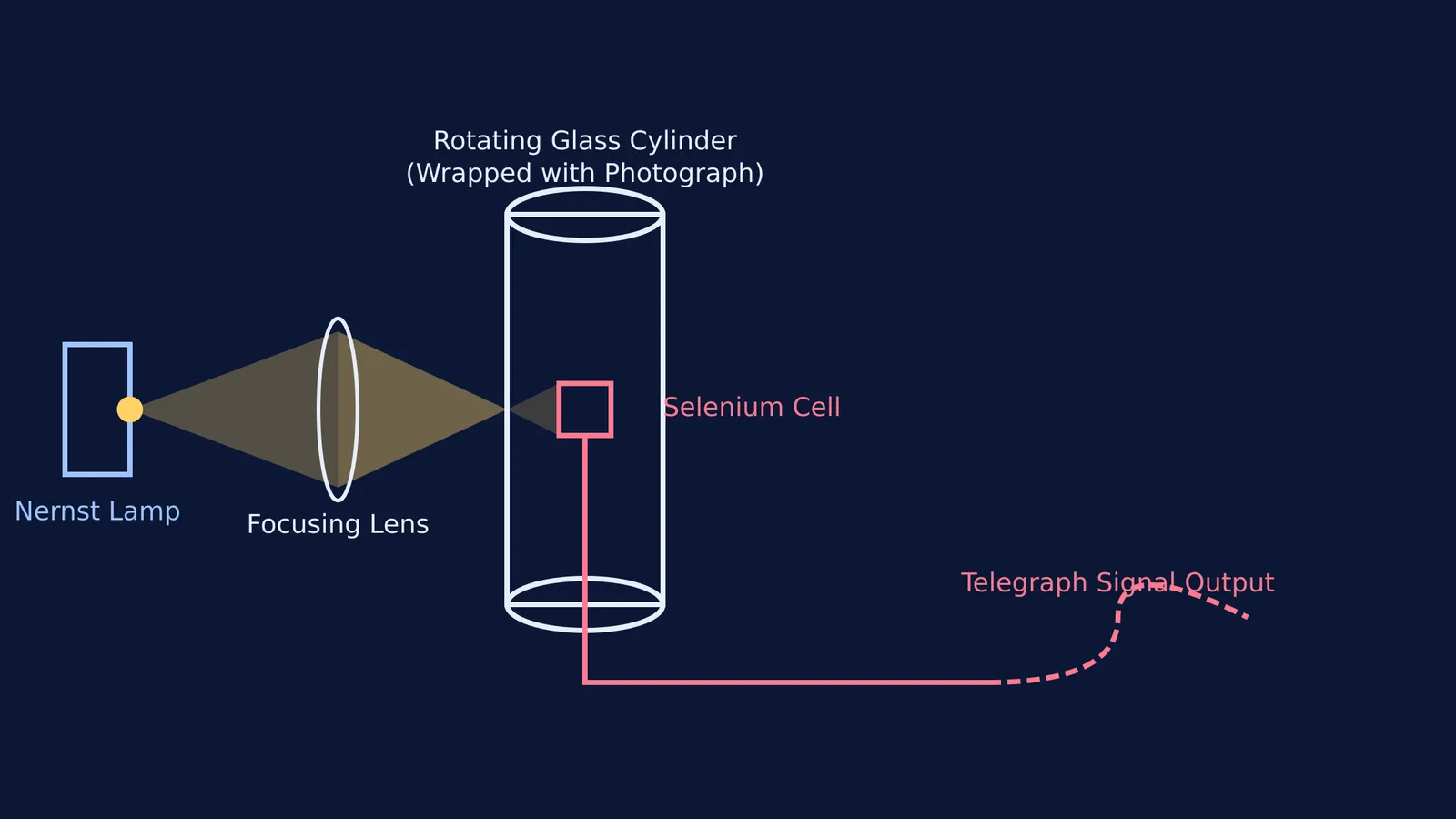
Korn's system relied on a brilliant optical and mechanical setup 2:
The Light Source: A Nernst lamp, an early form of incandescent bulb that followed the innovations of Joseph Swan and the carbon filament light bulb, provided an intense point of light.
The Rotating Cylinder: The photograph to be transmitted was printed on transparent film and wrapped around a glass cylinder. As a motor rotated the cylinder, it also moved it slowly sideways, much like the thread of a screw.
The Scanning Beam: The light from the Nernst lamp was focused into a narrow beam that passed straight through the transparent photograph.
The Selenium Cell: After passing through the film, the beam hit a selenium cell. Where the photograph was light, a strong beam passed through; where it was dark, the beam was blocked.
The selenium cell converted these varying flashes of light into a fluctuating electrical current. This current then travelled over standard telegraph lines to the receiver. At the receiving end, the fluctuating current controlled a light valve that exposed a fresh sheet of photographic film wrapped around an identical, synchronised spinning cylinder.
What is a selenium cell and how does it work?
The breakthrough in Korn's invention was the use of a light-sensitive selenium cell instead of a mechanical contact 1.
Selenium is an element whose electrical resistance drops significantly when it is exposed to light. In the dark, it acts as an insulator, but when struck by a bright beam, it becomes a conductor. As the light passing through the spinning photograph varied in brightness, the selenium cell's resistance fluctuated instantly. This sent a smoothly varying electrical current down the wire, allowing the receiver to print shades of grey (halftones) rather than just sharp black or white.
If you are studying early electronics or the photoelectric effect, it is crucial to understand how light intensity translates into current. The Fermi Concept Library has every concept in physics, chemistry, biology, mathematics and computing, each with its own lesson and its place in the map.
How long did the first photo transmission take?
The historic transmission on 17 October 1906 took about 12 minutes to send the portrait over the 1,800-kilometre circuit 1.
Just as Edmond Becquerel and the 1839 discovery of the photovoltaic effect showed how light and electricity interact, Korn's transmission proved that complex visual data could be carried by an electrical signal.
How do you calculate the transmission time?
We can calculate the time it takes to transmit an image by looking at the geometry of the rotating cylinder. Suppose a student needs to find the time taken for a complete scan.
The setup:
A photographic cylinder is 10.8 centimetres (108 mm) long.
The scanner reads the image in strips that are 0.15 millimetres wide.
The cylinder rotates at 60 revolutions per minute (rpm).
The calculation:
Find the total number of scanning lines:
108 mm ÷ 0.15 mm per line = 720 lines.
Each revolution of the cylinder scans exactly one line. At 60 rpm, it scans 60 lines per minute.
Total time taken = 720 lines ÷ 60 lines per minute = 12 minutes.
If you find yourself stuck setting up calculations like this in kinematics or rotational motion, the Fermi Problem Library has worked problems with a step-by-step solver that explains the reasoning rather than printing an answer.
By the 1920s, Arthur Korn had improved his system to the point where he successfully transmitted an image of Pope Pius XI across the Atlantic Ocean via radio 1. This transatlantic transmission demonstrated that the technology was not limited to physical telegraph wires. However, it was his 1906 wire transmission that first proved humanity could see across vast distances in a matter of minutes, forever changing how news, police records, and visual information would be shared across the globe.


