

On this page
When a young seedling bends toward a window, it looks like simple mechanical motion. For decades, naturalists struggled to explain how a shoot detects light at its apex yet bends several millimetres below in its stem. In 1880, Charles Darwin and his son Francis demonstrated in *The Power of Movement in Plants* that covering the tip of a canary grass seedling blocked phototropism, concluding that an "influence" travels from the tip down to the shoot (Wikipedia). Danish botanist Peter Boysen-Jensen later showed this influence passed through gelatin but was stopped by impermeable mica sheets.
Yet the nature of this influence remained unknown: was it electrical, physical, or chemical? In 1914, Hungarian botanist Árpád Paál published preliminary observations in the *Berichte der Deutschen Botanischen Gesellschaft* (Wiley), followed in 1919 by a landmark study in the *Jahrbücher für wissenschaftliche Botanik*. By testing seedlings in complete darkness, his simple manipulation decoupled shoot curvature from light itself.
What was Árpád Paál's asymmetric tip experiment?
Working at the Institute of Plant Physiology in Budapest, Paál studied the coleoptile of oat (*Avena sativa*) seedlings—the protective cylindrical sheath enclosing the emerging shoot. Paál reported early observations in 1914 in the *Berichte der Deutschen Botanischen Gesellschaft* (Wiley) before publishing his full study in 1919 in the *Jahrbücher für wissenschaftliche Botanik*.
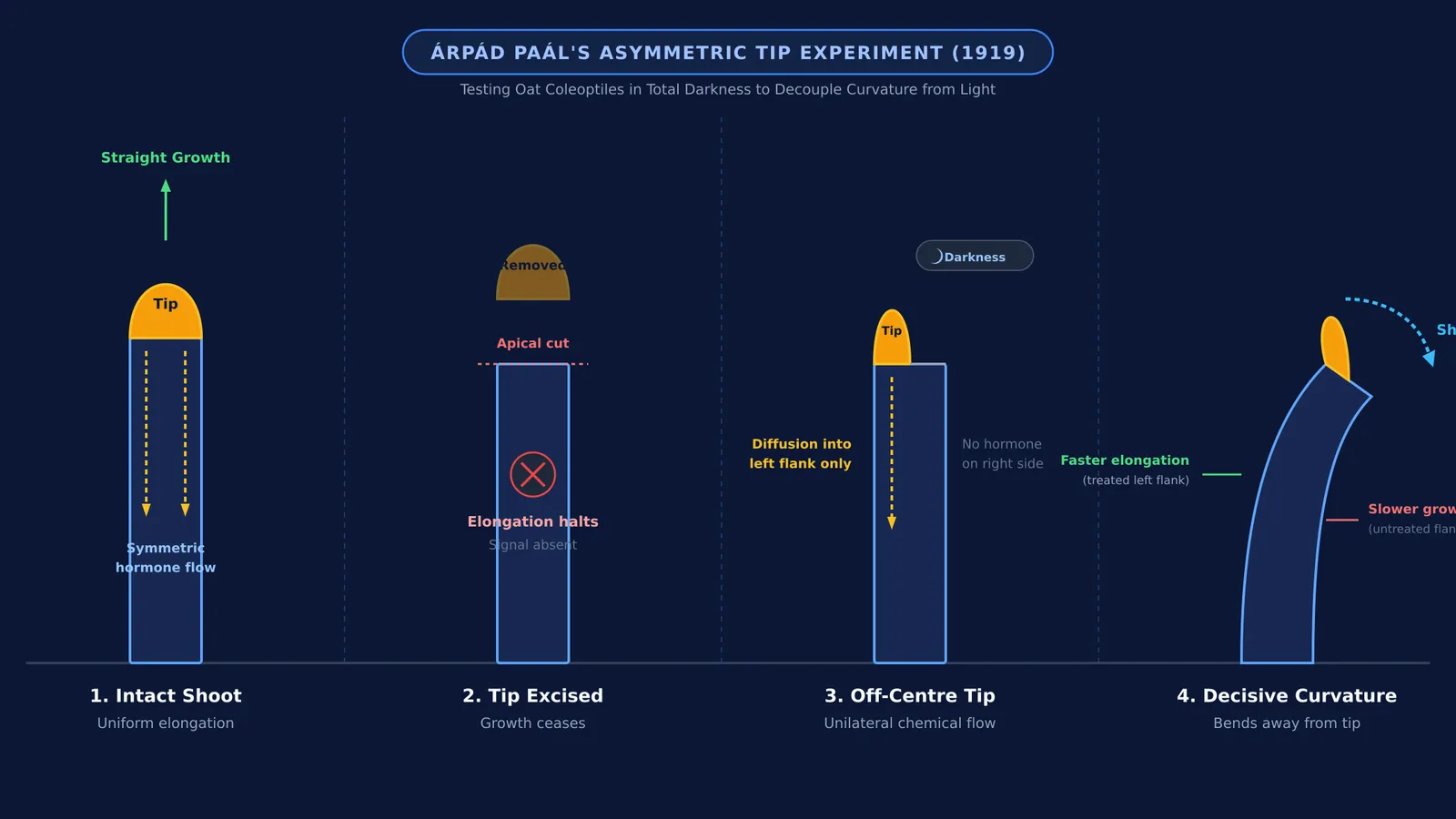
Under non-inductive red safelight or in darkness, Paál executed four steps:
He decapitated dark-grown oat coleoptiles by slicing off the tip.
He rested the stumps, verifying that decapitation halted shoot elongation.
He replaced each tip asymmetrically, covering only one half of the cut surface.
He kept the assembled seedlings in total darkness.
Even without light, the coleoptiles curved distinctly away from the side with the tip, demonstrating that bending did not require directional light (Cold Spring Harbor Perspectives in Biology).
How did Paál's dark experiment prove a chemical signal?
Curvature in the dark was decisive. If light were required to contract or expand stem cells directly, dark-grown shoots with off-centre tips would have stayed straight.
Paál concluded that the tip synthesises a diffusible chemical regulator that flows downward to stimulate cell elongation. In an intact shoot, this substance travels symmetrically down all sides. When placed on one flank, however, it diffused only into the tissue below that side.
Cells directly under the tip elongated rapidly, while cells on the opposite side grew much slower. This unequal growth forced the shoot to bend away from the tip. Paál deduced that phototropism in sunlight operates the same way: unilateral light creates an unequal distribution of this substance, concentrating it on the shaded side (Journal of Experimental Botany).
Understanding how microscopic elongation drives macroscopic bending is essential for mastering tropic movements in plants. The Fermi Simulation Lab offers interactive simulations for ideas that are easier to see than to read, helping students watch how differential hormone flow alters cellular expansion rates in real time.
How does Paál's discovery fit into the history of auxin?
Paál’s experiment provided the conceptual foundation for modern plant endocrinology. In 1926, Dutch botanist Frits Went reasoned that if this growth regulator was diffusible and water-soluble, it could be captured outside living plant tissue.
Went placed excised tips on agar blocks, removed the tissue, and mounted the agar asymmetrically on decapitated coleoptiles in the dark. The shoots curved away from the block, confirming Frits Went's oat seedling experiments and establishing the Avena curvature bioassay. Went named the compound auxin, from the Greek *auxein*, to grow.
Later chemical analyses identified auxin as indole-3-acetic acid (IAA), the primary hormone among plant growth regulators. Paál’s insight also underpinned the Cholodny-Went hypothesis: light directs auxin transport laterally to the shaded flank rather than destroying it (Cold Spring Harbor Perspectives in Biology).
How do you solve coleoptile experiment questions in exams?
Questions on plant tropisms frequently test setups by Darwin, Boysen-Jensen, Paál, and Went. You can solve any coleoptile bending problem with this 4-step framework:
Identify the tip's status: Check if the tip is intact, removed, covered by an opaque cap, or replaced with an agar block. Without a tip or auxin block, elongation stops and no curvature occurs.
Check the barrier type: Gelatin and agar allow water-soluble auxin to diffuse downward. Impermeable barriers like mica or metal foil block transport entirely.
Trace hormone distribution: Unilateral light directs auxin to the shaded side; an off-centre tip or block delivers auxin strictly to the contact flank.
Predict bending direction: Higher auxin concentration accelerates cell elongation. The stem always curves away from the high-auxin side toward the slower-growing flank.
The Fermi Problem Library provides worked problems with a step-by-step solver that explains the reasoning rather than printing an answer, allowing you to practise deducing tropism outcomes from varied experimental setups.


