On this page
For centuries, anatomy lessons in Europe followed a fixed routine. A professor read from Galen, a surgeon cut, and nobody expected the body on the table to disagree with the book. Andreas Vesalius broke that routine by doing the dissection himself and believing what he saw. This post covers his life, what the Fabrica changed, the specific errors he found, and the habits a biology student can copy from him.
Who was Andreas Vesalius?
The US National Library of Medicine's Historical Anatomies page on Vesalius gives the outline. He was born in Brussels in 1514 into a family of physicians, studied medicine at Montpellier and Paris, taught anatomy at Louvain and served as an army surgeon. In 1537 he moved to Padua, where he became professor of anatomy. A review in the Journal of Anatomy notes that he qualified in medicine at 23 and that his Padua post came with the duty of giving anatomical demonstrations.
In 1543 he published De humani corporis fabrica libri septem, Seven Books on the Fabric of the Human Body. The same year he joined the court of the emperor Charles V as physician, and he later served Philip II of Spain. While returning from a pilgrimage to Jerusalem he was shipwrecked on the Greek island of Zante, where he died on 15 October 1564.
How was anatomy taught before Vesalius?
The UC Museum of Paleontology's page on Vesalius and comparative anatomy describes the old method: professors read Galen to their students while a surgeon dissected an executed criminal to point out the parts. There was little reason for the professor to look, because everything worth knowing was assumed to be in the book.
Vesalius began, the same page says, as a defender of Galen at the University of Paris. At Padua he started dissecting corpses himself and drawing charts for his students. A student's notes from a demonstration in Bologna in 1540, quoted in the Journal of Anatomy review, record that he corrected "many false opinions" by dissecting "three human bodies and six dogs".
What errors did Vesalius find in Galen?
As he grew familiar with real human bodies, he found mismatches. The Berkeley page gives two clear examples:
The breastbone. Galen said the human sternum has seven segments. Vesalius found three.
The upper arm. Galen said the humerus was the longest bone after the femur. Vesalius found that the tibia and fibula of the shin are longer, pushing the humerus down the list.
The Journal of Anatomy review adds two more. The rete mirabile, a network of vessels Galen placed at the base of the brain, was shown by Vesalius not to exist in humans. And in the second edition of the Fabrica he stated that the pores Galen imagined in the wall between the heart's ventricles are absent.
Why was Galen wrong? Vesalius worked out that Galen had never dissected a human. According to the Berkeley page, Roman tradition did not allow it, so Galen was often describing oxen or Barbary macaques. Vesalius set up human and macaque skeletons side by side in his lectures to show students the differences. Our post on Galen's experiments and errors gives the other side: Galen was a careful experimenter whose followers forgot to check him.
What made the Fabrica different?
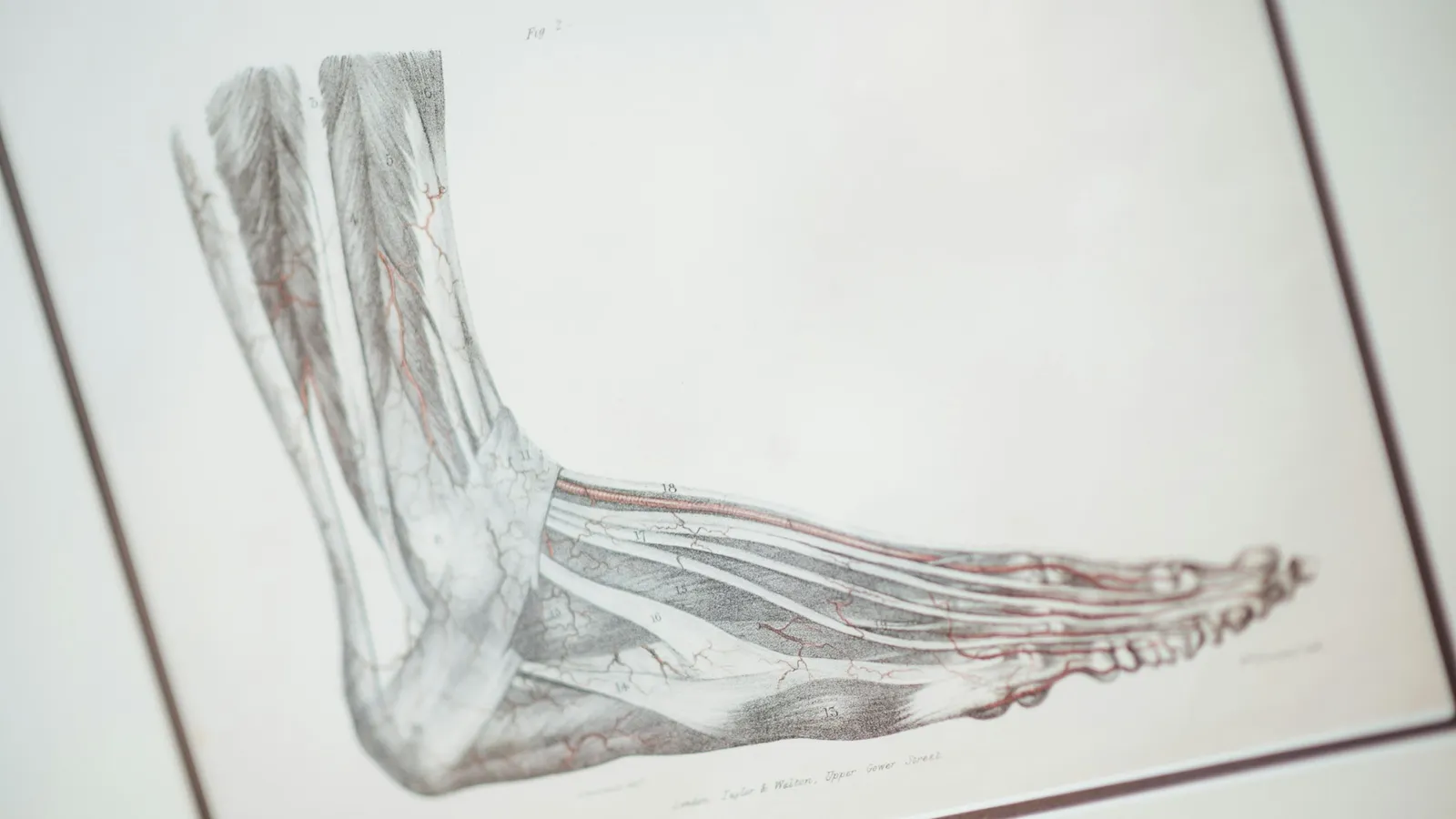
The Journal of Anatomy review notes that earlier texts such as Mondino di Luzzi's Anathomia had no illustrations. The Fabrica put large, detailed woodcuts beside the text, so a reader could compare description and image directly. The NLM page notes that the illustrations were once credited to Jan Stephan Calkar alone, but later scholarship shows several artists were involved, known collectively as "the workshop of Titian". It also notes that Vesalius still relied heavily on Galen in places, at times translating his words exactly. He was correcting a tradition, not throwing it away.
He also kept revising. A second edition appeared in 1555. In 2012 the historian Vivian Nutton described in Medical History a remarkable find: Vesalius's own copy of the 1555 edition, with hundreds of handwritten changes for a third edition that was never published. Most were improvements to the Latin, and some fixed mistakes made by the original block-cutter in the plates.
Was the Fabrica accepted straight away?
No. The Journal of Anatomy review describes a strong reaction from Galenist anatomists, including Vesalius's former teacher Jacobus Sylvius in Paris. Others welcomed it. The NLM page sums it up: he received both praise and condemnation. Over time, the approach won. Anatomy became a subject where you check the body, not the book.
Common mistakes when students write about Vesalius
Saying he discovered circulation. He did not. That was William Harvey, in 1628. Vesalius corrected structure, not the full picture of blood flow.
Saying Galen never dissected. Galen dissected a great deal, but animals rather than humans.
Treating the Fabrica as one man's drawings. Several artists produced the woodcuts.
What can a student learn from how Vesalius worked?
Check the textbook against the specimen. In a practical, look at the slide or model before you look at the labelled diagram, then compare.
Ask what the evidence was based on. Galen's apes, a frog dissection, a plant section: know which organism a fact describes.
Draw to understand. Vesalius's charts for students came before the Fabrica. Our guide to NEET biology diagrams has more on practising them.
Revise your own work. Vesalius annotated his own second edition. Go back to last month's notes and correct them with what you know now.
If a structure is hard to picture from a flat diagram, Fermi's AI tutor can draw the figure on a board as it explains and check your understanding as it goes.
Practice routine: pick one bone or organ from your NCERT book, sketch it from memory, then compare with the textbook figure and list every difference.
Next step: count the segments of the breastbone on a skeleton model or a labelled diagram, and check Vesalius's three against Galen's seven yourself.