

On this page
Ananda Chakrabarty was a microbiologist from West Bengal who built a bacterium that could feed on several parts of crude oil at once. He did it by moving whole plasmids from one bacterium into another. Then the bacterium went to court, and in 1980 the US Supreme Court ruled that a living microbe made by a person could be patented.
Who was Ananda Chakrabarty?
Chakrabarty was born in Birbhum district, West Bengal, and finished a PhD in biochemistry at Calcutta University in 1965, according to the University of Illinois Chicago obituary. He then spent six years as a postdoctoral researcher with I. C. Gunsalus at the University of Illinois Urbana-Champaign, studying how soil Pseudomonas bacteria break down camphor and octane (Illinois MCB tribute). He moved to General Electric in upstate New York, joined the University of Illinois College of Medicine in 1979, received the Padma Shri in 2007, and died on 10 July 2020, aged 82 (UIC obituary).
How did Chakrabarty create oil-eating bacteria?
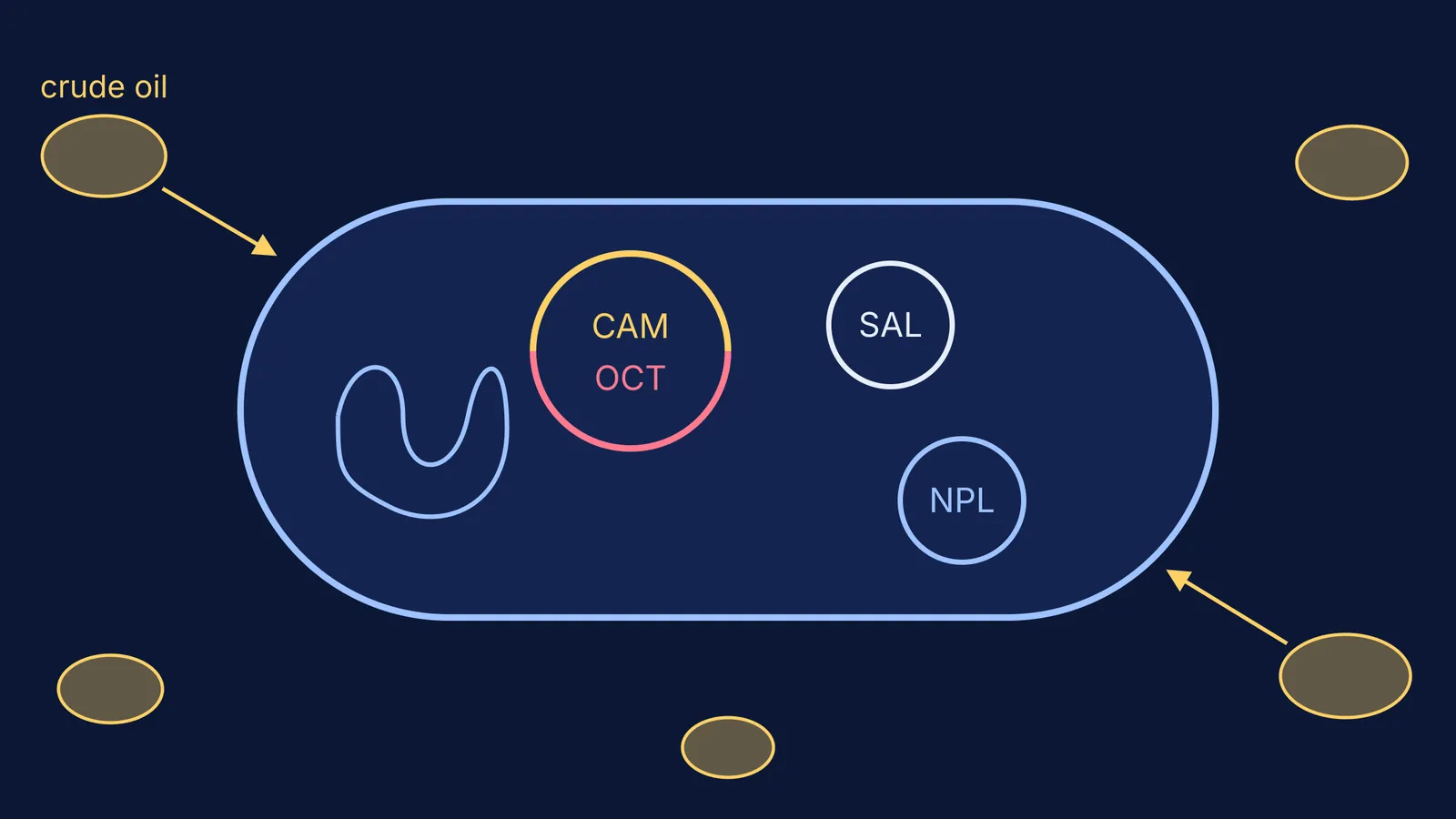
A plasmid is a small ring of DNA that lives in a bacterium separately from its main chromosome and can pass from one cell to another. In Gunsalus's lab, Chakrabarty showed that the genes for turning octane into octanoic acid sit on such a transmissible element, and that a cell holding both the octane (OCT) and camphor (CAM) plasmids loses them more readily (Chakrabarty, Chou and Gunsalus, PNAS 1973). That was the obstacle: each plasmid let a bacterium eat one kind of hydrocarbon, but they would not share a cell.
His patent, filed on 7 June 1972, sets out how he got round it (US patent 4,259,444):
Mix a donor strain carrying a plasmid with a recipient strain, so the plasmid passes across by conjugation. The patent mixed equal volumes for 15 minutes to 2 hours at 32 °C.
Treat cells carrying the clashing CAM and OCT plasmids with ultraviolet light. Because the two were then lost and transferred together, the patent concludes they had probably fused into one plasmid.
Add plasmids for salicylate (SAL) and naphthalene (NPL) the same way.
Grow the result on crude oil and compare it with strains carrying fewer plasmids.
The finished Pseudomonas aeruginosa strain, deposited as NRRL B-5472, carried all four breakdown routes (US patent 4,259,444). The patent states that the oil components that spread fastest on water "disappear within 2-3 days" and the rest coalesce into large droplets. Accounts of his life date the strain to 1971, at GE's research centre in Schenectady (Wikipedia summary).
Compare this with how Cohen and Boyer joined DNA from two sources to make the first recombinant DNA.
Why did the patent office refuse the bacterium?
The application made 36 claims of three kinds: the process of making the bacteria, an inoculum of the bacteria on a carrier material, and the bacteria themselves (Diamond v. Chakrabarty, Cornell LII). The examiner allowed the first two but rejected the third, on the grounds that micro-organisms are products of nature and living things cannot be patented.
What did the Supreme Court decide in Diamond v. Chakrabarty?
On 16 June 1980 the Court ruled 5-4 for Chakrabarty, with Chief Justice Burger writing for the majority and Justice Brennan writing the dissent (full opinion). The majority wrote that his claim was to "a nonnaturally occurring manufacture or composition of matter—a product of human ingenuity." It drew the line "not between living and inanimate things, but between products of nature, whether living or not, and human-made inventions." The patent was granted on 31 March 1981 (US patent 4,259,444). His university later called the ruling "of immense importance for the growth of biotechnology companies" (UIC obituary).
How do you apply the court's test?
Try the majority's line on three cases from this story:
A soil Pseudomonas that already carries the CAM plasmid: a product of nature, so not patentable as an organism.
The same species after a scientist adds OCT, SAL and NPL plasmids: human-made, and the kind of organism the Court said could be patented.
The steps used to make it: a process, which the examiner had accepted even before the case.
For a five-mark answer, keep the chain in order: plasmids carry breakdown genes; one plasmid gives one pathway; incompatible plasmids were fused; four pathways ended up in one cell; the 1980 ruling made such organisms patentable. Revise it alongside microbes in human welfare, and the vectors and cloning tools in biotechnology principles for NEET.
If words like plasmid, conjugation or replicon still blur together, the Fermi Concept Library has every concept in biology with its own lesson and its place in the map, so you can check each term before the next chapter builds on it.
Next time you read about a patented crop or cell line, ask the court's question: did nature make this, or did a person?


